When Will App Pop‑ups Finally End?
Estela Young
It’s hard to pinpoint exactly when pop‑ups became a staple of every major app, but they’re no longer a once‑a‑day occurrence—they’re now a daily (or even multiple‑times‑a‑day) sigh...
It’s hard to pinpoint exactly when pop‑ups became a staple of every major app, but they’re no longer a once‑a‑day occurrence—they’re now a daily (or even multiple‑times‑a‑day) sight.
This article looks at the perennial problem of app pop‑ups from a user‑experience perspective.
01 Kindness Is Harder Than Cleverness
In my article “A Year Doing User Experience” I once wrote that a product’s values shape its logic, and the core of any product is its value system. Unfortunately, because of a host of complex factors, many people on the product road sometimes forget those values—and forget their original purpose.
Jeff Bezos, founder of Amazon, gave a speech at Princeton’s 2010 commencement. He said, “Kindness is harder than cleverness; choice is more important than talent” (full speech here). As a child, Bezos tried to use his “little cleverness” to calculate a number that would convince his grandmother to quit smoking, only to make her burst into tears. When his grandfather learned what happened, he gave Jeff a line he’d remember forever: “Jeff, it’s harder to be kind than clever.”
That childhood episode led Bezos to say, “Cleverness is a gift. Kindness is a choice.”
Zhang Xiaolong at Tencent also recommended Bezos’s talk internally, writing in his endorsement:
I was struck by this article the first time I read it.
In a product discussion, a colleague suggested a clever trick to lure users into clicking, boosting clicks and downloads. I immediately said, “Let’s not mislead users. For product people, kindness matters more than cleverness.”
While we inevitably tap into human frailties to hit user needs, we must not over‑engineer that cleverness. We should engage users honestly, not set traps. Choosing friends, most people would say kindness matters more. Likewise, when users choose our product, the same principle applies.
I hope our product can be a friend to users, not just a tool for mutual exploitation. https://www.tisi.org/?page_id=7043&post_id=480
I’m an idealist.
I truly hope we can treat users as friends—real, genuine friends.
02 The Rise and Fall of Pop‑Ups
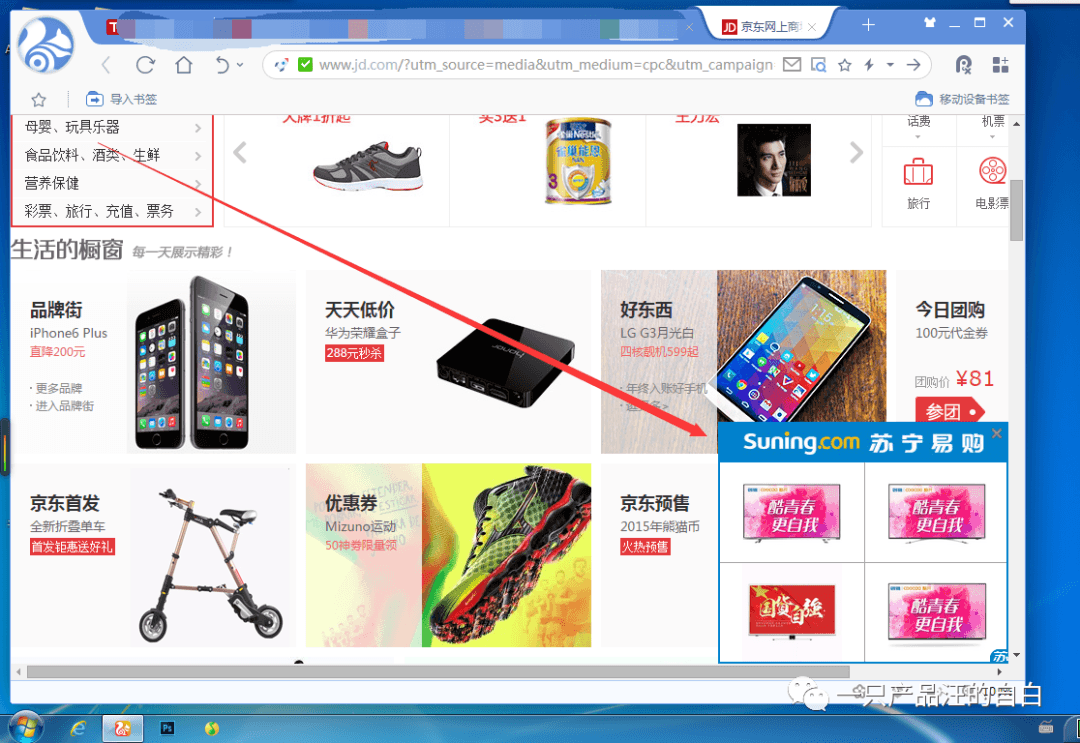
The history of pop‑ups is hard to trace in detail, but from the fragmented memories I have, I can recall the PC era when a sudden ad window would pop up from the lower‑right corner while browsing. (Image from Baidu)

These intrusive, rash‑like pop‑ups annoyed users so much that a Baidu search for “browser pop‑up ads” returns suggestions all about “how to close browser pop‑up ads.”

The explosion of pop‑ups on mobile can be largely credited to the gaming and food‑delivery sectors: many mobile games hand out freebies and gear the moment you log in, and delivery apps rain down red‑packet coupons after you sign in. Most of us are familiar with that pattern.

Because pop‑ups work so well (especially compared with other marketing tactics), they spread rapidly beyond those initial uses. Marketing campaigns, feature announcements, version upgrades, teen‑safety prompts—every scenario began to employ pop‑ups.

And it didn’t stop at the app’s main screen; channel homepages, mini‑programs, you name it—“pop‑up after pop‑up, endless.”


Why do product managers love pop‑ups so much?
On one hand, their effectiveness far exceeds other formats. It’s no surprise that a method that grabs attention so forcefully can’t go unnoticed; users who see it will inevitably click. Meanwhile, traditional banner slots have become “immune” to users, causing conversion rates to drop. Consequently, the higher‑performing pop‑up inherits more and more business‑operation metrics. In short, pop‑ups are growth accelerators and perfect KPI machines.
On the other hand—something many overlook—there’s product inertia and laziness: “Everyone’s using them, why shouldn’t I? It’s just a pop‑up.”
What they forget is that kindness outweighs cleverness, and we should “do unto others as we would have them do unto us.”
03 Regulating Pop‑Ups
Markets can self‑regulate, but they sometimes fail, and market adjustments can be slow. With pop‑ups, users dislike them, yet they’re still deployed; some users can ignore them, but others can’t; market correction takes time to take effect.
Fortunately, this year regulators have recognized the issue and begun to act.
In July 2021, the Ministry of Industry and Information Technology officially launched a crackdown on pop‑up chaos, initiating a nationwide clean‑up across Chinese internet companies.
According to the ministry’s website, recent actions targeted violations such as “pop‑up information that is virtually invisible, close buttons smaller than ants, pages disguised to mislead, and covert click‑bait.” Companies were urged to heed user complaints and eliminate deceptive tactics—using text, images, or video to trick users into unwanted navigation on splash pages.
Source: https://finance.sina.com.cn/tech/2021-07-08/doc-ikqcfnca5635848.shtml
Under this policy, major internet firms have started to act. In an article by “Zui Renwu” (最人物), we can glimpse just how rampant app pop‑ups have become and learn how big players are tackling the problem.
Within Alipay, a user can receive more than three pop‑ups per day. In some shopping apps, the frequency tops ten per day.
Pop‑up governance is split into three parts:
1️⃣ Refining the copy of in‑app pop‑ups—e.g., a past marketing message said “Red‑packet up to 5 CNY,” whereas now it’s more precise and plain: “Red‑packet 0.5–5 CNY.”
2️⃣ Strictly taking down marketing activities that don’t need a pop‑up format.
3️⃣ Completely eliminating “retention pop‑ups.”
In addition to content, Alipay has standardized the visual style of pop‑ups.
— Zui Renwu, public account: When Will App Pop‑Ups End? Have You Been Harassed Like This?
04 There’s Still Plenty We Can Do
In my view, there’s still a lot of room for improvement in pop‑up governance.
A “60‑point” baseline is to ban click‑bait headlines. Beyond eliminating vague “up to 5 CNY” claims, we must also curb deceptive phrasing like “free benefit” that actually has strings attached. For example, the screenshot below shows “Draw a red‑packet for great gifts,” but once you click you must complete tasks before you can enter the draw—purely a gimmick.

A “60‑point” solution keeps pop‑ups but strictly limits frequency, e.g., a marketing pop‑up may appear only four times per month. This is the approach most mainstream apps now adopt.
A “70‑point” solution shows pop‑ups only to a segment of users, similar to precision‑targeted ads—only to those identified by algorithms as interested. Assuming the 80/20 rule holds, perhaps 20 % of users click 80 % of pop‑ups (price‑sensitive users). If that’s true, there’s no need to disturb the remaining 80 % of users.
An “80‑point” solution hands control to the user: let them decide whether to receive pop‑ups and what kind of content they’re willing to see.
I haven’t figured out a “90‑point” plan.
A “100‑point” plan eliminates pop‑ups and marketing altogether, relying on product strength to solve operational challenges. I won’t elaborate—just share a picture.

The End
WeChat Official Account: A Product Dog’s Confession
Sharing product insights, reflections, and reading notes.
Thanks for following.
Originally written by Estela Young and published in Chinese on 一只产品汪的自白. Translated and edited for DriftSeas with permission.