What the Car‑pool Experience Is All About
Estela Young
This is an old article from 2020, the first product post on the public account, now reposted here. Time really flies. In December 2019, Didi held a “Car‑pool Day” event in Chin...
This is an old article from 2020, the first product post on the public account, now reposted here. Time really flies.
In December 2019, Didi held a “Car‑pool Day” event in China, which brought massive attention to its “car‑pool” service. Of course, it also sparked a wave of user complaints: “Car‑pool is so hard to use,” “The car‑pool experience is terrible.”
So, what exactly is a car‑pool product? What does a car‑pool experience entail?
01
What Is a Good Experience?
Before discussing the car‑pool experience, we must confront an unavoidable question: what is a “good experience”?
There is currently no universally accepted standard for a good experience. With everyone holding their own view, a landscape has emerged where anyone can discuss and evaluate experiences. Consequently, the difficulty and challenge of designing experiential products lie here—one thousand users, one thousand definitions of a good experience; “one size fits all” is truly impossible.
Yet a recent personal incident convinced me that a good experience is one that exceeds user expectations.
This idea isn’t original; many experts have already mentioned it. In retail, 7‑Eleven founder Toshihiro Suzuki wrote in Retail Psychology Warfare that sales power is the ability to make customers feel they “bought the right thing,” “ate the right thing,” and “came to the right place.” In my view, the root cause of those feelings is that expectations were surpassed. Likewise, 360 founder Zhou Hongyi stated in Zhou Hongyi’s Self‑Narrative – My Internet Methodology that “only what exceeds expectations can be called user experience.” Therefore, this article adopts that definition of a good experience and analyzes everything under it.
At the end of this section, I’ll share the after‑sales experience that led me to this conclusion. If you’re short on time, feel free to skip ahead.
Event description: A while ago I bought a smart electric kettle on Xiaomi Youpin. A few days ago it seemed to have a problem, but I wasn’t sure, so I didn’t pay much attention. One night the house tripped a breaker, and an electrician came to investigate. He suspected the kettle was leaking electricity. Not entirely convinced the kettle was truly faulty, I contacted Xiaomi customer service. The voice prompt was very brief, so I quickly reached a human agent. The agent promptly retrieved my purchase record and told me I still had six days left in the warranty, meaning a free repair. I chose to have the kettle shipped back for repair, with SF Express COD—no shipping cost for me. Three days later I received a new kettle from Xiaomi under a “replace‑instead‑repair” policy. In one sentence, the whole repair process felt unreal; the experience was exceptionally good.
Reflection: Why did I feel the experience was so great that I almost forgot the inconvenience of a broken kettle? The answer is simple: every step of the repair exceeded my expectations. There was a warranty, I could ship it back, SF Express was free, and I got a brand‑new unit. Each step was executed to the highest standard.
In short, a good experience is one that exceeds user expectations.
02
Car‑pooling Is Naturally Not a Good‑Experience Product
If a good experience means exceeding expectations, then car‑pooling is inherently not a good‑experience product. We can dissect this from two angles: (1) what users expect when they hail a ride, and (2) what car‑pooling actually is.
User expectations for a ride
If we abstract the ride‑hailing scenario, it’s easy to see that users want a ride that is fast, good, and cheap—provided they can actually get a ride. To illustrate, I ran a quick poll in my WeChat Moments and will share a few responses.
Survey question: In what situations do you take a ride?
• During the morning rush because the subway is too crowded +2
• When meeting a client because time is tight +2
• Going to the hospital for time‑sensitive matters +2
• On weekends for outings +2
• When the weather is extremely cold or hot +2
• After overtime when you’re too tired to walk +2
• When there’s no subway/bus that goes directly to your destination +2
• When the company reimburses a ride +2
• After drinking too much
There are many more answers, but from these we can abstract that users tend to ride when public transport is inconvenient, the weather is bad, they’re in a hurry, or they’re simply lazy. In other words, users seek convenience, comfort, and affordability—plainly put, “fast, good, cheap.”
What car‑pooling actually is (using Uber Express Pool as an example)
Car‑pooling groups multiple passengers traveling along similar routes and assigns a single driver to pick them up. In an ideal world, all passengers share the same origin and destination, making it as fast as a regular ride but cheaper—this would be a decent experience. In reality, most car‑pool rides have different origins and destinations that only partially overlap. Consequently, the experience diverges from user expectations in several ways:
- Loss of privacy: sharing a confined space with (multiple) strangers for a (relatively long) period.
- Loss of speed: waiting time is longer because the system first searches for compatible riders before finding a driver.
- Loss of convenience: with Uber Express Pool, users often have to walk to a designated pickup point and may need to walk from a drop‑off point to the final destination.
- Loss of time: picking up and dropping off additional riders can cause detours, extending arrival time.
- Loss of experience: the presence of fellow riders adds complexity; common complaints include late riders and riders bringing extra passengers—these are the top grievances from both drivers and passengers.
- Loss of flexibility: once a car‑pool request is placed, the itinerary cannot be altered (no adding waypoints, changing the destination, or rerouting—features that are supported in Uber’s regular rides).
These points illustrate the “car‑pool experience degradation.” In real life, the degradation is even greater—riders may request route changes, want to be dropped off first, carry large luggage, etc. I won’t enumerate all scenarios here.
If I had to sum up the degradation in one sentence, it’s a massive increase in uncertainty—users don’t know if they’ll be matched, how many people they’ll share with, whether they need to walk to a pickup spot, what the route will look like, when they’ll arrive, or who their fellow riders are.
Thus, there’s an inherent mismatch between what users want from a ride and what car‑pooling can deliver. From the user’s perspective, car‑pooling is naturally not a good‑experience product.
Moreover, this mismatch implies a limited user base for car‑pooling. Because the service’s intrinsic “poor” experience and modest cost savings filter out many potential users, the market size for car‑pooling has a natural ceiling.
03
What Is Being Done to Improve the Car‑pool Experience?
Now we get to the core question: what has Uber done to enhance the car‑pool experience?
We must return to the definition of a good experience. If we formalize “a good experience is one that exceeds expectations,” we get:
Good Experience = Actual Experience Value – Expected Experience Value
From this formula, improving the car‑pool experience can be approached in two ways: (1) lower the expected experience value—i.e., manage user expectations; (2) raise the actual experience value—i.e., optimize the core car‑pool experience.
Managing user expectations
Managing expectations for car‑pooling can be split into two parts.
The first part is user education, aimed at helping users form a correct understanding of car‑pooling or correcting misconceptions.
The second part is key information delivery, focusing on the details users care about that affect their decisions and feelings, such as estimated arrival time and route planning.
Part I – User Education
I believe Uber faces a huge challenge in user education. As the leader in mobility, Uber often launches car‑pooling in a city as a brand‑new service, meaning users have no prior knowledge of it. Therefore, educating users about “what car‑pooling is” is especially crucial.
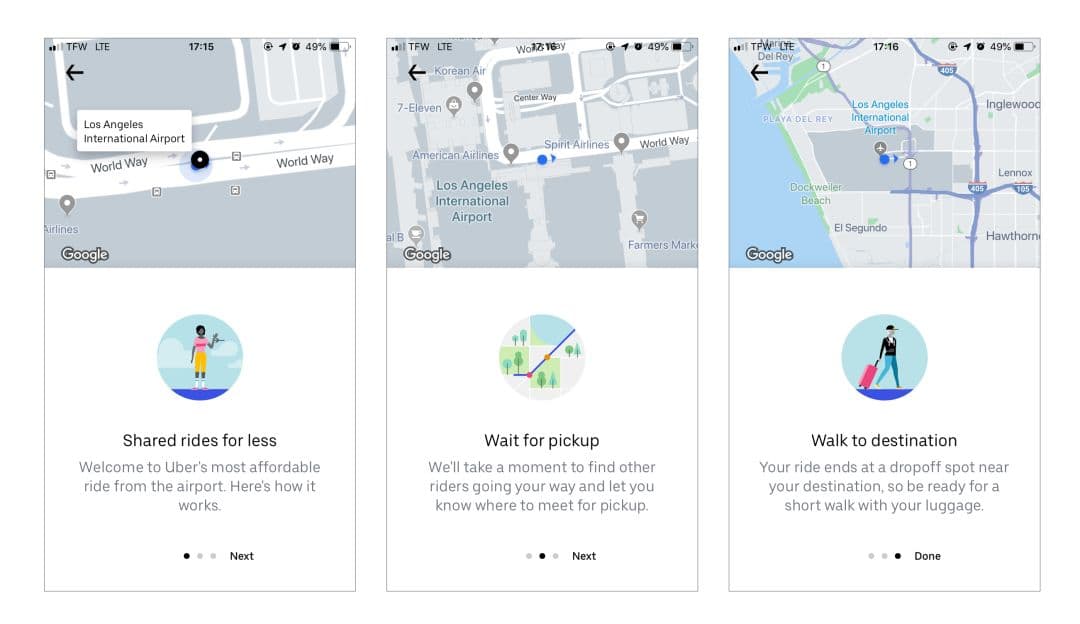
Besides city‑wide outreach during launch, Uber also educates users within the app. New users receive an in‑app tutorial, and after completing their first car‑pool ride, Uber sends a follow‑up email reinforcing the concept.
However, this is far from sufficient. The complexity of car‑pooling can’t be fully grasped in one or two interactions, and the limited channels for reaching users (few touchpoints, low reach, low open rates) make education a long‑term, persistent effort. This is a major pain point for the car‑pool user experience.
Uber and Lyft both present new car‑pool users with a three‑screen semi‑modal introduction

Part II – Key Information Delivery
Estimated Arrival Time for Car‑pool
Generally, when deciding whether to hail a ride and which vehicle type to choose, users weigh price against time. Although car‑pooling is cheaper, its uncertainty—especially regarding arrival time—makes users hesitant. Therefore, the estimated arrival time is critical for car‑pool decisions; it is the core metric users rely on.
Both Uber and Lyft display an estimated arrival window for car‑pool rides on the home screen. Note that the estimate is presented as a range.

Car‑pool Route Planning
Route planning for car‑pooling essentially shows the order in which passengers will be dropped off—“who goes first, who goes later.”
As mentioned, riders often don’t know the full route when they book. Displaying the planned route enhances users’ sense of certainty.
Uber continuously shows route‑planning information (including walking segments) after a ride is requested.

Optimizing the core car‑pool experience
The core car‑pool experience can be summed up as “matching people who are truly on the same way.” It’s important to note that “on the same way” is largely subjective. During matching, besides objective metrics like time and distance, we must also consider users’ subjective feelings—avoiding opposite travel directions, unnecessary U‑turns, etc. Focusing on these subjective goals helps prevent feelings of insecurity or amplified detour perception.
A classic user complaint illustrates the issue (feel free to skip if you’re short on time):
“I booked a ride with an estimated distance of 2.864 km. After traveling about 1.22 km, a new car‑pool request popped up, forcing the driver to make a U‑turn and drive roughly another 200 m (the driver had to turn around twice). The second passenger waited at the pickup point for 3–4 minutes. After another left turn, we drove about 1.5 km and arrived at my destination. Why was another order dispatched?”
04
Final Thoughts
This article looks at car‑pooling strictly from the experience perspective, not from the overall business angle.
Car‑pooling is a trade‑off among experience, efficiency, and scale. Where the boundaries of the car‑pool experience lie, and how to quantify the value that experience brings to the business, are open questions—feel free to comment and discuss.
WeChat public account: A Product Dog’s Confession
Recording product insights, reflections, and reading notes
Thanks for following

Originally written by Estela Young and published in Chinese on 一只产品汪的自白. Translated and edited for DriftSeas with permission.
Keywords
Sources & References
- [1]一只产品汪的自白