What Exactly Are the Five “A”s in a 5A Scenic Spot?
Estela Young
This year’s final stop on my western Sichuan trip for the National Day holiday was Mount Siguniang. Before I went, I assumed it was a 5A scenic spot—after all, it’s quite famous an...
This year’s final stop on my western Sichuan trip for the National Day holiday was Mount Siguniang. Before I went, I assumed it was a 5A scenic spot—after all, it’s quite famous and has appeared on numerous variety shows. When I arrived near the park, however, I saw a lot of promotional slogans on the roadside that included the phrase “successfully striving to become a 5A scenic spot.” I was instantly confused: does it mean “on the road to achieving 5A” or “has already succeeded in becoming 5A”?
So I looked it up and discovered that Mount Siguniang is currently a 4A scenic spot, still working toward 5A status.
That raised another question: what’s the difference between 5A and 4A, and what exactly are the five A’s?
After a bit of research, here’s my answer. The gap between 5A and 4A isn’t just one “A,” and 5A isn’t five separate A’s 😂.
Let me explain.
What Is a 5A Scenic Spot
In short, the 5A rating is a standardized quality‑grade evaluation system for scenic areas.
It is based on the Ministry of Culture and Tourism’s Measures for the Administration of Tourist Scenic Area Quality Grades. According to these measures, any tourist scenic area that has been officially open for more than one year within the People’s Republic of China can apply for a quality grade. The grades are divided into five levels, from low to high: 1A, 2A, 3A, 4A, and 5A.
The measures also outline the general assessment process, supervision, and related matters. For example, a 3A scenic spot can be evaluated by a qualified prefecture‑level authority; a 4A spot must be recommended by the province for national evaluation; a 5A spot must have held 4A status for at least three years and is also recommended by the province for national evaluation.
Specific rules:
Tourist scenic areas of grade 3A and below are evaluated by provincial tourism scenic‑area quality‑grade evaluation committees, which are authorized by the National Tourism Scenic Area Quality‑Grade Evaluation Committee. Provincial committees may further delegate authority to qualified municipal committees. 4A scenic areas are recommended by provincial committees and evaluated by the national committee. 5A scenic areas are derived from 4A spots; any scenic area that has been announced as 4A for more than three years may apply for 5A status. The 5A evaluation is conducted by the national committee on the recommendation of the provincial committee.
(The full document is included in the appendix for those interested.)
Requirements for a 5A Scenic Spot
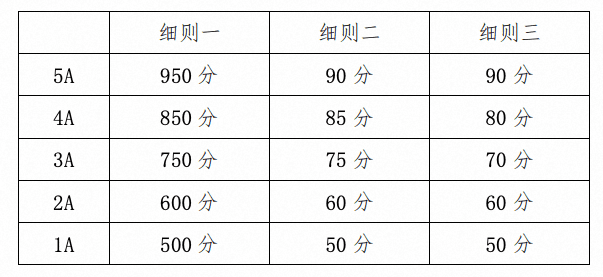
Under the Measures, detailed evaluation criteria have been established. The assessment covers three major dimensions:
- Criterion 1: Service quality and environmental quality scoring rules
- Criterion 2: Landscape quality scoring rules
- Criterion 3: Visitor‑opinion scoring rules
Each criterion is scored, and the required thresholds for each grade are specified. Criterion 1 has a maximum of 1,000 points; Criteria 2 and 3 each have a maximum of 100 points. By score alone, a 5A spot is the “top student” among the top students.
⟦TOK0⟩
Criterion 1 (service and environment) includes eight sub‑areas: tourism transportation, touring, tourism safety, sanitation, postal and telecommunications, tourism shopping, comprehensive management, and resource & environmental protection.
Landscape quality mainly considers resource attractiveness and market impact; see the screenshot for details.
⟦TOK1⟩
⟦TOK2⟩
Visitor‑opinion scoring is based on user surveys and consists of an overall score plus detailed items. The detailed items cover: overall impression, external transportation, internal tour routes, viewing facilities, signage, interpretive boards, promotional materials, guide commentary, service quality, safety assurance, environmental sanitation, restrooms, postal/telecom services, merchandise shopping, food & beverage, tourism order, and site protection. These dimensions largely correspond to the sub‑areas in Criterion 1.
In short, 5A does not mean five separate “A” aspects; rather, the spot is evaluated across three categories, each graded on a five‑level scale, with 5A being the highest.
Which Spots Are 5A?
As of October 2023, China has 318 5A scenic spots. The provinces with the most are Jiangsu (25), Zhejiang (20), Xinjiang (17), and Sichuan (16).
⟦TOK3⟩
A complete list of 5A spots by province can be found here: Ministry of Culture and Tourism – 5A Scenic Spots.
In my home city of Beijing, there are eight 5A scenic spots. I realized there are still a few I’ve never visited—time to plan! (Who knew the Ming Tombs are a 5A spot…)
That same portal also lets you look up red‑tourism classic sites, key rural tourism villages, national tourism resort zones, ski resorts, 5‑star hotels, Grade‑A inns, and more. It’s truly eye‑opening.
⟦TOK4⟩
That’s all.
Everyone, start planning your holiday itinerary!
Appendix – References
https://lyfw.mct.gov.cn/site/special/home Ministry of Culture and Tourism – Public Tourism Services
WeChat Official Account: A Product Dog’s Confession
Sharing product insights, reflections, and reading notes.
Follow us by scanning the QR code to stay connected.
⟦TOK5⟩
Originally written by Estela Young and published in Chinese on 一只产品汪的自白. Translated and edited for DriftSeas with permission.