We Three: Through Life’s Storms, Family Is What Holds Us Together
Estela Young
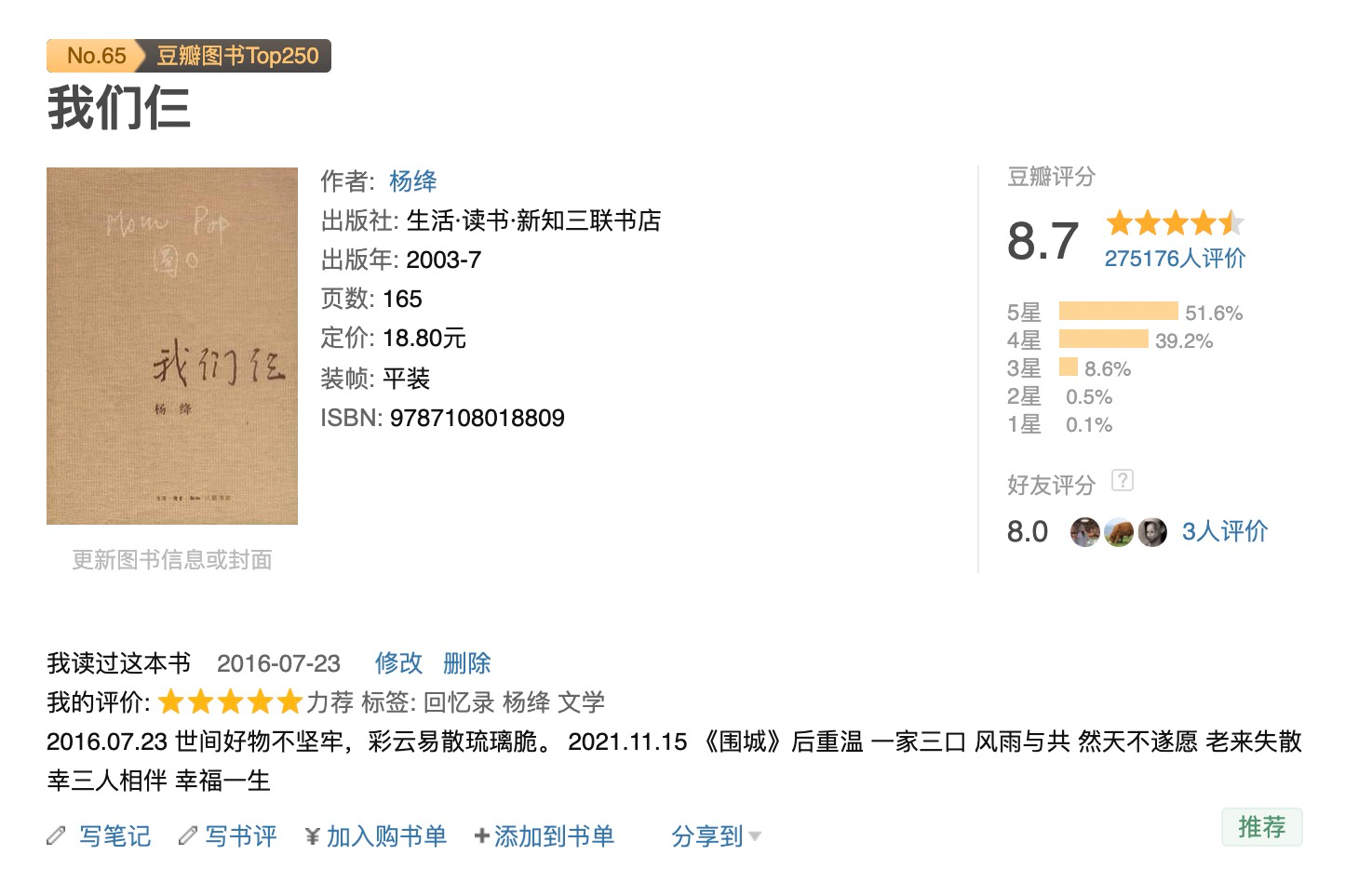
Full text: 1,004 characters, about 5 minutes read Douban “We Three” (《我们仨》) In November I binge‑watched the novel Fortress Besieged (《围城》) and the TV drama starring Chen Daoming. A...
Full text: 1,004 characters, about 5 minutes read
In November I binge‑watched the novel Fortress Besieged (《围城》) and the TV drama starring Chen Daoming.
At the end of Fortress Besieged there is a “reading guide” written by Yang Jiang (杨绛), which includes some anecdotes from their lives and I found them fascinating. My curiosity about Qian Zhongshu (钱钟书) and Yang Jiang grew, and I wanted to read more.
Naturally, I recalled that years ago I had read We Three (《我们仨》), but the details had long since faded from memory—I couldn’t bring any of the content to mind. That was fine; it was the perfect excuse to read it again.
A thin book of 74,000 characters, I finished it in three days, spending a total of three hours.
The book is divided into three chapters:
- Chapter 1 tells a dream of Yang Jiang in which Qian Zhongshu suddenly disappears and cannot be found.
- Chapter 2 continues the “long, endless dream,” using an abstract style to describe how Qian Zhongshu and their daughter Qian Yuan (钱瑗) were hospitalized and died one after another, and how the three family members were scattered to three different places, with Yang Jiang shuttling among them for several years.
- Chapter 3 recounts the family’s sixty‑year journey through stormy times, beginning with Qian Zhongshu and Yang Jiang’s marriage and studies at Oxford, followed by pregnancy, the birth of their child, and studies in Paris; then the wartime separation, the founding of the People’s Republic, subsequent experiences, and finally their settling in the Sanlihe residence.
Several aspects of the book moved me.
Mutual support between Qian Zhongshu and Yang Jiang. Their support is evident in daily life—according to the book, Qian Zhongshu was a bit “absent‑minded,” unable to handle many household chores (for example, he didn’t learn to strike a match or light a stove until his fifties, and then he bragged about it). Yet during Yang Jiang’s confinement after childbirth, he prepared a lavish meal and thereafter took charge of breakfast. Their support is also intellectual—both seized every spare moment for reading, translating, and writing; they generally left each other alone but consulted each other when problems arose.
Family as the ultimate anchor through decades of turmoil. The family endured countless storms and separations, yet when they looked back in old age, the most vivid memories were of one another, and the warmest comfort came from each other’s company.
The family’s resilience. During the war they were separated for years, they experienced the “going to the countryside” movement, survived various political struggles, lived without a permanent home, and drifted through rain and wind. To have gotten through such hardship is truly remarkable.
Finally, the prose reads with a calm, soothing rhythm that makes one feel life could be equally tranquil and slightly playful. I know, however, that life is rarely like that; it is Yang Jiang’s inner serenity and insight that allow her to write in such a manner.
In short, this is an excellent, relaxing read. Five‑star recommendation.
WeChat public account – A Product Dog’s Confession
Sharing product insights, reflections, and reading notes.
Updates are posted simultaneously; feel free to scan the QR code to follow so we don’t lose touch.

Originally written by Estela Young and published in Chinese on 一只产品汪的自白. Translated and edited for DriftSeas with permission.