The Silent Worker
Estela Young
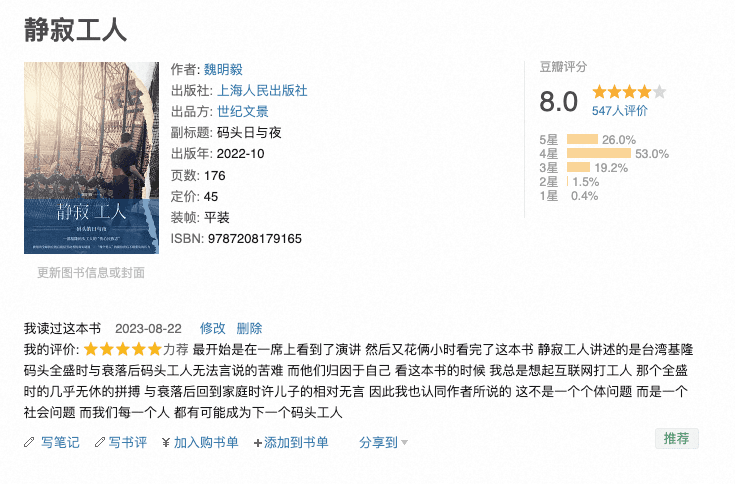
1 本书与作者 豆瓣评分8.0 作者介绍 Wei Ming‑yi, a psychological counselor with over ten years of experience, participated in the post‑earthquake psychological reconstruction after Taiwan’s 9.21 ...
1 本书与作者
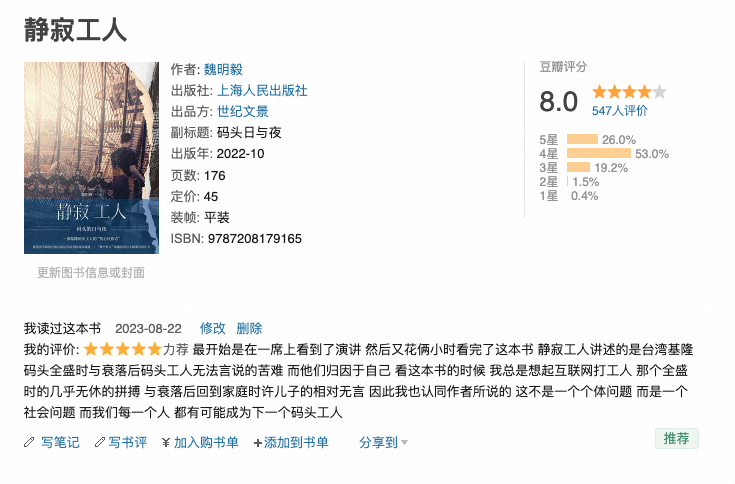
作者介绍
Wei Ming‑yi, a psychological counselor with over ten years of experience, participated in the post‑earthquake psychological reconstruction after Taiwan’s 9.21 disaster. He later entered the Institute of Human Development at National Tsing Hua University in Hsinchu, where his master’s thesis was titled “Keelung Dockworkers: Cargo Ships, Emotions, and Their Social Lives.”
2 推荐理由
I was drawn to this book after hearing a talk titled “This Issue Must Be Seen, Otherwise We’ll Twist and Misinterpret This Social Problem as an Individual Issue”. The speaker was the author, Wei Ming‑yi, and the core theme of the talk was “The Reflection of Suffering.” It tells the story of dockworkers in Keelung, Taiwan—people who once lived through a “glorious half‑sky‑red” boom and now endure the silence of a “dead port” after decline. Their collective suffering, cast out by society, the city, and their families, may help explain why Keelung has the highest suicide rate in Taiwan.
PS: The talk is excellent—listen to it directly. If you become interested in the workers’ stories afterward, then read the book.
One story in the talk moved me deeply (a father returning home early and spending a silent night with his son), so I picked up the book right after the talk.
I breezed through the foreword and got a sense of the author. But after finishing the first character’s story—Sister Qingshui—my heart sank and I couldn’t bring myself to read any further that day, so I stopped. The next day I opened the book again for the second character, Li Zhengde, but after about ten minutes I quit again and left the WeChat reading app. In this intermittent, stop‑and‑go fashion it took me five days and roughly two hours total to finish the book.
The book struck me most in two ways.
First, the rise and fall of the dock and its workers
In 1984 Keelung was the world’s seventh‑largest port. The harbor operated 24 hours a day, year‑round. Container ships waited for dockworkers to load and unload cargo; at night the whole dock glowed red. Because Keelung’s flat land is scarce, workers waited nearby for their shifts, so the city and the port blended into one bustling “never‑sleeps” metropolis.
By 1990, cheaper labor markets lured international container ships away (the book does not specify the exact reasons). Fewer ships arrived, mechanization increased, and fewer workers were needed. Later, government privatization policies further reduced the workforce. Large numbers of workers were cut off from the port, and the city changed along with the port and policy, becoming a “dead port.”
While reading, I kept thinking: isn’t this the same as the internet? Isn’t this “national or industry fortunes are personal fortunes”?
Second, the feeling of being cast aside
A dockworker’s day was divided into waiting for a shift, working, and a brief return home to sleep; most of life unfolded outside the home. Although the work was grueling, the pay was generous—by the 1980s wages plus side jobs could reach NT $200,000 per month.
Once, the dock belonged to the dockworkers; now Keelung’s harbor has been transformed into a passenger port, polished to welcome tourists, and separated from the cargo side into two distinct worlds. Dockworkers no longer belong to the new port.
- In the past, dockworkers ate and chatted together in tea houses while waiting for shifts; now many have left the dock and lost contact, not even knowing what their former colleagues are doing.
- In the past, they would go to certain shops during waiting periods to talk with “aunties” for emotional support; now those shops, like the dock itself, have faded away.
- In the past, because they spent long hours away, many had multiple short‑term marriages—divorce was common, making Keelung’s night market the city with the highest divorce rate in Taiwan. Today, workers who finish early and go home early struggle to relate to sons who have grown up without much interaction; they numb themselves with alcohol, and dinner tables are quiet, with little conversation.
Then and now.
Thus dockworkers have been completely pushed out by the city, the port, their peers, the “aunties,” and their families. Because of Taiwan’s “gau” (ability) culture, they internalize all this, suffering in silence. When silence becomes unbearable, they choose to leave. I can now understand why Keelung’s suicide rate is the highest on the island.
So when the author says in both his talk and his book, “They are us,” I wholeheartedly agree.
“This issue must be seen. If it isn’t, we will shift, distort, and misinterpret this social suffering as an individual problem, thinking it’s a personal issue.
Watching these dockworkers suffer makes me wonder: is the collective suffering only the distant dockworkers of 1980s Keelung? Is it because they were marginal, low‑status, and lacked life skills?
No. They are us—the difference lies only in the era, the industry, the region.
As a psychologist, my work is stable in 2023, but will it still be stable in ten years? I don’t know. Taiwan has seen waves of layoffs among organic chemists, engineers, and similar “cast‑aside” situations. Therefore, the story of Keelung dockworkers is not a distant, foreign tale; it is always our story.”
The tragedy of the dockworkers seemed to foretell my own future. Realizing this left me both shocked and saddened, and forced me to reconsider the kind of life I want to lead.
Wow, that’s heavy. I truly don’t want to become the next dockworker.
WeChat Official Account – A Product Dog’s Confession
Recording product insights, reflections, and reading notes.
Follow the QR code to stay updated and avoid losing contact.
⟦TOK1⟩
Originally written by Estela Young and published in Chinese on 一只产品汪的自白. Translated and edited for DriftSeas with permission.