The Overachievers in My Friend Circle
Estela Young
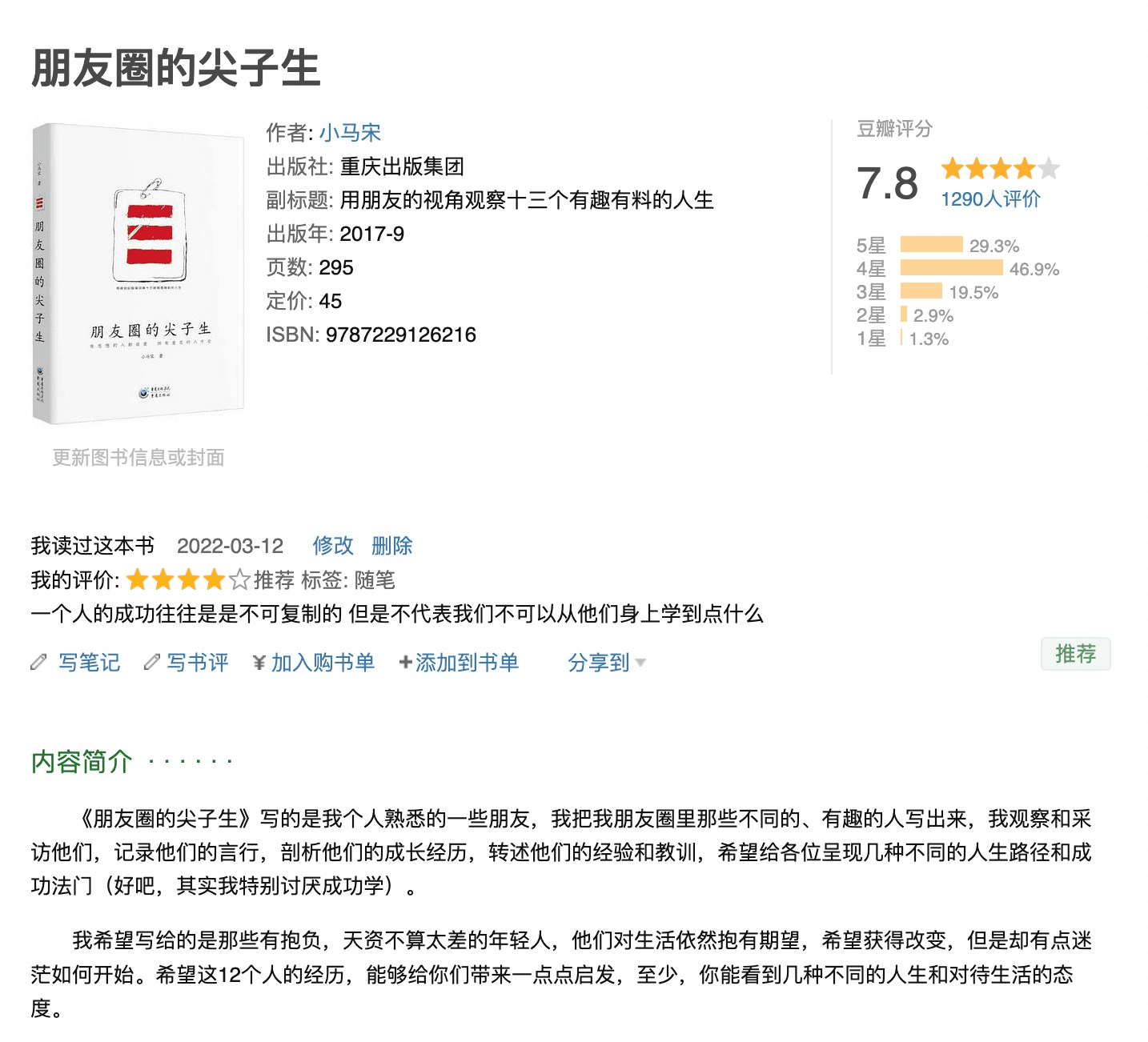
Douban link "The Top Students of the Friend Circle" (《朋友圈的尖子生》) is a book that Xiao Ma Song (小马宋) wrote over two months. It leans heavily toward essayistic prose and is extremely c...
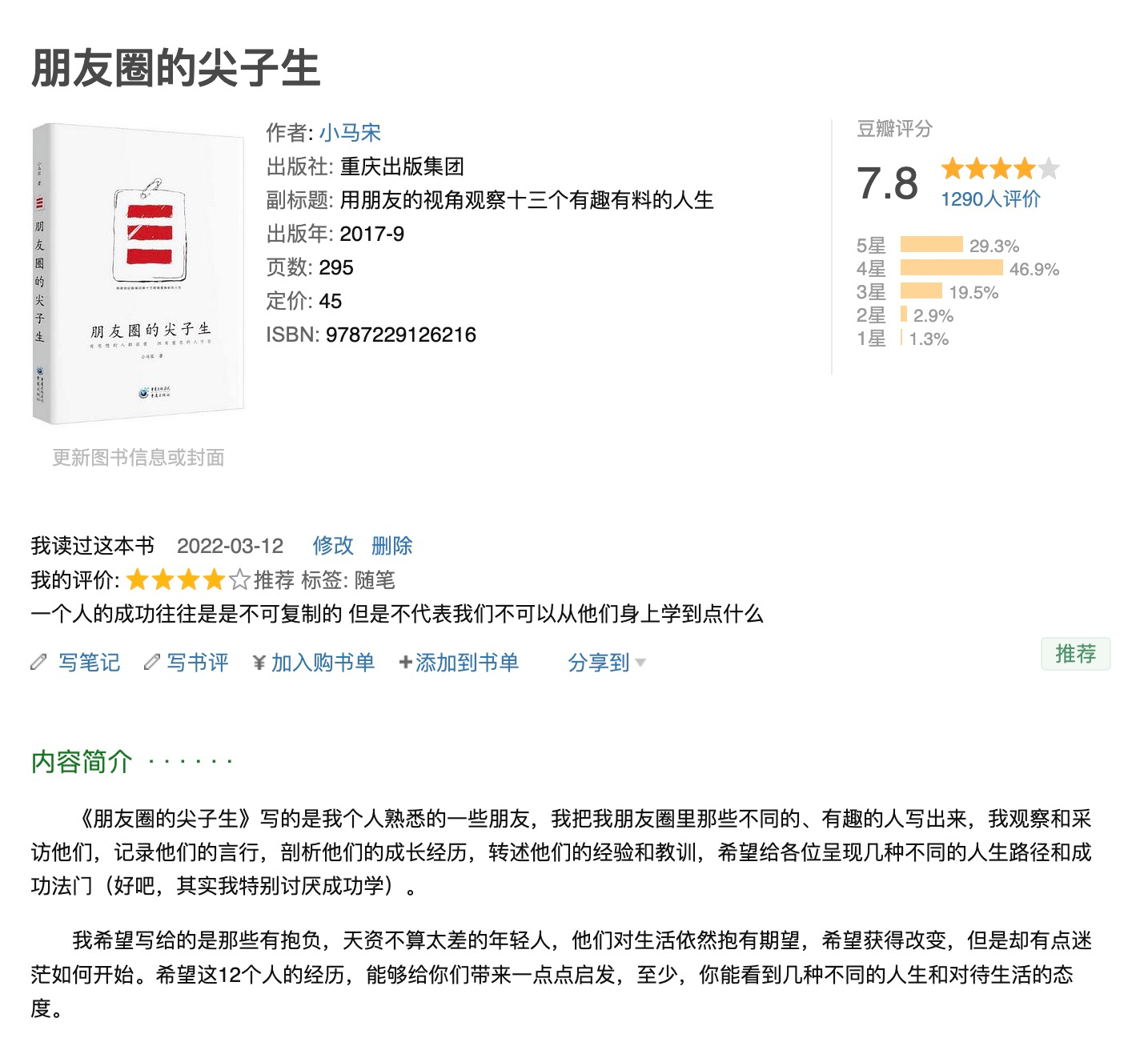
"The Top Students of the Friend Circle" (《朋友圈的尖子生》) is a book that Xiao Ma Song (小马宋) wrote over two months. It leans heavily toward essayistic prose and is extremely conversational in tone. The whole book reads more like a series of personal interviews. If you enjoy stories, don’t want something overly academic, and hope to learn something from other people’s life experiences, feel free to leaf through it.
As for who Xiao Ma Song actually is, I’m not entirely sure. I can’t remember when I first followed his WeChat public account, only that he’s a figure in the marketing world. From the book I learned that he once served as Creative Director at Ogilvy (a pretty prestigious ad agency) before striking out on his own.
The phrase “top student” in the title evokes mixed feelings for me. After reading, I think the choice of “top student” is mainly because the people featured truly have extraordinary, non‑ordinary life stories, and—being an ad professional—the title also serves to grab attention. That’s just my personal interpretation.
In short, the book interviews more than a dozen people. Unlike the Douban‑favorite figures Tuō Bù Huā (脱不花) and Li Jiao‑Shòu (李叫兽), my favorites are Blizzard’s Feng Xin (冯鑫, especially his talk at Beihang University) and Ma Zhan‑Kai (马占凯). I prefer them because they feel more down‑to‑earth, not as “legendary” as some of the other stories (e.g., the 12‑year‑old stock trader/16‑year‑old Shanghai real‑estate investor). Their stories also motivate me to learn more.
Consequently, the excerpts below contain far more about those two than about anyone else. Just a note.
Below are selected passages from the book, kept as a keepsake; I’ve marked the parts I found especially interesting with 🌟.
马占凯 – Nothing Is Unlearnable
- Early Meituan marketing: the “Dreams Come True” column, later repurposed for recruitment as “Recommend Talent, Get a BMW.”
- Sogou Input Method: initially emailed Baidu and got four “Thank you for using Baidu” replies; later discovered Sogou and got hired; after joining, the product fell silent, so he persisted, gave a 20‑minute talk to CEO Wang Jianjun, then wrote a “Potential Killer App” proposal.
- “Twin‑Catalyst Effect”: two strong people together become even stronger.
- 🌟 Daily reading, daily practice (exercise), daily journaling.
- 🌟 To master a skill you need three key ingredients: quantity (the more the better), diversity (learn a bit of everything), and excellence (learn from the best).
- 🌟 Advice for confused young people: mingle with higher‑level individuals. There’s a saying that your income is the average of the six people closest to you—that’s the power of circles. If you want to improve a certain ability, befriend the best at that ability and spend time with them; those masters will help you jump over the initial learning hurdle and reach a turning point. Whether you’re learning, starting a business, or tackling any project, first find a reliable person. The fastest way is to let that reliable person solve your problem.
冯鑫 – Hustle and Creation
All excerpts are from Feng Xin’s talk at Beihang University.
- Whether or not to encourage entrepreneurship is irrelevant; once you’re out in the world, only one thing is real, everything else is illusion. The one truth I understand is that you have to hustle—hustle to create.
- 🌟 You need to do three things: first, quietly look for space within the project you’re handling. Second, once you find that space, design a product. Third, when the product yields results, take time to reflect. I think living a life like that is perfect; I hope I can keep doing something like this forever.
- Here’s what I really want to share: forget about “starting a business.” Whether you start or not is secondary; use your time to create. If life had a “notice board” like the one you see at a park entrance, the essential notices would be simple: you may not be able to reflect every day or even every week, but at least once a month ask yourself two questions. First, does your current environment allow you to create, or does it only want you to perform mechanical tasks? If it doesn’t allow creation, leave it. Second, ask whether 50‑60 % of what you did this month was creative, or whether you were just going through the motions, echoing others. If you’re merely existing without creation, you’re just living. As long as you can reflect monthly and check these two points, you can adjust when needed.
- 🌟 Finally, I want to share something I saw in a hospital that feels 99 % true. I saw a crematorium, saw other wards with ash boxes, and even saw some ashes myself. The hospital is a profound place to learn about life. When you see ashes, you realize one certainty: no matter how we live, we all end up burned, leaving only a tiny amount of ash. That seems undeniably true. So the two sentences I leave you with are: create, and be happy.
李叫兽 – Knowledge Determines Destiny
- The “odd teenager”: bought books and studied fighting techniques.
- Systematic, strategic thinking: whenever you don’t know how to do something, you must find a method, a “hook.” Before tackling any task, study it like a rocket—systematically understand how it works.
- 🌟 How to build a knowledge system:
- Forge connections between pieces of knowledge—after learning something, ask yourself: what other phenomena can this explain? What else?
- Imagine multiple uses for a piece of knowledge—ask: what can I do with this? What else?
- Probe the reasons behind things—when you encounter an odd or interesting event, ask: why? What theory or knowledge explains it? Are there similar cases?
- Professor John Carter’s decades‑long study of Harvard Business School students found that the biggest differences between high achievers and average performers are twofold: (1) they believe in themselves and think they can change something; (2) they love asking “why.” They can’t tolerate contradictions, ambiguity, or vagueness, and they keep their curiosity about the world alive.
- Li Jiao‑Shòu’s signature works: “The Difference Between Copywriting for a ¥3,000 Salary vs. a ¥30,000 Salary,” “X‑type vs. Y‑type Copywriting.”
脱不花 – Sword‑like Mastery of the Business Sea
- CIA officers spend a lot of time crafting personalized “hooks” for target individuals. A good hook usually contains three elements: the reason for the first meeting (e.g., a Luo Pang meetup), the reason to stay connected (e.g., co‑authoring a book or planning a program), and the reason for continued meetings (the “Party A Shut Up” event lasted about five months). The book stresses that trust and frequent interaction must be built naturally and gradually, proving your reliability through professional competence.
- Opportunities belong to the prepared, and also to those willing to take a bold gamble.
- 🌟 Don’t rush forward so much that you forget your direction.
- 🌟 A child may have a hundred years ahead; what’s the point of competing with other kids for a few weeks?
杨超 – The Wonderful Girl and Her Under‑Achiever Alliance
- Researching how to graduate from university without attending many classes.
- Within existing rules, make the most of them.
李倩 – The Victory of a Playbook
- Bachelor’s in Chinese, master’s in Management; roles ranging from editor to merchant partnerships, then marketing, entrepreneurship, and the Chinese Academy of Sciences.
- Why she “gets” brands: (1) she has seriously read the classic texts; (2) she has strong resistance to distraction.
- “Tear‑through” reading method: after reading a book, tear out everything you understand, leaving only what you don’t.
- People who chase technical efficiency love hacks and tools; those who chase cognitive efficiency pursue the essence of things and deep thinking.
- When entering an industry, first learn its principles or laws, not just technical shortcuts.
- In any industry, first identify what the best looks like.
- In a company or as an individual, it doesn’t matter what you do as long as you can articulate your own playbook, your own logic.
- Find good opportunities; 2) Clarify purpose and the shortest path; 3) Don’t obsess over what many say—most success stories aren’t replicable.
马文亚 – “Gresham” and “Buffett”
🌟 How to get something done:
- Pinpoint the goal.
- Break the big goal into small ones.
- Act every day. For example, reading is important—can you read five minutes each day?
马佳佳 – Born with “Internet Celebrity” Genes
- Opened a trendy adult‑product shop near Communication University of China.
叶梓颐 – The Goddess and Her Earthly Tales
- Night‑sky photographer; left the advertising industry to become a professional photographer.
- Markets herself using advertising‑style thinking.
刘丹尼 – Another Path for a Top Student
- Graduated from Wharton Business School; landed a HK Blackstone job with a ¥1.5 million salary, then joined Dazhong Dianping, later founded Le Chun Yogurt.
- “My Failure Story: Rookie Mistakes Made While Starting a Business”
Finished
2022‑03‑12
WeChat public account: A Product Dog’s Confession
Recording product insights and reflections, keeping reading notes.
Follow the QR code to stay updated and avoid losing touch.

Originally written by Estela Young and published in Chinese on 一只产品汪的自白. Translated and edited for DriftSeas with permission.
Keywords
Sources & References
- [1]Douban link
- [2]一只产品汪的自白