Take One Step Forward
Estela Young
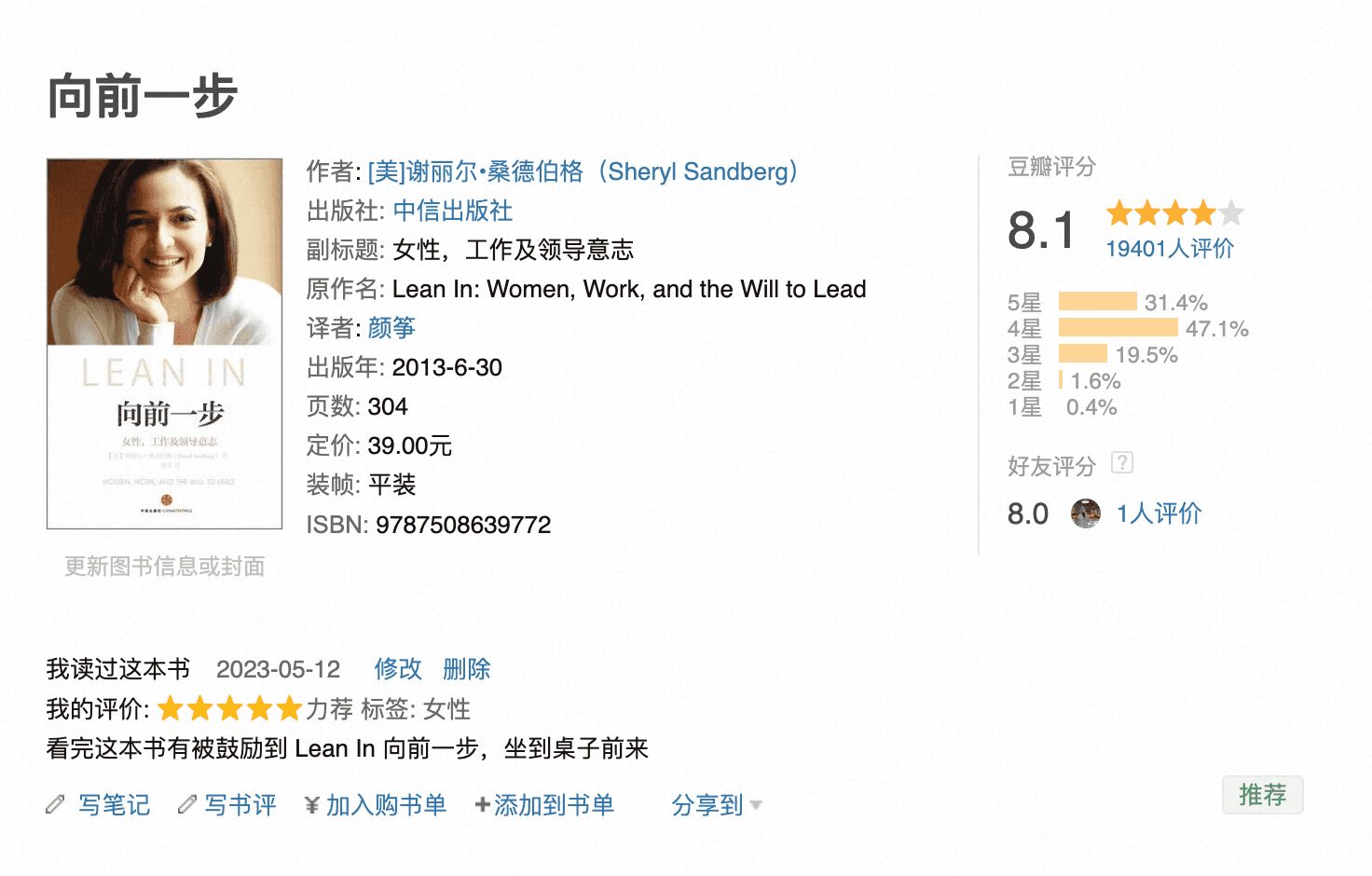
1 本书与作者 Director of the Office of the Treasury Secretary, Clinton Administration Vice President of Global Online Sales and Operations, Google 2008‑2022 Chief Operating Officer of M...
1 本书与作者
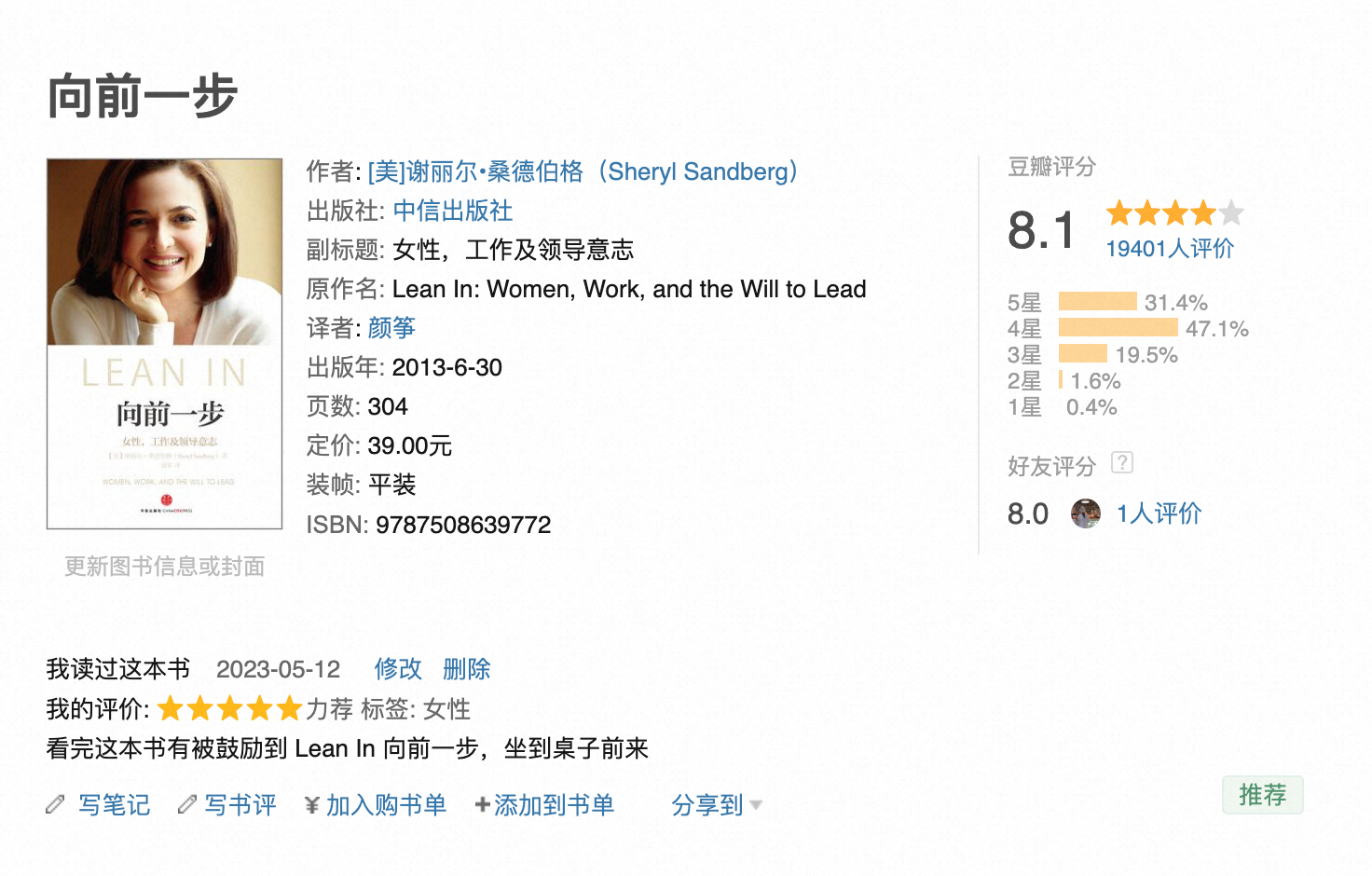

- Director of the Office of the Treasury Secretary, Clinton Administration
- Vice President of Global Online Sales and Operations, Google
- 2008‑2022 Chief Operating Officer of Meta (formerly Facebook)
- Lean In Foundation
- Highest‑paid female executive in the United States, #5 on Forbes’ list of 100 Most Powerful Women
- More
2 推荐理由
本书扉页推荐语
“She believes that women often lack the courage to rise to leadership not because they don’t want to pursue their dreams, but because of internal fear and self‑doubt. In the book she encourages every woman to boldly ‘sit at the table,’ to join the conversation, to speak her mind. She also offers a set of success codes that inspire women to embrace challenges and pursue their life goals with enthusiasm.”
我的推荐语
As a modern professional woman approaching the 30‑year milestone, the issues I face fall into a few categories:
- Career development – Where is the future for women’s careers? Why are there so few women at the top? What hidden gender bias exists in the workplace?
- Family contributions – How do we decide on marriage, children, and parenting, and how do we balance the contributions of both partners?
- The invisible housework – Why does it always feel like I’m the one doing the chores?
The book was first published in 2013, ten years ago. I have seen it on the shelves of many bookstores, assuming it was just another cliché of “women’s success literature,” so I never read it. This year, by chance, I opened it, skimmed a few pages, and then read it straight through.
In its pages I realized I am not alone—whether it’s the workplace, the family, or the housework, even the richest female executives in America face the same challenges. Some of the book’s ideas sparked and encouraged me (and perhaps other women) to break the invisible discipline and bias society imposes on women, to recognize what we truly want, and to pursue it confidently and bravely. Take one step forward, trust yourself, and stop hiding behind the table.
I hope every man and woman can read this book: for men, understanding the differences between the two worlds is the first step toward change—not just for mothers, wives, and daughters, but for yourselves and your own futures; for women, know you are not alone, trust your power, and fight for your ideals.
3 本书内容
You can get a quick overview of the book’s content through the TED talk “Why Are There So Few Women Leaders?”
If you do want to stay in the workforce, there are three tips
- One, sit at the table
- Two, make your partner a real partner
- Three, don’t leave before you leave
Below is the detailed content of the book. Most of it is quoted directly; I have reorganized and trimmed it for structure.
女性的职场困境
女性职场境况是有史以来最好的
In today’s United States and other developed nations, women’s situation is the best it has ever been. We stand on the shoulders of women who came before us, enjoying the rights they fought for. In 1947, my longtime mentor Larry Summers’ mother, Anita Summers, was hired by the Standard Oil Company. When she started, her boss said, “I’m glad we hired you because we get an equally smart employee for less money.” She was grateful and even a bit flattered. To be called “as smart as a man” was high praise; to be paid the same as a man was still unimaginable.
但是,社会并不欢迎女性成功
The Heidi and Howard Story
In 2003, Columbia Business School professor Frank Flynn and NYU professor Cameron Anderson conducted an experiment to test how men and women are perceived in the workplace. They began with a real Harvard Business School case study about female entrepreneur Heidi Roizen, describing how she became successful through a “straight‑talking personality” and a network of influential tech leaders. Flynn and Anderson gave half the participants the original story about Heidi; the other half read the same story except the protagonist’s name was changed to a man, “Howard.” They then surveyed the students’ impressions of Heidi or Howard. All students judged both to be equally capable—author Gloria Steinem noted this as a major step forward. Yet, despite equal respect, students preferred to work with Howard; Heidi was labeled selfish and “not the kind of person you’d want to hire or work for.” The only variable was gender, but the impressions diverged dramatically.
The experiment supports a clear conclusion drawn from the Heidi case: for men, success correlates with likability; for women, it correlates inversely. When a man succeeds, he is welcomed by both men and women; when a woman succeeds, she becomes less liked by both. The fact is both shocking and expected: shocking because few admit they still cling to old gender stereotypes; expected because the bias is plainly evident.
Decades of social‑science research have confirmed the “Heidi/Howard” finding: our evaluations of individuals are filtered through stereotypes—gender, race, nationality, age, etc. The default image of men is “providers, decisive, ambitious.” The default image of women is “caring, sensitive, public‑spirited.” Because we pit male and female traits against each other, achievements and associated qualities are automatically assigned to men. Heidi’s career focus and strategic power‑building clash with our expectations of women, whereas Howard’s identical behavior fits the male stereotype. The result? We like him, not her.
Most women have never heard of the “Heidi/Howard” study, and many of us have never seen its negative outcomes reported. Yet we feel the penalty of success. When a woman is strong, decisive, or competitive, she is seen as deviating from her “proper” behavior track. If she pushes a project hard, is highly competent, or focuses on results rather than pleasing others, she is perceived as “acting like a man,” and people dislike her for it. To avoid this backlash, women temper their ambition. Writer Ken Auletta observed this phenomenon and summed it up in The New Yorker: “(Women’s) self‑doubt becomes a form of self‑defense.” To avoid being disliked, we question our abilities, downplay our career goals, especially in the presence of others; sometimes we internalize inferiority before anyone else even voices it.
Professor Sheryl Greenfield, who has studied this for years, explains the cost of women’s success: “Our cultural tradition ties leadership traits to men and nurturing traits to women, putting women in a double bind. We not only believe women should be caregivers, we see that as their primary role. When a woman shows traits that aren’t about warmth, people get uncomfortable.”
When a girl tries a leadership role, she is often labeled “bossy.” A boy attempting the same is rarely judged that way; it’s expected and non‑offensive.
这种歧视的观念及其结果体现在方方面面
In reality, although legal equality exists, societal attitudes—and women’s self‑perception—still present barriers.
A 2011 McKinsey report found that men are promoted based on potential, whereas women are promoted based on past achievements. The report stated, “In career advancement, men rise on potential, women on performance,” meaning a man can be promoted by showing what he could do, while a woman must prove what she has already done. When a man succeeds, people analyze his talent and qualities; when a woman succeeds, the first question is, “Who is backing her?”
In 1999, when I was appointed Chief of Staff at the U.S. Treasury, someone told me, “Looks like being a woman has its perks.” I was furious. They implied I didn’t earn the job on merit. I realized that if someone can point out a “female advantage” publicly, there are likely many more whispers behind my back.
Sometimes I wonder what my life would be like without the “female” label. I certainly wouldn’t wake up thinking, “As the COO of Facebook, what will I do today?” That’s how people often introduce me. When people discuss female pilots, engineers, or race car drivers, the word “female” carries surprise. Yet we rarely apply the same gendered lens to men in those professions. A Google search for “male CEO of Facebook” yields: “No results found.”
The reality is that the world remains male‑dominated. Consequently, women’s voices are not equally heard when truly impactful decisions are made. Of 195 heads of state, only 17 are women. Women hold just 20 % of parliamentary seats worldwide. In the 2012 U.S. election, women won a record 18 % of congressional seats. In China, women make up 21 % of the National People’s Congress. All far from parity.
Globally, women’s representation in corporate leadership is even lower. Only 4 % of Fortune 500 CEOs are women. In the U.S., women comprise about 14 % of senior executives and 17 % of board members—a figure that has barely moved in over a decade. For people of color, the gap widens: women of color hold 4 % of senior executive roles, 3 % of board seats, and 5 % of parliamentary seats. In China’s major listed companies, women hold 8.5 % of board seats, and fewer than 4 % serve as board chair.
Wage progress is similarly sluggish. In 1970, women earned 0.59 × men’s wages; by 2010, the ratio had risen to 0.77 ×. As Marlo Thomas said on Equal Pay Day 2011, “In 40 years, wages have risen only 18 cents while a dozen eggs have become ten times more expensive.” Unlike many developing and developed nations, China’s gender pay gap has widened; urban women now earn 26 % less than men. In OECD countries, women earn on average 16 % less than men.
Year after year I see female friends and colleagues gradually exiting the workforce. Some leave by choice; others are forced out of inflexible firms, returning to homes lacking partner support; still others stay but suppress their ambition, no longer aiming higher. I watch the prospects for our generation of female leaders dim.
不幸的是,面对这些女性自我设立了障碍
Beyond external barriers, women also contend with internal ones: lack of confidence, fear of speaking up, and retreat when they should advance. Yes, we often hold ourselves back, internalizing the negative messages we’ve received: “Women speaking bluntly is wrong; women being ambitious is wrong; women having more power than men is wrong.” Consequently we lower our expectations of our own achievements, take on most housework, care for the children, compromise our careers for partners or fertility plans, and are less eager than male colleagues to pursue senior management. I’m not listing other women’s mistakes—I’ve made these missteps myself and still sometimes repeat them.
For women, “feeling like an impostor” signals a deeper problem: we constantly underestimate ourselves. Research consistently shows women rate their performance lower than it actually is, while men overrate theirs. In a study of surgical residents, female students gave themselves lower scores than male peers, even though faculty rated the women’s performance higher. A survey of thousands of potential political candidates revealed that, despite identical credentials, men were about 60 % more likely to say they were “fully qualified” for office. At Harvard Law, nearly 1,000 students rated themselves lower than male classmates on every law‑related skill. The effect intensifies when women evaluate themselves in male‑dominated fields or before mixed audiences.
The lack of confidence becomes a self‑fulfilling prophecy. I truly don’t know how to tell myself—or anyone—that they must believe, from the bottom of their heart, that they are the best person for a given job.
From my experience, women are more cautious about role changes and new challenges. I often find myself trying to persuade them to step into new areas. In many conversations, women respond with, “I’m not very good at that,” “That new role sounds exciting but I lack experience,” or “I still have a lot to learn in my current job.” I can’t recall having the same dialogue with male employees.
When I was starting out, I turned down many opportunities because I thought, “I’m not ready for that,” or “I don’t know enough about the field.” Looking back, rapid learning and delivering results at a given moment is what matters most. Now I tell people that there is no perfect timing for your next goal; you must seize opportunities, create ones that fit you, rather than constantly saying no. Learning ability is the most essential trait of a leader.
However, the obedience praised in school—“raise your hand, wait to be called”—is not valued in the workplace. Career advancement usually rewards risk‑taking and self‑promotion, traits that aren’t encouraged in girls. This may explain why women’s academic achievements don’t translate into proportional representation at senior levels. So, while many women enter the pipeline of higher education, the pipeline to leadership ends up delivering mostly men.
Interestingly, when negotiating on behalf of others (e.g., for a teammate or colleague), women perform as well as men, sometimes even better, because their advocacy isn’t seen as selfish. But when a woman negotiates for herself, she violates the accepted gender norm. Both men and women tend to avoid working with a woman who bargains aggressively or pushes for higher pay, perceiving her as harsher than women who don’t negotiate. A woman who negotiates for her own success may incur long‑term costs to her reputation and future promotions.
更不幸的是,女性的自我实现预言进一步强化这类观念
The stereotypes ingrained in us from childhood become reinforced as we grow, turning into self‑fulfilling prophecies. Most leadership roles are held by men, so women don’t expect to obtain them, which is one reason they remain under‑represented. The same applies to pay: men earn more, so expectations for women’s salaries stay low.
Social scientists have long observed that once members of a group develop a negative, ingrained perception, they tend to act in accordance with that perception. For example, people often stereotypically believe that boys are better than girls at mathematics and the sciences. When participants are reminded of their gender right before a math or science test—even something as simple as adding “Male” or “Female” options at the top of the exam sheet—girls’ scores tend to drop, while boys’ scores remain unchanged. The scarcity of women studying computer science is partly due to this stereotype threat. A summer intern at Facebook once told me that in his department there were more men named “David” than there were women in total. Evidence shows that all kinds of stereotypes reinforce themselves, from “White people can’t jump high” to “Asian students perform better academically.”
The most unfortunate thing is that changing attitudes must involve men and address the biases women hold toward themselves
Everyone is biased, often without realizing it
A 2012 study found that when a male and a female applied simultaneously for a lab‑director position, even with identical qualifications and experience, scientists judged the woman to be less competent, offered her a lower starting salary, and provided less mentorship. Other research on job applications shows that gender bias skews our perception of individual performance, typically inflating evaluations of men and deflating those of women. To this day, evaluations that ignore gender still tend to produce more favorable outcomes for women. Unfortunately, most jobs require face‑to‑face assessment of candidates.
We also have a natural tendency that fuels bias: we prefer to work with people like ourselves. Innovisor, a consulting firm, surveyed employment conditions in 29 countries and found that when choosing work partners, both men and women strongly prefer partners of the same gender. Yet diverse teams consistently outperform homogenous ones. Managers should therefore deliberately cross‑mix team composition—or at least signal that intention—to motivate employees to change.
All of us, myself included, are biased whether we admit it or not. Assuming we can be completely objective actually makes things worse, creating what sociologists call a “bias blind spot.” This blind spot leads people to be overconfident in their own objectivity, preventing them from overcoming bias.
Women’s equality requires men’s awakening and deep involvement
In 2012, Kunal Modi, a student at Harvard Kennedy School, wrote an essay earnestly urging men to “act like men” on both family and career issues. He argued, “For the sake of American companies’ performance and shareholder returns, men should play an active role in ensuring that the most talented young people (often women) are encouraged to pursue career advancement… So, men, get involved now—not out of a self‑sacrificial stance for the benefit of your mother, wife, and daughters, but for the sake of ourselves, our companies, and our nation’s future.”
Today, despite great social progress, both men and women find it hard to make truly free choices. A woman without an employer and colleagues who support her, and a partner who shares household responsibilities, has few options. Likewise, a family‑oriented man does not earn full societal respect until he conforms to traditional expectations. Unless everyone is encouraged to seize possible opportunities, “equal opportunity” cannot truly be “equal.” Only then can men and women both realize their potential.
Senior men often fail to recognize the advantages they receive simply by being male, which blinds them to the disadvantages women face. Junior women, believing that senior men’s status derives from merit, work hard to follow the rules and advance—rather than questioning possible gender bias or speaking up. The result is that everyone collectively sustains an unfair system.
Ken Chenault, former CEO of American Express, publicly acknowledged in a meeting that both men and women are likely to interrupt a woman’s speech and to attribute a woman’s original idea to a man.
The obstacle to women sometimes comes from women themselves
The reality can be harsh: one factor that hinders more women from gaining power sometimes comes from women who already hold power. Earlier generations of women believed (largely correctly) that only one woman could reach senior leadership in any company. In that era, surface‑level gender ratios were fashionable; women would watch the surroundings rather than unite against an unjust system, often viewing each other as competitors. Their career ambition intensified this antagonism, leading some women to be ignored, have their rights violated, or even be maliciously undermined by other women.
By the 1970s, the phenomenon was so common that the term “queen bee” was coined to describe a woman who rose quickly in a male‑dominated leadership hierarchy, using her position to suppress other women “worker bees.” For some, this was self‑preservation; for others, it signaled that they had “matured” and fully assimilated into a society that privileges men. In this sense, “queen bee” behavior is both a cause and a consequence of sexism. These women have internalized women’s lower status; to feel more valuable, they prefer to interact only with men and typically do not promote other women.
Women holding women back is heartbreaking. Former Secretary of State Madeleine Albright once said, “Hell has a place prepared for women who do not help other women.”
The consequences of this obstruction extend beyond personal pain. Negative judgments women make about female coworkers are often taken as objective assessments and may sound more credible than men’s opinions. When women voice gender‑biased views, they legitimize them. It might seem that if a woman opposes such bias, she is not acting out of sexism—but that’s wrong. Women frequently absorb gender discrimination unconsciously and then propagate it. Thus, women are both victims and perpetrators of sexism.
The “us vs them” framing pits men against women and cannot lead to true equality; the “us vs us” intra‑female competition also falls short. As law professor Joan Williams of UC Hastings put it, this is a “gender war.” One of its most visible fronts is the “mom battle” that pits full‑time mothers against working mothers. Williams explains, “These mom battles are fierce because the two groups’ identities are jeopardized by conflicting societal ideals: the ideal worker must be always on call for work, while the ‘good mother’ must always be present for her children. Consequently, the ideal professional woman must prove she can be excellent even when not with her kids. The other group of women chooses a slower‑pace career—or quits altogether—to demonstrate that any compromise is for the family. This pits the two groups of women against each other, because neither can meet the inherently contradictory ideal.”
In June 2012, Debora Spar, dean of Barnard College, wrote to The Atlantic about the tangled emotions that make many successful women feel guilt and self‑blame. She argued that women “spend a lifetime proving, in ever‑new ways, that we have taken up the feminist torch and have not betrayed those who fought for our right to pursue careers. Yet we are subtly sliding toward failure, because feminism’s goal is not to make us feel guilty or to thrust us into endless competition—comparing whose child is better, whose marriage more stable, whose work hours longer—but to give us freedom: the freedom to choose without constantly feeling we are doing something wrong.”
We all want our choices to be respected. So let’s start by respecting each other. Working‑mother professionals should view full‑time mothers’ work as genuine work, and full‑time mothers should likewise respect women who make different choices.
How to Act – Proactively Seek Opportunities
Embrace risk, choose growth, challenge yourself, and actively pursue higher positions when it’s time for a promotion (always with a smile). These are key aspects of self‑directed career management. As my favorite quote from the brilliant Black writer Alice Walker goes, “The most common way people give up their power is by thinking they don’t have any.” Don’t wait for others to give you power.
Often women need a more open mindset toward career risk. When I left Google for Facebook, few of the teammates who left with me were women; men were far more eager to take on the “higher‑level testing opportunities” that tech‑speak describes, despite the high risk and potentially greater reward. Many of the women on the Google team later expressed interest in joining Facebook—by then it was a mature company. This shows that opting for stability can cost you growth opportunities.
Avoiding risk can be wise in life, but in business it leads to stagnation. An analysis of senior‑management appointments found that even when women assume new roles, they are more likely than men to stay within the same functional area; when women are promoted, they tend to move upward within the same company rather than jump to another. Staying in the same function or organization breeds inertia and limits personal development. Seeking diverse experiences elsewhere is highly beneficial for leadership development.
I understand the external pressure that pushes women to play it safe and avoid job hopping. Stereotypes make it harder for women to enter male‑dominated fields, and many compromise for a partner’s career rather than fully pursuing their own ambitions. A career change—especially moving to another city—can feel impossible for a woman in a relationship, leading to a terrible outcome: staying put means stagnation, while risk aversion prevents her from taking on challenging roles. In my experience, men are more likely to pursue stretch assignments and high‑visibility projects; women often hesitate. Research shows this gap widens in environments that emphasize individual performance or close gender collaboration.
Another reason women shy away from expansive work or leadership roles is fear that they lack the necessary skills. This can become a self‑fulfilling prophecy, because every job requires some competence. An internal HP report revealed that women only apply for a position when they believe they meet 100 % of the qualifications, whereas men will apply when they feel they meet 60 %. This disparity creates a massive cascade effect. Women need to shift their mindset from “I’m not ready yet” to “I want to do it, and I can learn as I go.”
Women also tend to be more cautious about promotions, often assuming that strong performance will automatically be rewarded. Carol Frohlinger and Deborah Kolb, founders of Negotiating Women Inc., label this mindset “Tiara Syndrome”: women expect that if they perform well, others will notice and place a tiara on their heads. Hard work and good results deserve recognition, but if acknowledgment doesn’t come, it’s perfectly reasonable to advocate for oneself. As discussed earlier, self‑advocacy must be measured, yet it remains essential.
How to Act – Stay Present, Don’t Be “Physically Here, Mentally Gone”
One of the most common ways women retreat is the “body is here, mind is elsewhere” mentality.
I interrupted her and asked whether she had children. She said no, but wanted to plan ahead. I then asked if she and her husband were discussing having kids. She replied that she didn’t have a husband yet, and then laughed, “Actually, I don’t even have a boyfriend.”
To me, she was being overly hasty, but I understand why. From a young age, girls learn they will eventually have to choose between career success and being a good mother. By college, women start weighing career goals against personal goals. When asked how to choose, female undergraduates are twice as likely as their male peers to say they would choose marriage.
A classic scenario plays out: an ambitious, moderately successful woman is climbing a challenging career ladder while already thinking about having a child. In certain circumstances that thought becomes front‑and‑center, especially after she finds a partner. She may reason that because her job is demanding, she must cut back on work to prepare for a child. A legal assistant might stop aiming for partnership; a teacher might stop leading curriculum development; a sales rep might take a smaller territory or forgo a management role. Often, women unintentionally stop pursuing opportunities; even when an opportunity is presented, they may decline or hesitate, preferring to hand it to someone else. The problem is that even if she becomes pregnant tomorrow, there are still nine months before she can actually care for the child. Women typically make extensive mental preparations before trying to conceive; the gap between that preparation and actual pregnancy can span years. For the colleague mentioned at the start of this chapter, that interval could easily be a decade.
I want to stress that stepping back at work is appropriate only when genuine rest is needed or a child is about to be born—not years in advance. Before you must pause your career, you should be pushing forward.
How to Act – Redefine Career Development as a Grid, Not a Ladder
People often use the “ladder” metaphor for careers, but it no longer fits most of us. Statistics show that since 2010, Americans change jobs an average of 11 times between ages 18 and 44. This means the era of joining one organization and climbing a single vertical ladder is over. Goler cites Patty Sellers’ more apt analogy: “A career is a lattice, not a ladder.”
When choosing a job, the single most important criterion is whether it will enable rapid growth. In a fast‑growing company, there’s always more work than hands; when growth stalls or the company stagnates, people become idle, and internal politics can halt progress, shaking everyone’s confidence. He told me, “If someone invites you onto a rocket, don’t ask where you’ll sit once you’re on board—just get on.”
For years I have repeated Eric Schmidt’s advice to countless people: reduce your career‑choice metrics to one thing—growth potential. Not everyone can or wants to work in high‑tech, but every field contains roles that can unleash your growth. In mature industries, look inside the organization for “rockets”—expanding departments or teams. In sectors like education or healthcare, seek positions that demand high levels of professional skill. For example, in my brother’s pediatric neurosurgery practice, some cities have a surplus of doctors while others are underserved; he chooses the latter to maximize his professional potential.
I recommend setting two kinds of goals: a long‑term vision and a “18‑month” short‑term target.
Everyone should have a long‑term dream, and everyone should have an “18‑month goal.” (I pick 18 months because two years feels too long and one year too short; the exact timeframe isn’t critical.) My own 18‑month goals usually consider two dimensions: first, and most importantly, what my team can deliver for the company. Employees who focus on results and impact are the most valuable—think of Lori Goler, who wisely directed her attention to solving Facebook’s hiring challenges rather than to herself. This perspective lets women think from a shared‑interest angle, aligns with expectations, and is a smart move.
Second, I set personal learning objectives for the next 18 months. This process is often painful. I constantly ask myself and those around me: how can I improve? I find that if I’m afraid to do something, it’s usually because I’m not yet proficient or I haven’t dared to try.
Women’s Family Dilemma
Women Face the Work‑Family Conflict
We’re all too naïve and too idealistic; the combination of career ambition and personal development is far more challenging than we imagine. At roughly the same stage of life, we’re expected to pour ourselves into work, while our biology pushes us toward having children. Husbands usually don’t share the housework or help with the kids, so we end up shouldering two full‑time jobs. Moreover, workplaces haven’t evolved to offer the flexible time needed to balance family responsibilities. All of this catches us off guard and leaves us scrambling.
A survey of Princeton University’s 1975 graduates found that 54 % of women anticipated a work‑family conflict, compared with 26 % of men. The same survey of the 2006 graduating class showed 62 % of women foresaw the conflict, versus only 33 % of men. Although the surveys are 30 years apart, women have consistently entered the workforce with roughly twice the level of expectation of this stumbling block as men. Even in 2006, 46 % of men who anticipated the conflict hoped their spouse would quit work to raise the children, while only 5 % of women believed their spouse would adjust his career for the family.
Personal choices are rarely purely personal. Social customs, peer pressure, family expectations, and so on all shape us. Most importantly, when economic conditions allow, women who leave the workforce receive not only permission but encouragement from many quarters of society.
We can think of a career as a marathon—a long, grueling event that may eventually pay off. Imagine the starting line populated by both men and women, all prepared and professionally trained. When the gun fires, they all start running together. Along the way, people cheer the men: “Go! Keep going!” The women, however, hear different messages: “You don’t really have to do this!” or “It’s a good start… but you probably won’t finish the whole race.” The farther the athletes get, the louder the cheers for the men become: “Stay the course! You must persevere!” For women, the voices become increasingly skeptical. External and internal doubts constantly question their resolve to keep running, sometimes even turning into outright opposition. As women struggle under the pressure of fierce competition, onlookers shout, “Your child at home needs you—why are you still running?”
Child‑bearing seems like a women‑only issue, and the “penalty” is mainly handed to women
Predicting how a person will react after becoming a parent is difficult, but societal expectations are easy to spot. When a couple announces a baby, everyone congratulates the man with a simple “Congrats,” but adds to the woman, “Congrats! What about your career?” The prevailing belief is that raising children is a woman’s responsibility—a view that has changed little over the past three decades.
After becoming parents, women’s labor‑force participation drops sharply. In the United States, employment rates fall to 54 % for mothers with children under three, then rebound to 75 % for mothers with children aged six to fourteen. In OECD countries, the rates are 52 % and 73 % for the same age groups, respectively.
Among married mothers, 52 % of those whose spouses earn low incomes leave the labor market, compared with 40 % of those whose spouses earn high incomes. Higher‑earning spouses often lead women to sacrifice their own work hours to accommodate their husbands’ schedules. If a husband works more than 50 hours per week, a mother who either cares for children or works fewer hours than her husband is 40 % more likely to quit. Many of these women are highly educated. A 2007 Harvard Business School survey of graduates showed that 91 % of men were in full‑time jobs, versus 81 % of women who graduated in the early 2000s and 49 % of those who graduated in the early 1990s. In 2000, only 56 % of women in their late thirties who had graduated from Yale remained employed, compared with 90 % of men. The mass exit of highly educated women from the workforce is a major driver of gender gaps in leadership.
Scholars and politicians (usually men) often proclaim that motherhood is the most important and hardest job in life. Yes, women who leave the workforce pay a steep price for it. In the United States, only 74 % of professional women will return to work at all costs, and just 40 % will continue in full‑time positions. Yet they find their earnings dramatically reduced. Leaving work for a single year cuts a woman’s average annual income by 20 %; returning after two to three years drops it by 30 %. The average “time off the fast lane” for women is precisely those two to three years. In most OECD nations, the “penalty” for mothers is also evident: the longer the maternity leave, the larger the earnings gap between working mothers and fathers. Ordinary working mothers earn about 22 % less than male colleagues at the same level, while childless women earn 7 % less than childless men.
If society truly values the education and upbringing of children, institutions should work to eliminate this unreasonable “penalty,” helping everyone combine career development with family responsibilities. Rigid work hours, insufficient paid leave, and the high cost or unreliability of childcare also prevent women from performing at their best and achieving top results.
Expectations tied to gender still heavily shape men’s and women’s futures. People assume women are more inclined toward family than work. That belief functions like a penalty, because employers already assume female employees can’t meet expected career achievements. For men, the opposite holds: society expects men to put career first. When we evaluate a man, we first look at his professional accomplishments, then treat his family achievements as secondary or not a primary source of pride. This mindset lets an adult man boast on the field that he can keep playing soccer without worrying about the wife in labor or the newborn at home.
Yet gender discrimination affects both men and women
Even when benefits such as paternity leave or reduced hours exist, employees often fear they won’t be able to use them without being seen as less committed. That fear is well‑founded. Those who take such benefits frequently face unreasonable penalties—from steep pay cuts to lost promotion opportunities and marginalization. Whether male or female, putting family first incurs a work‑related cost, but men pay an even higher price. When a male employee takes time off or simply leaves early to care for a sick child, he faces negative consequences: ridicule, lower performance ratings, and fewer promotion prospects.
Men who try to quit work entirely to become full‑time caregivers also feel societal pressure. In the United States, fewer than 4 % of fathers are full‑time, and many of them report feeling isolated as full‑time parents. My friend Peter Loon was a full‑time dad for many years. Although people verbally respected his choice, he still sensed he wasn’t welcome in the neighborhood’s social circles: at the playground or school “mom‑and‑me” classes, others looked at him with a hint of suspicion. Even the friendly, easy‑going circles of women didn’t extend an olive branch; he was constantly reminded that he was breaking social conventions.
Beyond childbirth, the torment of housework
When asked in a meeting what men could do to boost women’s leadership, Harvard Business School professor Rosabeth Moss Kanter replied, “Do the laundry.” Ordinary chores—laundry, grocery shopping, cleaning, cooking—are tasks every household must handle, and they are usually done by women.
Over the past 30 years, women’s gains in the workplace have far outpaced those at home. A recent analysis in the United States found that when both spouses work full‑time, mothers do 40 % more child‑care and 30 % more housework than fathers. A 2009 survey showed that only 9 % of dual‑income couples said they shared household chores and child‑rearing equally. In China, women do on average twice as much housework as men, including time spent caring for children. Although men are slowly taking on more chores, the change is very slow and far from equal (not surprisingly, same‑sex couples tend to split chores more evenly).
National policies reinforce this gender gap. Even when both parents stay home, the U.S. Census Bureau designates the mother as the “primary caregiver.” Mother‑care is labeled “nurturing,” whereas father‑care is termed a “child‑care arrangement.” Chinese policy similarly emphasizes “women as the main caretakers of children.” I’ve even heard men say they’re going home “to check on the kids,” but I’ve never heard a woman describe looking after her own child that way. A friend of mine, during a corporate team‑building retreat, listed “watching the kids” as a hobby—half the men in the group did so. Hobby? For most mothers, caring for children isn’t a hobby; swimming is.
Even though mothers may have a more natural bond with their children, fathers can acquire comparable parenting skills by learning and putting in effort. If a woman wants to advance her career while her partner prefers to be an excellent stay‑at‑home dad, traditional views are inevitably challenged. As Gloria Steinem put it, “It’s not a biology issue; it’s a consciousness issue.”
Emotional support and daily life with a partner
Emotional support and the sharing of everyday moments are priceless.
Even after we live in the same city, we still have to coordinate each other’s work schedules. Dave and I are fortunate enough to afford extra childcare costs, but we still face many painful decisions about work hours, housework, and so on. Every weekend we sit down to decide who will drop the kids off at school each day and to make sure we eat dinner together as often as possible. (We discuss the day’s highs and lows over dinner. I’ll admit, my biggest strength is usually being the first to get home for dinner.) If one of us has a conflict and can’t be home on time, the other adjusts his schedule to come home first. On weekends I try to focus entirely on the kids—even though everyone knows I’ll sneak into the soccer field’s restroom to send emails.
Like any marriage, Dave and I have to work at it. We’ve faced countless obstacles in sharing life’s responsibilities. After relentless effort and endless discussions, we’ve become a solid team in scheduling and dividing duties; each of us makes sure to complete our assigned tasks. Our division of labor is fairly traditional: Dave handles the bills, finances, and tech support; I organize the kids’ daily activities, keep the fridge stocked, and plan birthday parties. Sometimes I get frustrated by how conventional this split feels—am I just perpetuating the old pattern? Yet I’d rather plan a “Little Explorer Dora” themed party than wrestle with insurance paperwork. Fortunately Dave feels the opposite, so the arrangement works for us. Maintaining this fragile balance requires constant communication, honesty, and tolerance. We never strive for a perfectly 50‑50 split at every moment; absolute equality is hard to define or sustain, and we allow occasional deviations.
Partners like Dave are rare. Society expects women to raise children but has no comparable expectation for men. My brother David told me a coworker bragged that he was playing soccer the afternoon his first child was born. David’s response was commendable—he didn’t smile and nod; he loudly said he didn’t think that was something to boast about. Whether on the field, at work, or at home, we should speak out loudly against such attitudes.
How to do it—finding a life partner
For a woman seeking a life partner, my advice is to date a variety of men: the bad ones, the cool ones, the commitment‑phobics, and the passionate ones—but don’t marry them. A “bad” man’s swagger won’t make him a good husband. When you’re ready to settle down, look for a man who wants to treat you as an equal. Such a man believes women should be smart, opinionated, and career‑oriented; he values fairness and is prepared—indeed eager—to share household responsibilities. These men do exist; trust me, over time you’ll realize they’re the most attractive.
I firmly believe a woman’s most important life decision is whether she has a partner who understands and cares for her. Every female leader I know has a spouse who fully supports her career, without exception.
Research confirms Holleran’s observation: egalitarian relationships make both partners happier. When husbands do more housework, wives are less depressed, conflicts decrease, and marital satisfaction rises. When women work outside the home and share the bread‑winning, the marriage becomes stronger. In fact, when wives contribute half the household income and husbands share half the housework, the risk of divorce drops by half. For men, greater involvement in child‑rearing builds patience, empathy, and adaptability—traits that benefit all relationships. For women, higher earnings increase decision‑making power at home and provide a safety net in case of divorce, especially since women generally outlive men. Moreover, many couples find that sharing household duties boosts sexual activity—a known catalyst for marital vitality. It may seem counterintuitive, but one of the best ways a man can flirt with his wife might just be washing the dishes.
If you want your partner to become a true life teammate, start by seeing them as an equal—someone with the same status and capabilities as you.
Women often fall into a common mindset when assigning or hinting at tasks to their partners, which backfires: they think they’re giving orders. Theoretically that’s fine, but sharing responsibility should be a joint effort; otherwise one person feels they’re merely doing a favor for the other rather than contributing equally.
I’ve seen many women, because of excessive control or nitpicking, unintentionally dampen men’s willingness to help with chores. Social scientists call this “maternal gatekeeping”—the idea that a mother says, “Oh no, you’re doing it wrong; let me do it!” When fathers defer to mothers on everything child‑related, mothers gain huge power to either encourage or block paternal involvement. If she acts like a gatekeeper, unwilling to “let go” and even questioning her husband’s efforts, he will do less and less.
Whenever a married woman asks me how to co‑parent with her husband, I answer, “Let go. Let him change the diaper on his own. No matter how he does it, it’s fine. If he changes the diaper without you telling him, even if he puts it on the child’s head, smile. Let him try. Over time he’ll learn the right way. But if you force him to follow your method, you’ll end up doing everything yourself.”
How to do it—rejecting “having it all”
“Having it all” may be the biggest trap women fall into.
We’re all engaged in constrained optimization, trying to maximize our utility across career, children, relationships, and other life elements while allocating limited time resources. Because resources are scarce, no one can truly “have it all.”
Research by Stanford professor Jennifer Aaker shows that setting achievable goals is key to happiness. We should aim for sustainable, realistic plans—not perfection. The question isn’t “Can I do everything?” but “Can I do the things that matter most to me and my family?” The purpose is to raise happy, healthy children.
“What’s the crassest question a woman can be asked? ‘How old are you?’ or ‘What’s your weight?’—no. The worst question is, ‘How do you manage it all?’ People keep asking me that, with a judgmental look. ‘You’re a mess, aren’t you?’ they seem to say with their eyes.”
Like me, most women I know have good jobs and still worry about being inadequate. We compare our work effort to that of colleagues (often men) who do far less housework, then compare our home effort to that of full‑time moms. Spectators’ commentary makes us feel we’re stumbling while sliding toward failure—adding insult to injury.
Today, a “good mother” is expected to hover constantly around her child, caring for every little need. Sociologists call this new phenomenon intensive mothering, which culturally stresses that women should spend a great deal of time with their children. Because working‑class mothers are seen as falling short of this high‑intensity standard, modern women often appear to be living in failure—even when the time we spend with our kids matches the amount our own mothers spent with us.
Finally, this is the world I hope for…
“Opportunity favors the bold.”
“Completion outweighs perfection.”
“If fear were absent, what would you do?”
In the future there will be no longer a label of “female leader,” only “leader.” The work toward genuine equality continues—not just for the generations who have already fought, but for the generations still fighting. I believe women can wield even greater leadership in the workplace, and I believe men can contribute more at home. I am convinced that a world where half of institutions are run by women and half of households are managed by men would be a better world.
I hope to create an ideal world for all children (including my own). I want my sons and daughters to make their own life choices, free from any external or internal obstacles that might slow them down or make them doubt themselves. If my son wishes to take on the role of a full‑time dad, I hope he will receive respect and support. If my daughter wants to make a splash in her career, I hope she will not only be respected and supported but also welcomed for her achievements.
May they each pursue what they truly want to do. When they discover the work that lets them fully realize their potential, I hope they will stay proactive and forever forward‑moving.
Perfection is not the goal; wholeness is. Regardless of gender, everyone deserves an independent, complete personality and self‑actualization—a process that accumulates physically, psychologically, professionally, emotionally, materially, and spiritually, and that must develop gradually.
Like a tree that starts from a single seed, it gradually develops deep roots, a sturdy trunk, lush branches, and abundant fruit. Through the seasons it takes on different forms; over the years it bears different loads. We cannot demand that it bear flowers and fruit simultaneously, yet growth is its perpetual pursuit. Just as a tree’s worth isn’t measured solely by how many pieces of furniture it can produce, a woman should not be reduced to a vessel for lineage or a statistic in gender‑equality metrics. Her value isn’t defined by the titles she holds, the money she earns, or the number of children she bears, but by whether she, as a living individual, enjoys a rich, fulfilling life. She should be free from internal or external interference and have the right to choose freely—whether that choice is to become president or a full‑time housewife, both deserve respect and admiration.
I believe true equality means that both men and women have equal opportunities to attain personal freedom and thus achieve comprehensive development. One day, regardless of gender, everyone will be able to be their authentic self, enjoy the freedom to choose, realize their potential, and create their greatest self‑value. That day will be a shared celebration for all genders!
Originally written by Estela Young and published in Chinese on 一只产品汪的自白. Translated and edited for DriftSeas with permission.
Keywords
Sources & References
- [1]一只产品汪的自白