Nintendos Experience Design
Estela Young
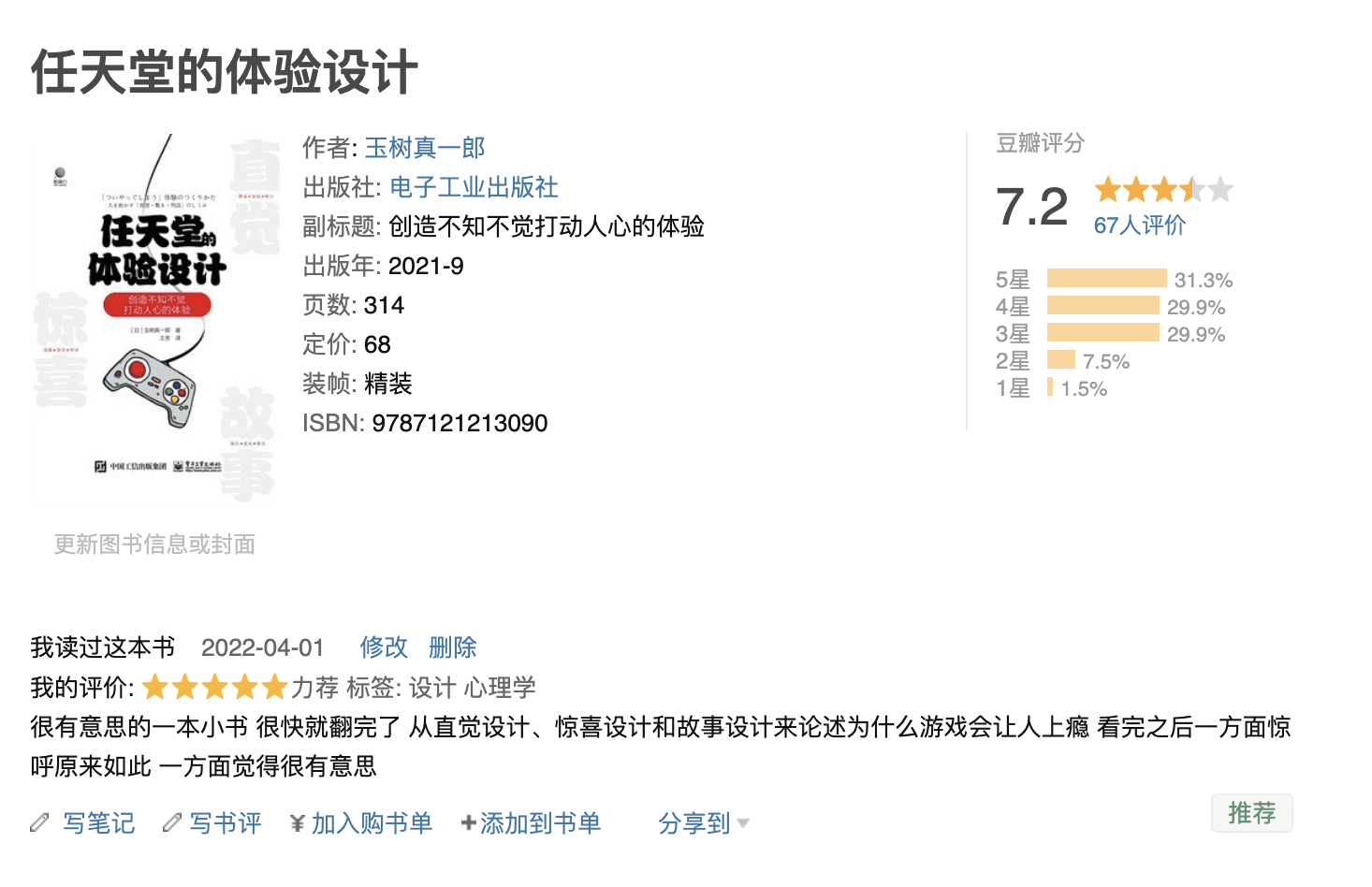
Douban link 1 Author Biography (excerpted from the book) Yushun Shinichiro, Representative of Rikai Affairs Office Born in 1977. Graduated from Tokyo Institute of Technology and ...
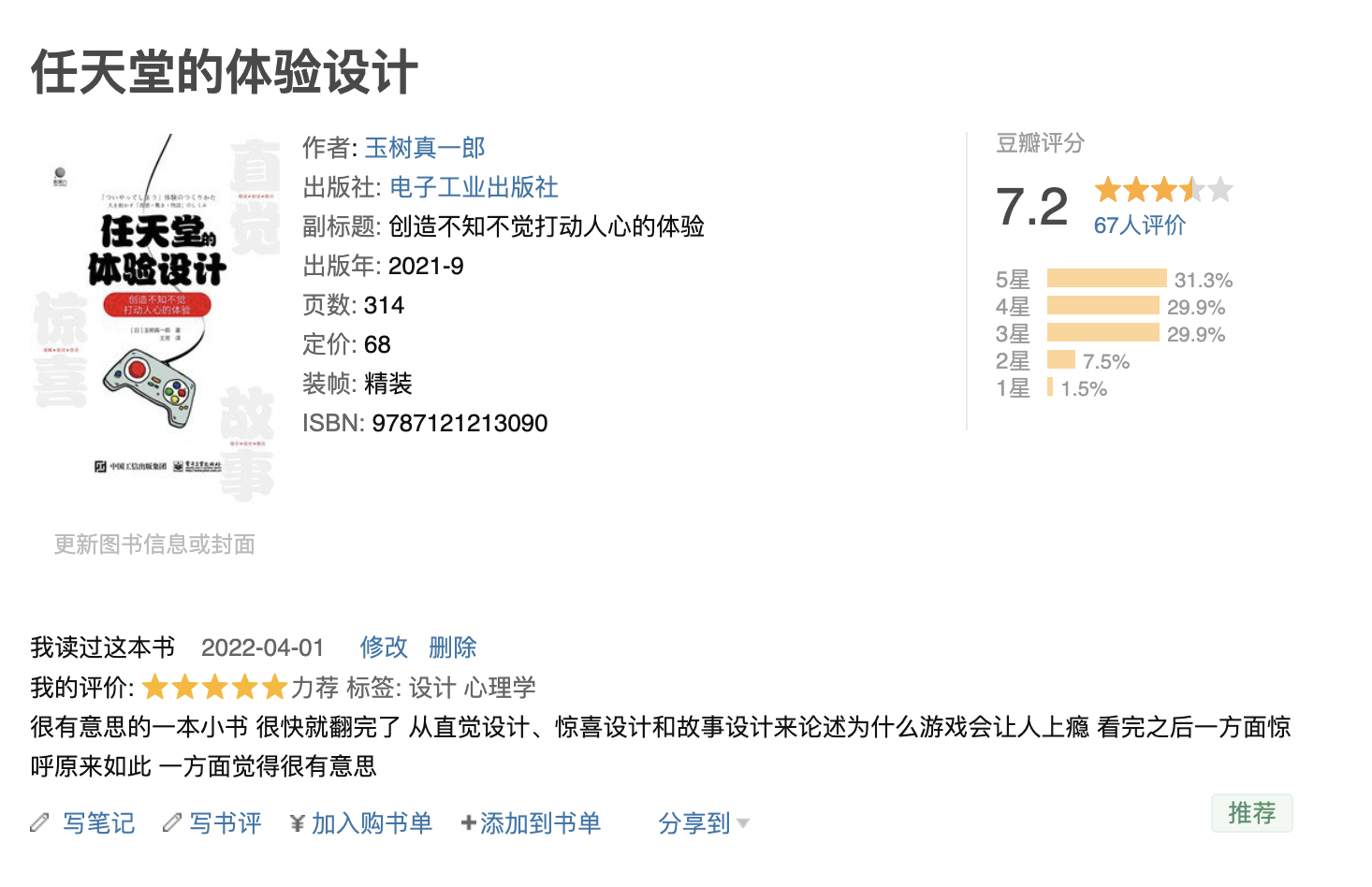
1 Author Biography (excerpted from the book)
Yushun Shinichiro, Representative of Rikai Affairs Office
Born in 1977. Graduated from Tokyo Institute of Technology and the Institute of Advanced Science and Technology, Hokuriku. He started his career at Nintendo as a programmer and later became a designer. As the planning lead for the Wi handheld console that sold over 100 million units worldwide, he was involved from the initial concept stage in hardware, software, and network service planning and development. He is known as “the disseminator of Wi” and “the person who has demonstrated Wi the most”.
2 One‑page overview of the book
3 What the book is really about
3.1 What “experience” means
Although the word “experience” contains the character 体 (body), it has nothing to do with the physical body. If it moves your heart, it is an experience.
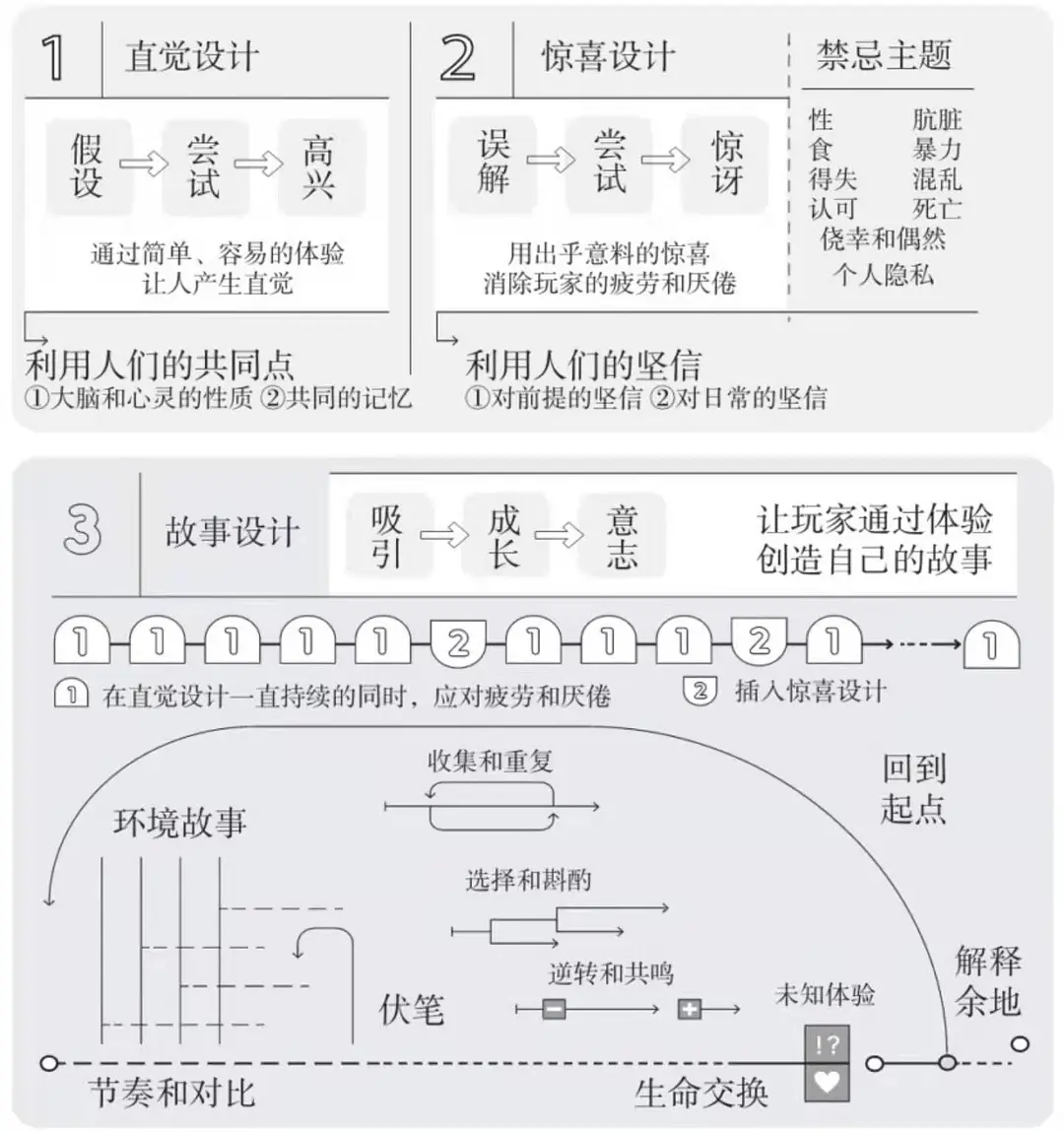
The book calls the method of creating moving experiences “experience design” and groups it into three types that can be applied both in business and everyday life: intuitive design, surprise design, and story design.
- Intuitive design makes people act automatically; use it when a problem is hard to understand.
- Surprise design makes people become engrossed automatically; use it when a problem causes fatigue or boredom.
- Story design makes people want to narrate automatically; use it when a problem lacks value.
Each kind of experience design conveys a bundle of emotions, creates a situational context, and touches the player’s heart—that is the essence of experience design.
Experience is the present tense of memory.
Experience = 5W1H + emotion + present
Memory = 5W1H + emotion + past
Whether a situation leaves a deep impression depends on how strong the experiencer’s emotions are.
3.2 What intuitive design is
Structure of intuitive design
- Assumption – The player spontaneously forms the hypothesis “Should I …?” but the player does not know whether the hypothesis is correct.
- Attempt – The player spontaneously decides “Let’s try …” and takes action but the player does not know whether the attempt is correct.
- Joy – The player spontaneously confirms “… was right.” Here the player first becomes convinced that the assumption and the attempt were correct.
Why intuitive design works
- Our brains constantly generate a hypothesis about the next action: “Should I do X?”
- Within a few seconds the player’s mind experiences a large swing.
- The result of intuitive design is that the player intuitively understands the experience itself; anything that can be grasped intuitively is inherently fun.
- Why do people play games? Not because the game itself is fun, but because the intuitive experience feels fun, so they keep playing.
- Games aim to give you the feeling “I’m smart, I’m capable.”
Key points of intuitive design
- The first step is the assumption; to raise the chance of success, the experience itself must be simple and easy—an absolute prerequisite.
- The secret to successful intuitive design is the principle of simplicity and ease. Complex, hard‑to‑understand things can be made by anyone; creating something simple and easy is the real challenge.
- If you want to design a popular experience that many people enjoy, you must always start from the user, considering “what kind of brain and spirit the user has” and “what memories the user carries.”
- To stay close to the user, prioritize the sequence from “understanding” to “good, correct.” Compared with simply communicating that a product or service is good or correct, it is more important to let users intuitively grasp the relationship between the product and the service first. This, I believe, is the essence of “being user‑centric.”
3.3 What surprise design is
Why create surprise design
- Fatigue and boredom are the fatal flaws of intuitive design. Players constantly learn how to use commands and other specialized knowledge—a continuous learning process. While experiencing intuitive design, their mood swings between “unease” and “excitement.”
- “Surprise stimulation” is a design that continuously alleviates that fatigue and boredom.
- The essence of “surprise stimulation” lies in an unexpected experience.
- We call experience designs that generate surprise surprise design.
Structure of surprise design
- Misunderstanding – The player spontaneously makes the wrong assumption “Should I …?” but the player firmly believes the assumption is correct.
- Attempt – The player spontaneously tries “Let’s try …” and acts but the player firmly believes the attempt is correct.
- Astonishment – The player spontaneously discovers “… was wrong,” and is shocked. Only then does the player realize the assumption and the attempt were wrong.
The player misinterprets, tries, gets an unexpected result, and is astonished. This chain of experiences that produces surprise is what we call surprise design. Its target audience is players who have become fatigued and bored after a series of intuitive‑design‑driven games; it is meant to dispel that fatigue and extend the duration of enjoyment.
3.4 What story design is
What a story is
- What is a story? Story = story content + story narration.
- Another common definition is “a series of events + their presentation.” “Series of events” corresponds to story content, “presentation” to narration.
- A game is not a story; a game narrates a story. Like articles, audio, or video, a game is one medium for storytelling.
Structure of story design
- Attraction – Capture players who want to understand the story and get them to narrate it.
- Growth – Let players grow together with the protagonist of the story.
- Will – Players use their own will to shape their destiny.
Why story design works
The brain constantly seeks a complete picture of the surrounding world. In other words, the brain is a storytelling organ.
Players use their senses and cognition to narrate a story, which is a richly fulfilling experience for the brain.
The player’s growth is the true meaning of a game.
The fictional story that unfolds in a game is ultimately a tool for fostering player growth. Designers must enable the real‑world player to actually develop in reality.
What game designers really want to depict is not a “fictional story” confined to the game world, but the player’s own growth story.
The “fictional story” set in an imagined world with imagined protagonists is merely a means to create a growth experience for the player.
The “player’s story” is the story the player lives through via the game experience.
Change through gameplay is what matters. If the player does not perceive their own growth, the experience is meaningless.
That is why many games’ “stories” ultimately circle back to the starting point.
4 Takeaways and insights
This is a light, breezy read—hardly any effort is required, probably because the author employed a lot of intuitive, surprise, and story design while writing it.
Anyway, the first major takeaway is a clear understanding of why games are addictive: I prefer to view it as the personal growth players experience within the game, which creates an emotional bond. The sense of achievement from growth and the memory forged by that emotional link constitute the essence of game addiction.
The second major takeaway is that, once you know these designs, you can apply them to work and daily life. For example, while scrolling through Alipay’s “Ant Forest” I think about how to add “surprise design” and “story design,” because I’m already exhausted by endless “intuitive design” (even though I’m not the product director of Ant Forest). Or, when delivering a PPT, a few unexpected surprise‑design tricks can produce surprisingly effective results; the book offers several examples for reference.
Of course, many more applications are still being explored, and I’d love to brainstorm with anyone who has read the book.
In short, it’s a pretty interesting book ~
WeChat public account: A Product Dog’s Confession
Sharing product insights, reflections, and reading notes.
Follow us via QR code to stay connected.

Originally written by Estela Young and published in Chinese on 一只产品汪的自白. Translated and edited for DriftSeas with permission.
Keywords
Sources & References
- [1]Douban link
- [2]一只产品汪的自白