Hard Road Ahead: Five Pivotal Choices in China’s Socialist Path
Estela Young
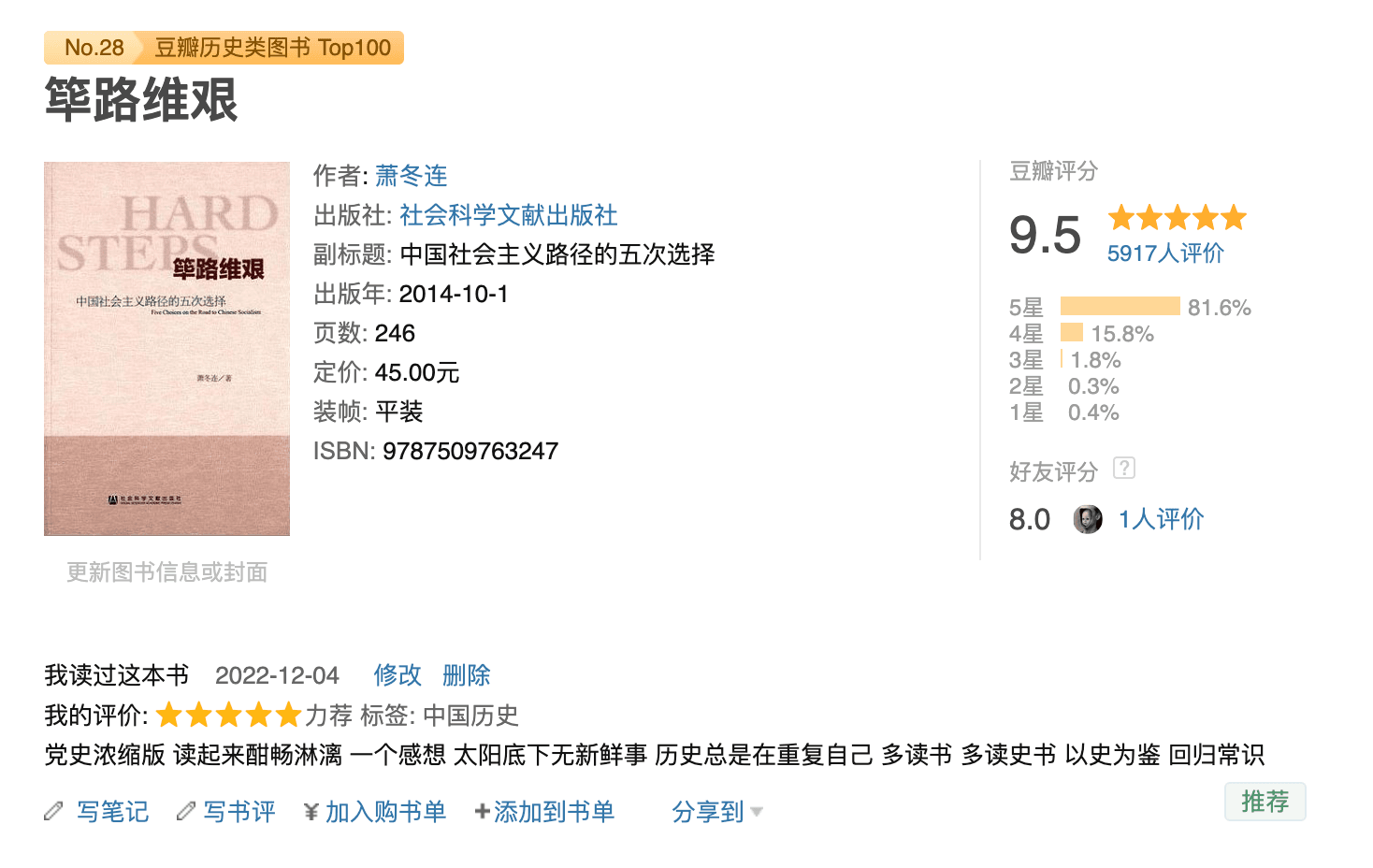
1 This Book and Its Author Douban rating 9.5 Author introduction (excerpt from the flyleaf) Xiao Donglian, born in October 1950 in Hunan, is a scholar of modern Chinese history. F...
1 This Book and Its Author
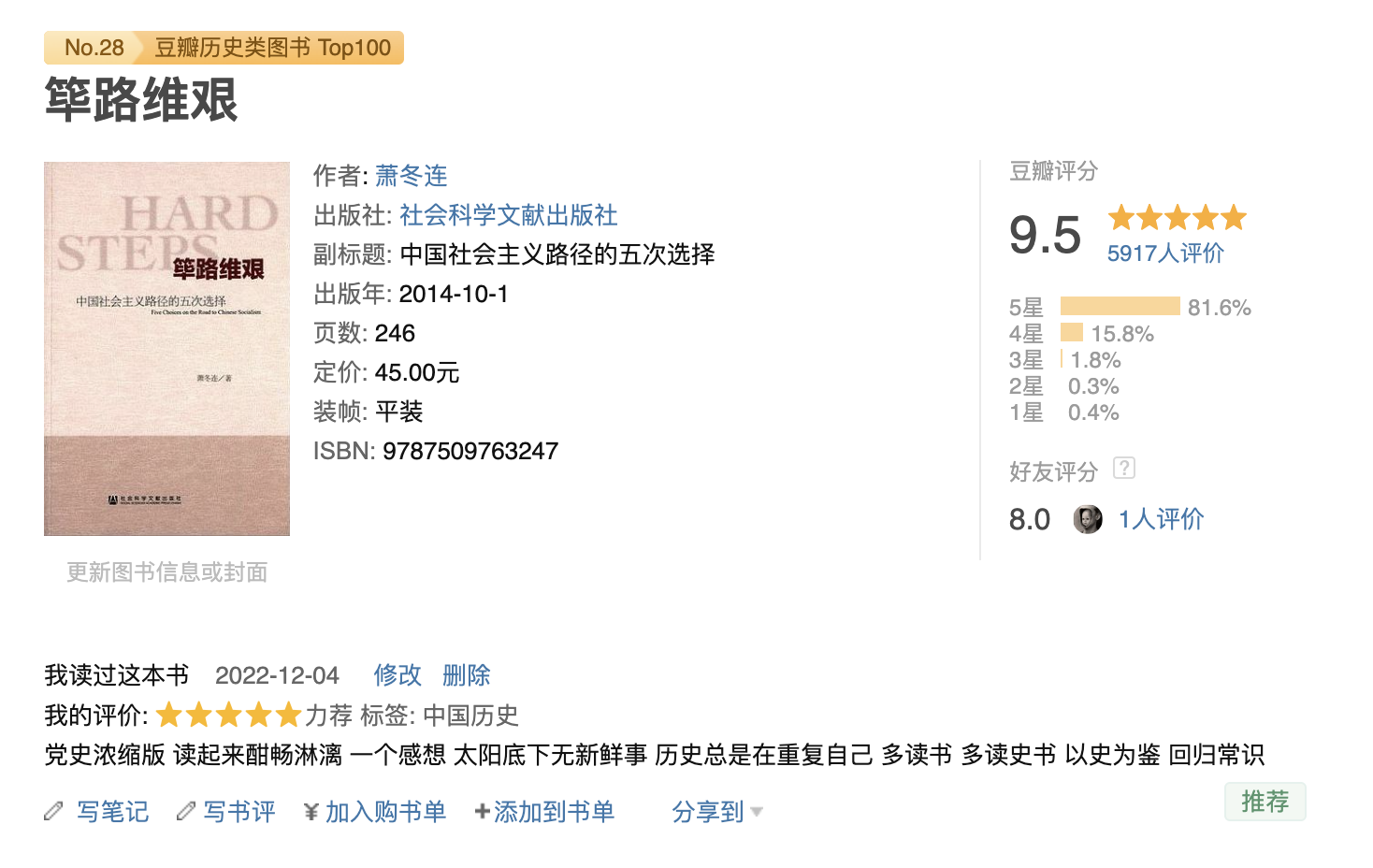
Author introduction (excerpt from the flyleaf)
Xiao Donglian, born in October 1950 in Hunan, is a scholar of modern Chinese history. From 1979 to 2000 he taught at the PLA Political Academy and the National Defense University. He is now a part‑time researcher at the Contemporary Chinese History Research Center of East China Normal University and a specially invited researcher of the China Economic System Reform Research Association. His main research interests are modern Chinese history and the history of China’s reform and opening‑up.
His publications include Rise and Hesitation: A Decade of Rural Review and Prospect, Fifty Years of State Affairs: Diplomatic Volume, Seeking China: A History of the First Ten Years of the Cultural Revolution, Turning Points in History: From Rectification to Reform and Opening‑Up, among others.
2 Contents of the Book
Title: “Hard Roads, Hard Choices – Five Turns on the Path of Chinese Socialism.”
The author argues that, when viewed through the lenses of the ruling party’s nation‑building strategy, development model, and core policies, the practice of socialism in China since 1949 has undergone five pivotal choices: implementing New Democracy, emulating the Soviet model, pursuing a “catch‑up” path, launching a continued revolution, and turning to reform and opening‑up. These five choices constitute two overarching processes: moving from entering traditional socialism (often called the Soviet model) to exiting it, and forging a distinct path of “socialism with Chinese characteristics.”
The book details each of these five choices in depth.
I consider this work a thorough supplement to the gaps in high‑school history curricula, and it answered the confusion and doubts I once felt when studying this period. Moreover, it gave me a deep appreciation of the complexity of history, of social activity, of groups, of human nature, and of individuals.
As the saying goes, there is nothing new under the sun—so it’s always worth revisiting history.
3 Excerpts from the Book
For readers interested in the content, it is advisable to read the foreword first and then decide whether to continue. Below are selected passages with key information omitted for reference. I give this book a five‑star recommendation.
“Chapter 2 – Emulating the Soviet Model”
- The social transformation movement also encompassed three crucial dimensions: political, cultural, and social.
- Political centralization: omitted here
- Cultural transformation: omitted here
- Social integration: urban‑street administration (street offices and residents’ committees), work‑unit system, personnel file system, household‑registration system (urban/rural hukou).
- Consequently, a nationwide system described as “omnipotent politics” emerged. Under this political‑social structure, the state monopolized most scarce resources and attempted to shape people’s ideas; state power permeated the entire society, individuals became highly dependent on the state, and the masses were mobilized to achieve state goals.
“Chapter 3 – Pursuing the Catch‑Up Path”
- For leaders and cadres accustomed to rule by personal will and policy‑driven governance, shifting from a revolutionary order to a rule‑of‑law order proved a formidable hurdle.
- The People’s Commune movement became the largest utopian experiment in history.
- Communes did not create a classless society; instead, they dramatically expanded state control.
- “Collectivized life, militarized organization, combat‑style action.” In many places collective dormitories were set up, men and women were separated, and the family unit was to be eliminated.
- State power reached an unprecedented level of social control, granting the government extraordinary mobilization capacity.
- The boundless expansion of state authority directly produced the “Five Winds” (i.e., the winds of communism, extravagance, forced orders, blind directives, and over‑consumption/appropriation), which abused popular labor.
- Extravagance wind: In practice, fabricators were seldom held accountable, while officials who spoke the truth were invariably punished.
- Within the leadership, some recognized the falsities, but no one was willing to speak openly. Perhaps the fabricators initially saw it as a political game of number‑crunching, never foreseeing the consequences. In any case, they were not the ones bearing the ultimate costs; peasants suffered hunger and even death.
- The XX incident occurred as early as the winter of 1959‑1960. Regional and county leaders sealed off information, intercepted correspondence, set up checkpoints, patrolled borders, and prevented starving migrants from fleeing.
- The real danger lies not in mistakes made from inexperience, but in the loss of corrective ability caused by stifling criticism.
- From this we should learn to remain vigilant about the limits of human rationality and to treat ideal‑driven social schemes with caution. Ideals illuminate the way forward, but reality is a process of trial, error, and improvement. Applying an ideal directly as a societal experiment inevitably brings disaster. The higher the ideal, the grander the goal, and the stronger the authority, the greater the potential catastrophe.
“Chapter 4 – Launching the Continued Revolution”
- Experience shows that a closed nation provides the most fertile soil for radical ideas and personality cults. A highly politicized social system makes political competition the only viable route for upward mobility, so political campaigns have never lacked enthusiastic participants; each movement has produced a large cadre of activists.
- Many man‑made catastrophes in human history are proclaimed to serve lofty ideals and goals.
- No one in the upper echelons possessed the will—or the power—to challenge XX authority. Everyone could only follow XX’s decisions, either voluntarily or under pressure, consciously or reluctantly.
“Chapter 5 – Turning to Reform and Opening‑Up”
- China began to abandon endless class struggle and political campaigns, focusing instead on a modernization agenda centered on economic development.
- Had China continued to close its doors and launch campaigns for another two decades, the world’s modernization would have progressed so far that the gap between China and developed nations would have become enormous.
- I see two fundamental challenges: the privatization of public power (concentration of power and corruption) and the pervasive infiltration of commercial principles into society (the relentless pursuit of individual profit erodes the basic fairness and value standards that sustain a healthy society, leading to a loss of social trust, a breakdown of the social bottom line, and widespread disorder. A nation hollowed of values cannot become a truly modern great power).
I sincerely recommend reading the entire book from cover to cover.
WeChat public account: “A Product Dog’s Confession”
Recording product insights, reflections, and reading notes.
Follow us for updates—scan the QR code to stay connected.

Originally written by Estela Young and published in Chinese on 一只产品汪的自白. Translated and edited for DriftSeas with permission.