Happiness Beyond Perfection
Estela Young
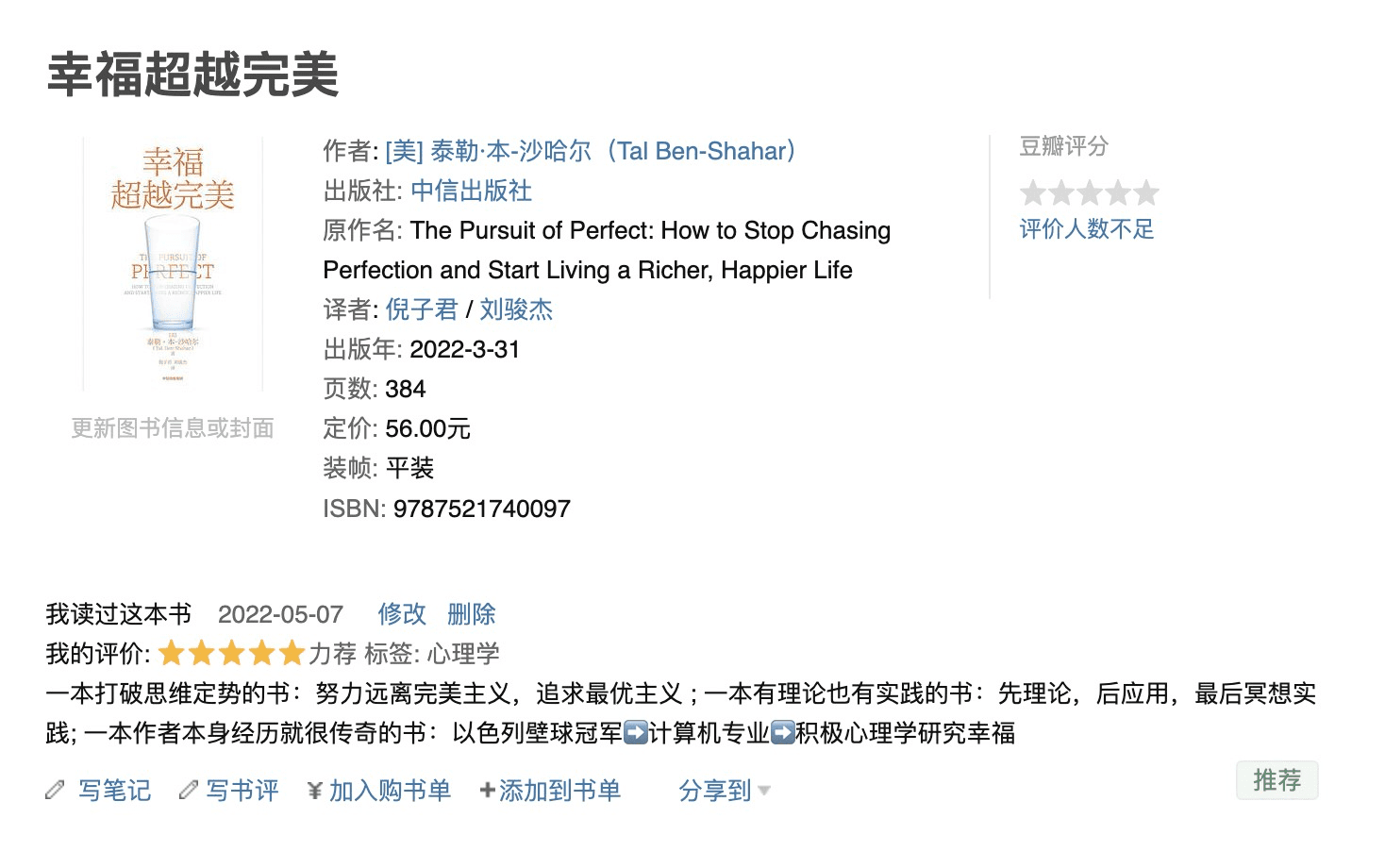
Douban link (new edition, no rating) Douban link (old edition, rating 8.7) 1. Author Biography Tal Ben‑Shahar, Ph.D., holds dual bachelor’s degrees in psychology and philosophy fro...
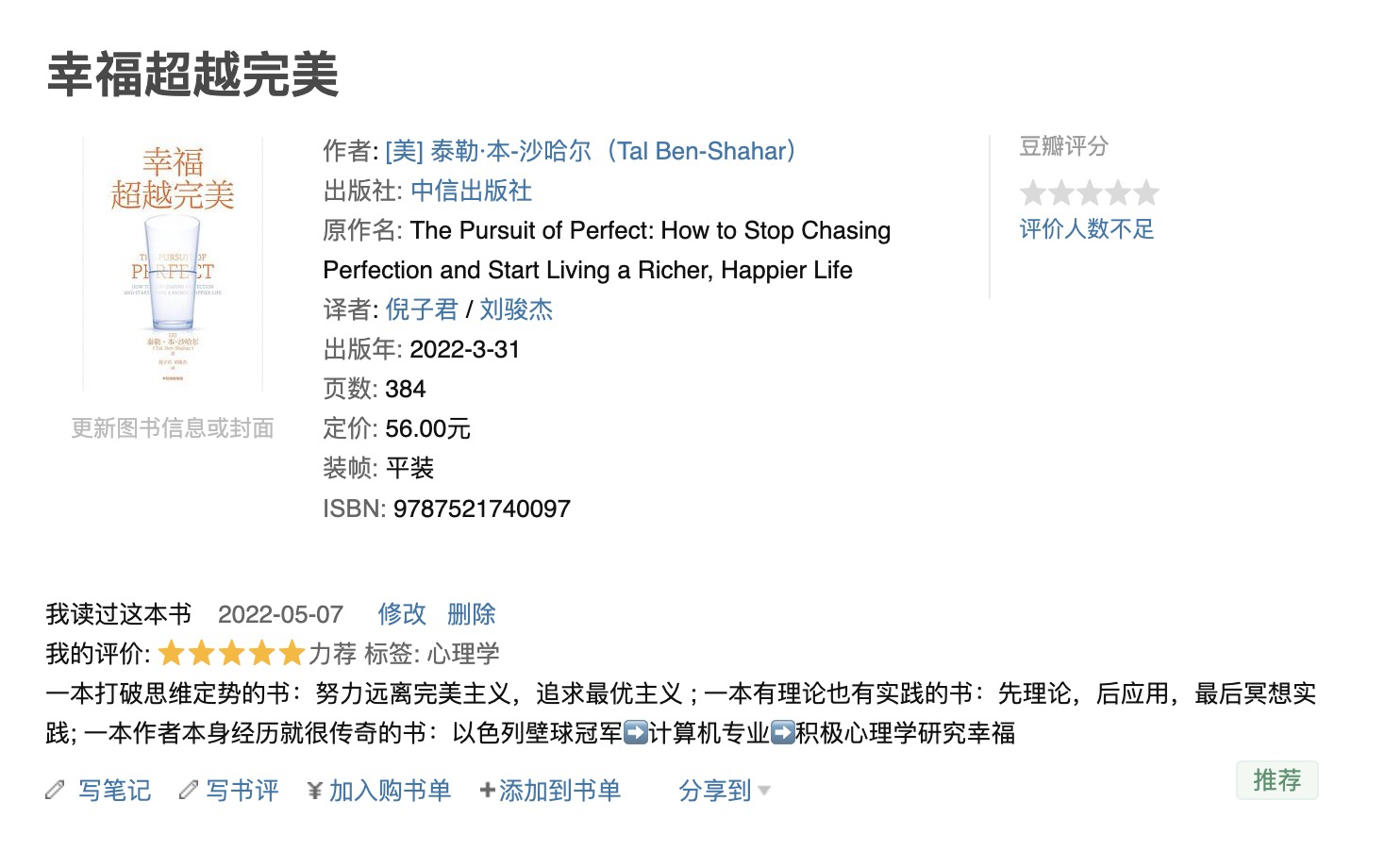
Douban link (new edition, no rating) Douban link (old edition, rating 8.7)
1. Author Biography
Tal Ben‑Shahar, Ph.D., holds dual bachelor’s degrees in psychology and philosophy from Harvard University and a doctorate in organizational behavior from Harvard. He is the author of the New York Times bestseller The Pursuit of Happiness; his courses “Positive Psychology” and “Leadership Psychology” were repeatedly voted by Harvard students as the most popular (ranked first and third) courses for several years.
Dr. Ben‑Shahar’s personal story is also remarkable, and it is recounted in detail in this book. An Israeli, he became the youngest squash champion in Israel as a teenager and moved to the UK’s squash hub to chase greater achievements. Persistent injuries from intense training and pre‑competition anxiety that led to defeats forced him to end his professional athletic career early, after which he enrolled at Harvard to study computer science. Although he succeeded academically, he remained unhappy and lived in chronic anxiety. He later switched to psychology, delving into positive psychology and seeking an answer to the question “How can one be happy?”
Note: Positive psychology studies the factors that make individuals, groups, and organizations more vibrant and happier. In short, it is the science of happiness.
2. Book Overview
The Chinese title of the book is 幸福超越完美 (Happiness Beyond Perfection), but I prefer the original English title The Pursuit of Perfect: How to Stop Chasing Perfection and Start Living a Richer, Happier Life. In plain language: “Pursue optimalism, quit perfectionism, and live a richer, happier life.”
As the title suggests, the book introduces the concepts of perfectionism and optimalism and explains them in depth. It is divided into three parts:
- Part 1 contrasts perfectionism with optimalism, discussing acceptance of failure, embracing emotions, welcoming success, and respecting reality.
- Part 2 applies the theory to various domains—how teachers and parents can help children achieve both happiness and success, how to bring perfectionism and optimalism into the workplace, and why true love requires letting go of unrealistic fantasies of a perfect romance.
- Part 3 offers ten short meditation exercises, each targeting a specific aspect of perfectionism; they are detailed and practical.
I recommend this book because, in its brief snippets, I see a reflection of my former self—the part that chased perfection, feared failure, and ended up anxious. As the author writes, no one is 100 % a perfectionist or 100 % an optimalist. I admit that I still cling to perfectionist tendencies in some areas, which may explain why I don’t feel fully happy.
If you, too, feel unhappy, give this book a try; I hope it helps.
3. Excerpts
3.1 Misconceptions About Happiness
- The biggest obstacle people encounter in the pursuit of happiness is the belief that life must be both happy and perfect.
- Implicit in this belief is a deeply rooted, common view: a happy life consists of countless flawless positive‑emotional experiences, and anyone who has ever felt envy, anger, disappointment, sadness, fear, or anxiety is not “truly” happy. In reality, only two groups never experience these normal negative emotions: the mentally ill and the dead. So occasionally feeling negative emotions can actually be a good sign—it proves we are not mentally ill and that we are still alive.
3.2 Perfectionists vs. Optimalists
- In recent years psychologists have discovered that perfectionism is more nuanced and not entirely negative. Sometimes it serves as a powerful driver that pushes people to work hard and set high standards for themselves.
- Consequently, contemporary psychologists distinguish between adaptive, healthy “positive perfectionism” and maladaptive, neurotic “negative perfectionism.” Seeing the stark contrast between these two types and the vastly different outcomes they produce, I prefer to use completely different terminology. In this book I refer to “negative perfectionism” simply as perfectionism, and I call “positive perfectionism” optimalism.
- Perfectionists and optimalists are not mutually exclusive categories. No one is 100 % a perfectionist or 100 % an optimalist. Rather, we should view perfectionism and optimalism as points along a continuum, with each person leaning toward one end or the other to varying degrees.
- Moreover, a person may be a perfectionist in some life domains and an optimalist in others. Generally, the more a person cares about something, the more likely they are to adopt a perfectionist mindset about it.
3.3 Are You a Perfectionist?
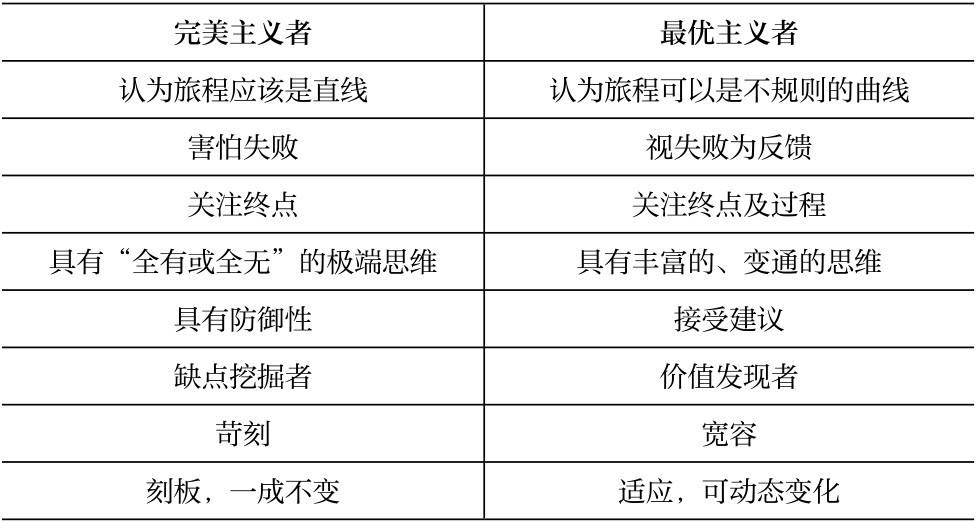
Differences in the expression of perfectionism and optimalism
Accepting Failure
“The greatest mistake humanity can make is to be afraid of making mistakes.” — Albert Hubbard
Fear of failure: The core and most conspicuous trait of perfectionism is a dread of failure. Perfectionists focus first on how to avoid failure, then shun challenges out of that fear, and when failure does occur they collapse, which only deepens their fear of future failures.
Goal‑only focus: Perfectionists care only about reaching the goal; the journey is meaningless. They rush through life, unable to enjoy the present, viewing the process as an annoying step that must be shortened to reduce pain.
All‑or‑nothing thinking: Also called “binary thinking,” it evaluates things with a single standard—no middle ground, no nuances. For example, when Ben‑Shahar played squash he thought he was either a champion or a total failure.
Defensiveness: When criticized, perfectionists become highly antagonistic, unable to see any value in the feedback or any learning opportunity. Their defensive behavior harms themselves and reduces their chances of success.
Digging for flaws: As Henry David Thoreau said, “Even in heaven, the flaw‑diggers will find faults.” Perfectionists, terrified of failure, constantly focus on the half‑empty cup.
Harshness: Perfectionists are severe with themselves and others. When they err, they struggle to forgive themselves. This harshness stems from the belief that a flawless life is possible (and desirable); all mistakes are avoidable, so being hard on themselves feels like taking responsibility.
Rigidity: To a perfectionist, there is only one straight path to the desired destination. Their self‑imposed (and other‑imposed) routes are inflexible. Even the language they use—must, have to, should, inevitably—is absolute and dogmatic.
Yet optimalists tend to be more successful, for several reasons:
- Learning from failure: Failure doesn’t guarantee success, but a lack of failure guarantees it won’t happen.
- Peak performance: Acceptance of failure creates a modest excitement that fuels optimal performance.
- Enjoying the process: Success requires thousands of hours of sustained effort; one must enjoy, not despise, the journey.
- Efficient time use: Time is scarce; not every task deserves equal attention.
- 80/20 rule: Focus 20 % of effort on the tasks that yield 80 % of the results.
Embracing Emotions
- “Those who do not know how to cry with their whole heart will never know how to laugh out loud.” — Gorda Meyer
- From an emotional standpoint, most perfectionists idealize a life composed of uninterrupted positive feelings.
- Perfectionists expect a constantly elevated emotional state; optimalists anticipate peaks, valleys, and all the fluctuations that come with a full human experience. Perfectionists reject any painful emotion that deviates from their imagined flawless positivity, while optimalists allow themselves to feel the entire spectrum of human emotion.
- The White‑Bear Experiment: Try this classic task devised by psychologist Daniel Wegner: for the next 10 seconds, keep telling yourself “don’t think of a white bear.” Inevitably, you’ll picture a white bear. If you truly want not to think of a white bear, it’s better to allow the image, then watch it fade naturally.
- True acceptance means acknowledging emotions as they are and coexisting with them. That includes recognizing that painful feelings may be more intense and longer‑lasting than expected, yet still accepting them. Genuine acceptance is not just “I’m sad, and that’s okay,” but also “Even after accepting my sadness, I don’t feel better,” and that’s still acceptable. This capacity to fully accept is a core difference between perfectionists and optimalists.
- Positive acceptance means recognizing reality as it is and then choosing the most appropriate, valuable action. At any moment we can decide: act bravely despite fear, respond kindly despite jealousy, honor our nature while remaining compassionate.
Welcoming Success
- “Good enough”: The underlying idea of a “good enough” mindset is to accept the overall limits of our lives and then allocate our time and energy in the most optimal—or near‑optimal—way possible.
- Appreciating success: Many perfectionists possess wealth, health, fame, and good looks, yet remain unhappy. In fact, external markers such as wealth and status have little correlation with happiness. This reveals a simple truth: happiness depends on our mindset, not our social standing or bank balance. Once basic needs (food, shelter, education) are met, our happiness hinges on what we choose to focus on and how we interpret events. Do we see failure as disaster or as a learning opportunity? Do we view a cup as full or half‑full? Do we savor what we have or take it for granted?
- Cultivating gratitude: Research on gratitude consistently shows that when we appreciate the good in our lives, more good things appear. Conversely (unfortunately, a fact), taking things for granted causes them to diminish. Being grateful for what we have and shedding the entitlement toward our achievements are prerequisites for further success.
Respecting Reality
- “Two plus two equals four. Nature does not need your precious opinion. It does not care what you like or whether you agree with its laws. You can only accept nature as it is, with all that it reveals or conceals.” — Fyodor Dostoevsky
- The antidote to perfectionism and the prescription for optimalism is to accept reality in its raw form—whether failure, emotion, or success. When we refuse to accept failure, we avoid challenges and deprive ourselves of growth. When we reject painful emotions, we become trapped in rumination, magnifying them and denying peace. When we cannot acknowledge, embrace, or be grateful for our achievements, nothing feels meaningful.
- Self‑acceptance, in simple terms, is realism: what is, is; what I feel, I feel; what I think, I think; what I do, I do.
- Emotions are emotions: In any conversation—with a child, a partner, anyone, including ourselves—if emotions start to run high, the first step is to clearly see each other’s current feelings. This helps us curb the impulse to “help,” “lecture,” “advise,” or “persuade.”
3.4 Applying Optimalism
Parenting and Education
- Our culture tends to glorify external achievements. As parents and teachers, we must work hard to counter this bias. Because the world constantly celebrates quantifiable success, children internalize the belief that worth is earned by bringing home good grades and praise—a prerequisite for self‑value. Parents and teachers can create a completely different environment, showing children that our love and support accompany them throughout the journey, not just at the finish line.
Workplace Application
- Managers play a crucial role in fostering optimalism among employees. They can create psychologically safe environments rather than ones that instill fear of failure, allowing continuous learning and long‑term performance gains.
- Managers can also schedule regular, science‑backed breaks, which benefit mental health and enable greater achievements.
4. Final Thoughts
If I had to sum up the book in one sentence, it would be: Accept reality (it’s imperfect), accept yourself (you’re imperfect, others are imperfect), accept your emotions (“It’s okay to feel sad”), accept all unchangeable facts, then consider how to achieve the best possible outcomes. Change your attachments first; there are many ways to act once you do.
And… live an imperfect yet happy life.
WeChat public account: “A Product Dog’s Confession”
Sharing product insights, reflections, and reading notes
Follow us via QR code to stay connected

Originally written by Estela Young and published in Chinese on 一只产品汪的自白. Translated and edited for DriftSeas with permission.