Four-Day Quanzhou, Fujian Tour – February 2025
Estela Young
Quanzhou Town Tower 🌴 Overview February 2025 | 5 days 4 nights | ≈ ¥2,500 per person Round‑trip airfare ¥1,180/person Accommodation ¥970/person Most attractions are free; Quanzh...

Quanzhou Town Tower
🌴 Overview
February 2025 | 5 days 4 nights | ≈ ¥2,500 per person
Round‑trip airfare ¥1,180/person Accommodation ¥970/person
Most attractions are free; Quanzhou string‑puppet show ¥50; meals not included.
On the last day we rented a BMW 5‑Series for a self‑drive to Jinjiang: ¥600+ per day plus ¥100 for fuel.
Itinerary at a Glance
🏞️ Original Plan | Dreams are beautiful
DAY 1 Quanzhou Old City city‑walk
Xijie (West Street) – Kaiyuan Temple – Xiao Xicheng – Bell Tower – Yuanmiaoguan – Chengtiansi – Quanzhou Old City – Zhongshan Street – Flower Lane Catholic Church – Goldfish Alley – Fuwen Temple – Qingjing Mosque – Tonghuai Guan Yue Temple – Tianhou Palace – Fumei Palace
DAY 2 Qingyuan Mountain – China Min‑Tai Relations Museum – Quanzhou Museum – Quanzhou Puppet Theater (tickets must be bought in advance)
DAY 3 Nan Shaolin Temple – Quanzhou Intangible Cultural Heritage Museum – Quanzhou Overseas Maritime History Museum – Lingshan Islamic Holy Tomb – Luoyang Bridge – Xunpu Folk Culture Village – Nanyin performance
DAY 4 Jinjiang historic‑site day‑trip, then fly back to Beijing
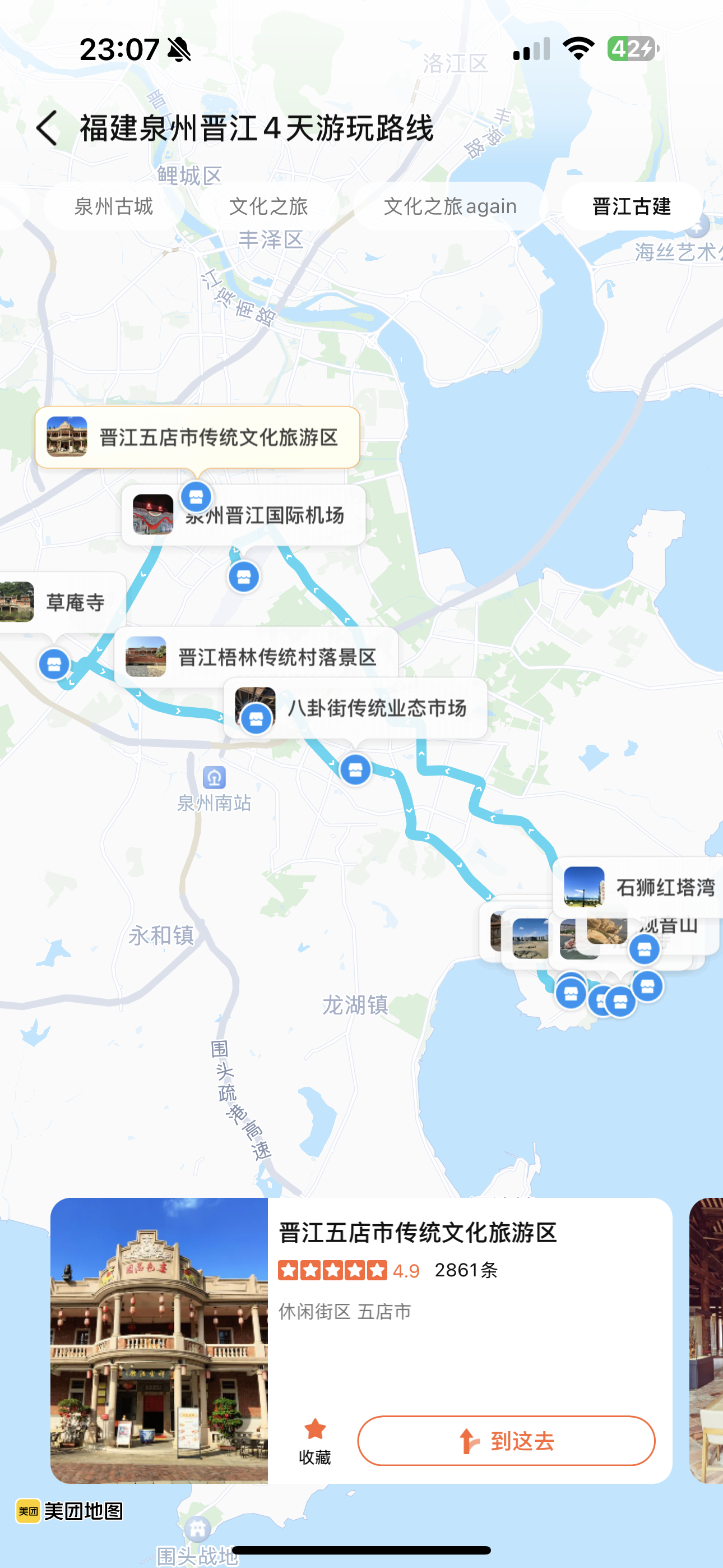
Jinjiang Wudian Market Traditional Culture Tourism Zone – Cao’an Temple – Jinjiang Wulin Traditional Village Scenic Area – Bagua Street Traditional Market – Yongning Ancient Town (Yongning City God Temple) – Shishi Golden Coast – Luojia Temple – Guanyin Mountain – Shishi Hongtawan
I mapped this route on Dianping; click the link for the “Fujian Quanzhou Jinjiang 4‑Day Travel Route” (mobile users can view it here).
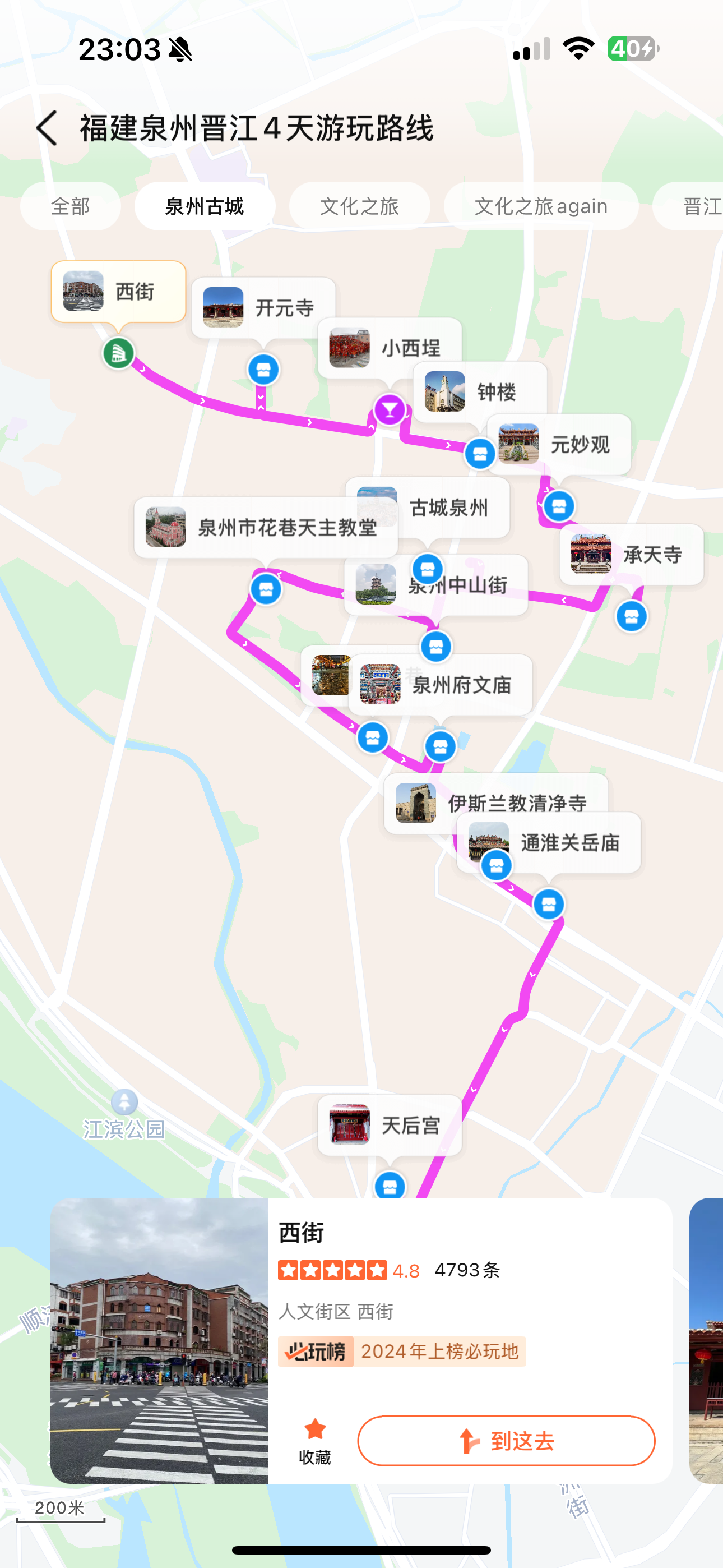
🏞️ Actual Itinerary | We only left the house after waking up naturally, you know how it goes…
DAY 1 Xijie – Kaiyuan Temple – Xiao Xicheng – Bell Tower – Yuanmiaoguan – Chengtiansi – Tonghuai Guan Yue Temple – Zhengyin Academy’s free Nanyin performance
DAY 2 Tianhou Palace – Qingjing Mosque – Fuwen Temple – Quanzhou Puppet Theater’s string‑puppet show
DAY 3 China Min‑Tai Relations Museum – Nan Shaolin Temple – Flower Lane Catholic Church – Goldfish Alley
DAY 4 Jinjiang Wudian Market Traditional Culture Tourism Zone – Cao’an Temple – Luojia Temple
Details for each site follow.
Flights and Accommodation
✈️ Flights
Outbound – Beijing Daxing → Quanzhou Jinjiang, CZ8973, 20:25–23:25, ¥500/person
Return – Quanzhou Jinjiang → Beijing Daxing, MU8177, 21:00–00:05, ¥680/person
🏨 Accommodation
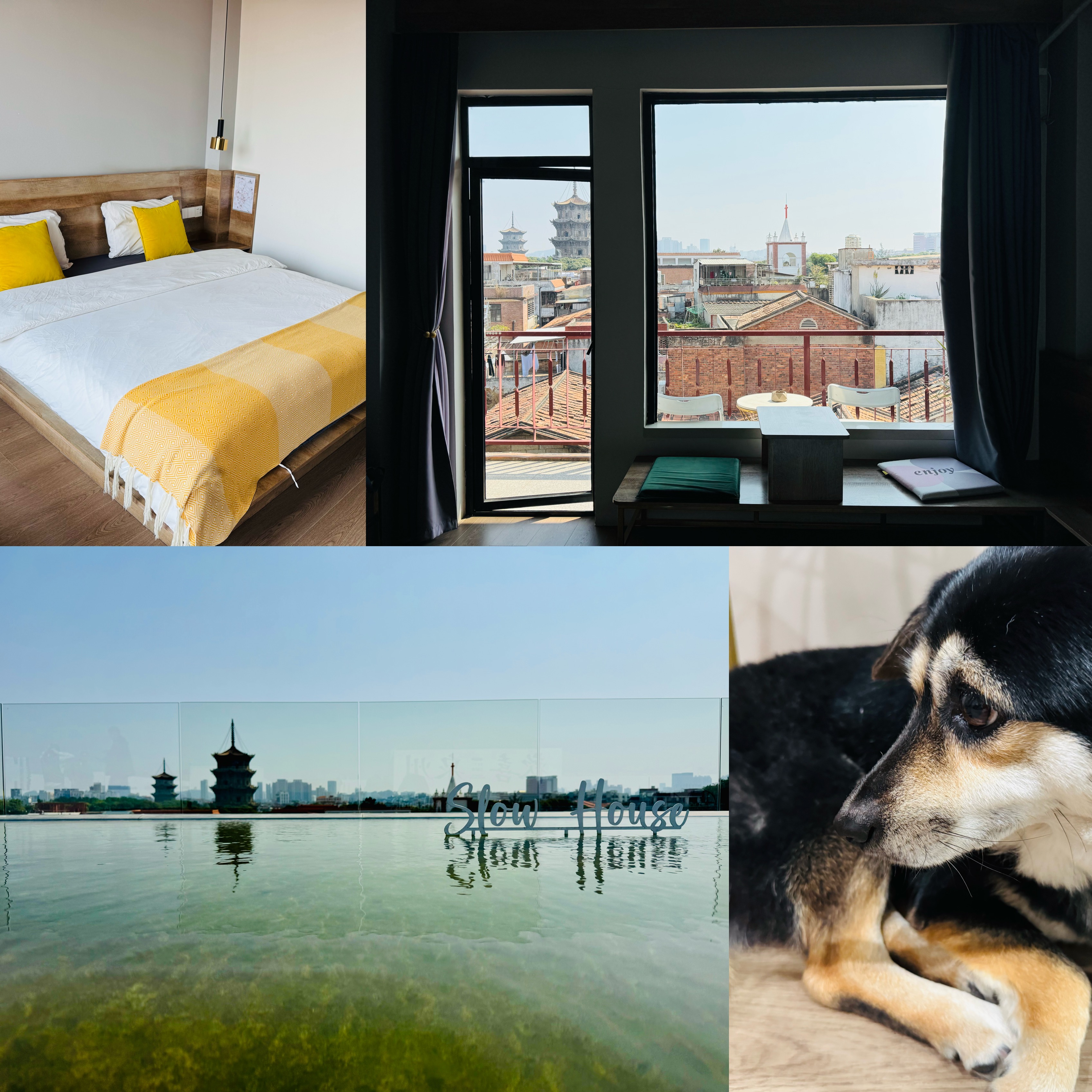
Slow House is a boutique chain recommended by a friend, with four locations in Quanzhou. I stayed at two of them to get a broader experience.
Slow House “Above the Fireworks” – Soy Projection King‑Size Bed Room | 2 nights | ¥840
Located on West Street, directly above the West Street market and a short walk to Kaiyuan Temple. Quiet at night.
Note: the room is compact; consider booking a larger space.
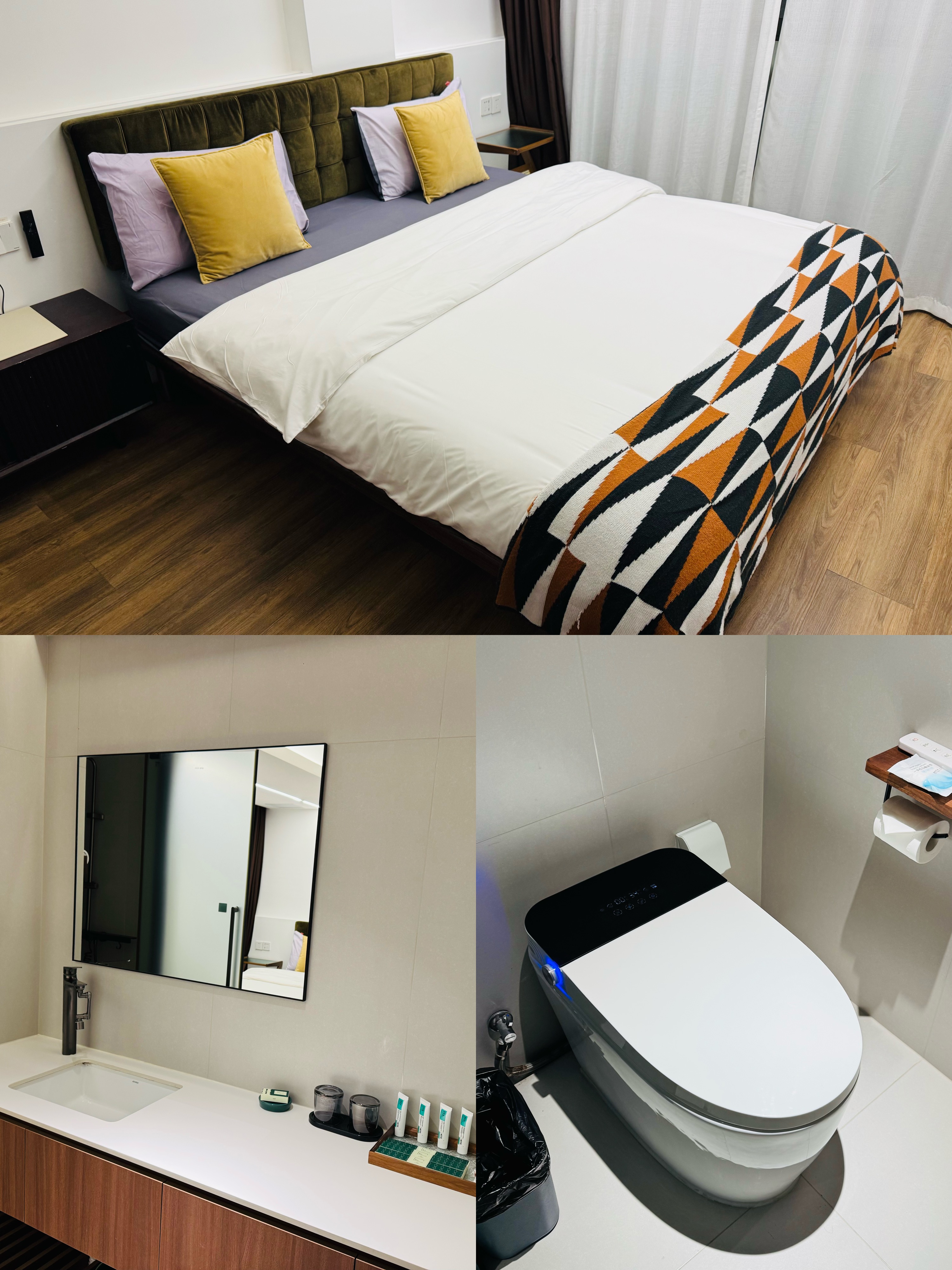
Slow House “Ask the West” – Tower View King‑Size Bed Room | 2 nights | ¥1,100
Also on West Street, just a few steps from the previous property.
The ground floor houses the popular “Three‑Legged Tiger” stir‑fried gout hotpot (essentially a seafood hotpot), plus local milk‑tea shop “Berry Crazy” and “Hu Jian,” all operated by Chengfeng Breaking Waves Catering Co. — how do I know? Shhh, a little mystery.
The third floor is a shared lounge where you can sip tea, have a drink with the host, and play with a dog named Oreo. The fourth floor contains the guest rooms, equipped with Xiao‑Ai (a smart speaker) and offering views of the East and West towers and the cathedral. The fifth floor is a rooftop; on sunny days it’s perfect for photos.
Between the two, I recommend “Ask the West” for a richer experience. Book via the WeChat public account “SLOW HOUSE.”
P.S. I’m not sure whether I can get a returning‑guest discount, but feel free to ask.
🌆 Old‑City City Walk
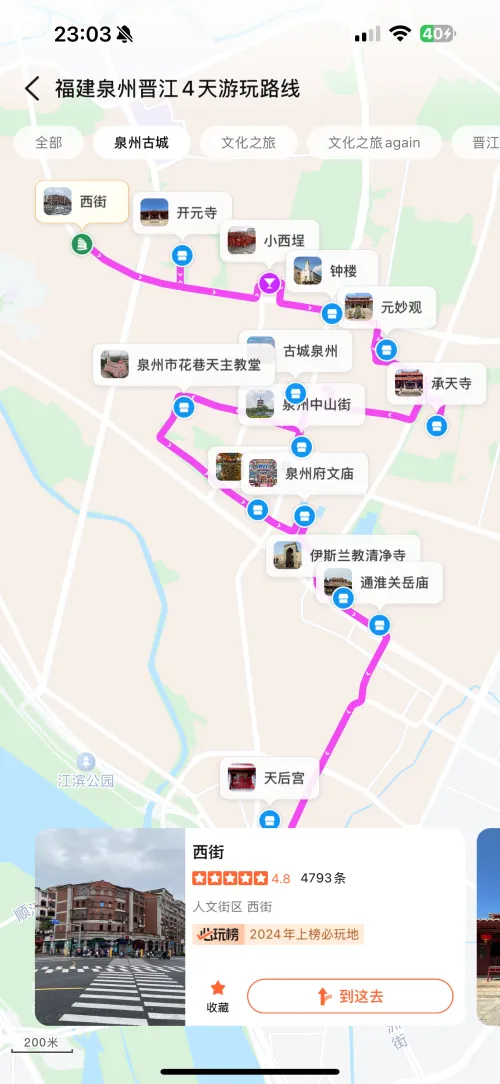
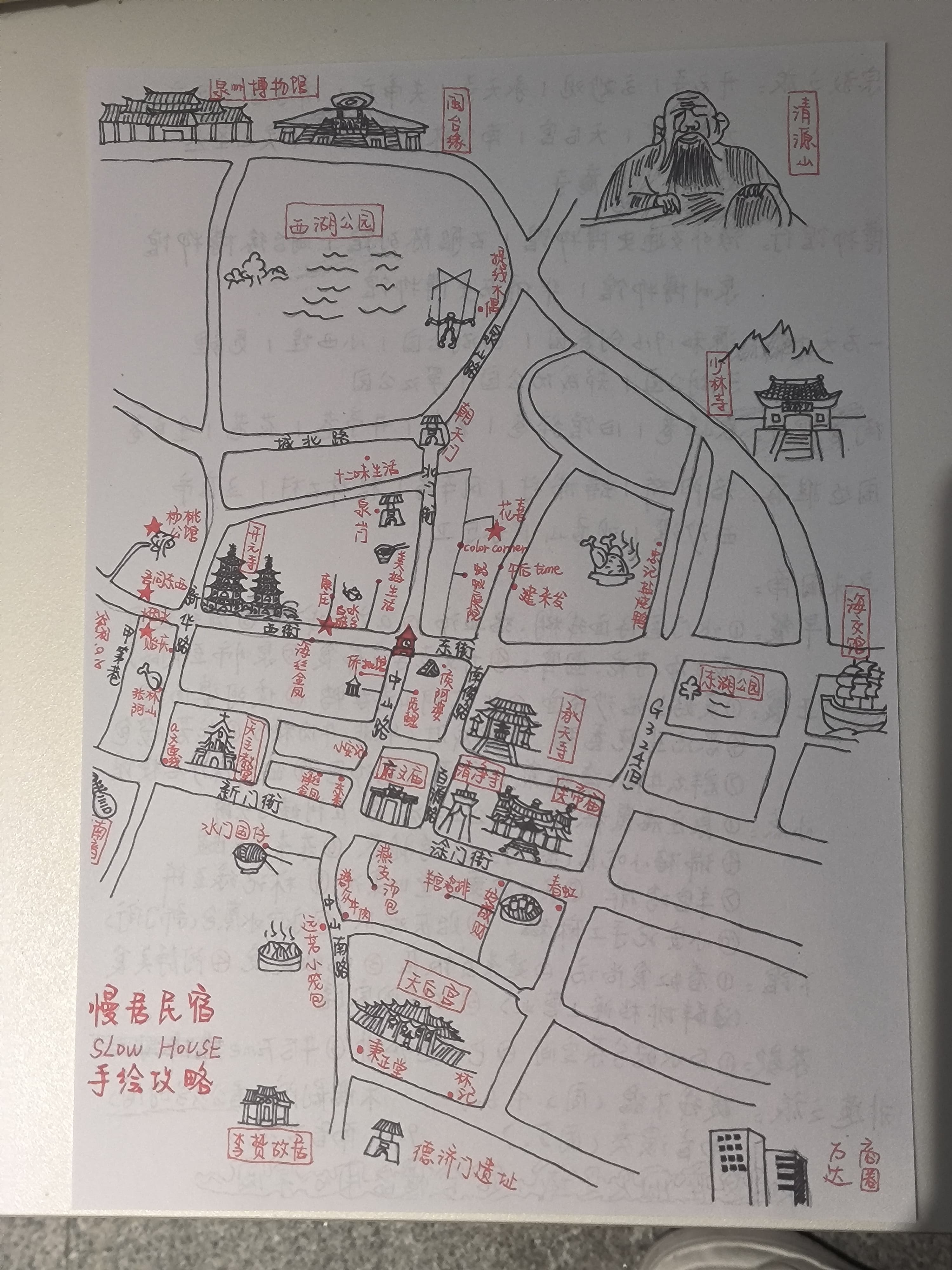
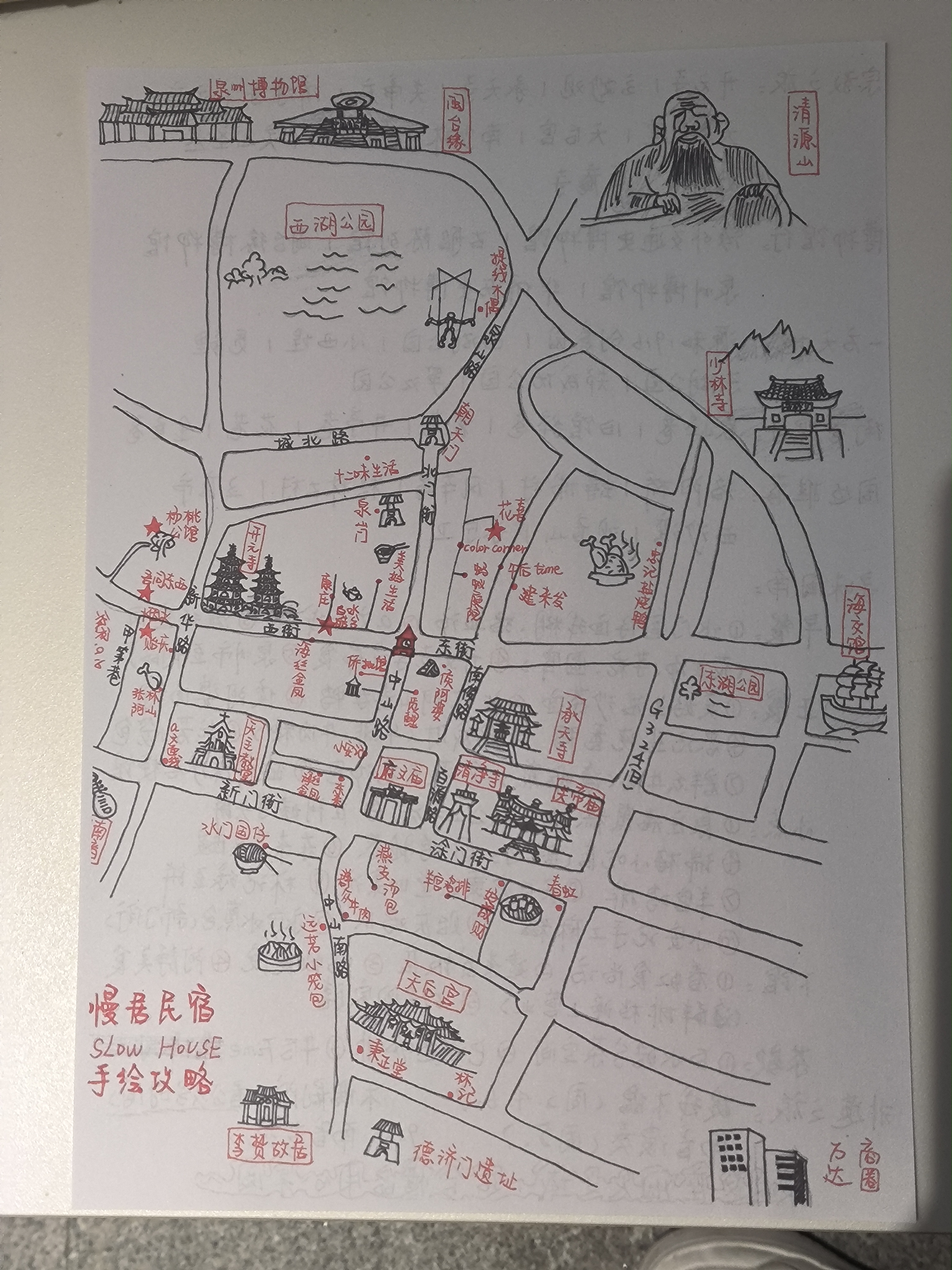
The map above shows that Quanzhou’s old city is modest in size, with temples, palaces, and churches packed together—perfect for a city walk.
If walking feels too much, beginners are welcome to hop on a “Xiaobai” (tourist bus). It stops at all major sights and costs ¥2 per ride.
Before boarding, tell the driver which stop you want; we only used the Xiaobai to get to Tianhou Palace—everything else we walked.
More Xiaobai details are in the image below.


Kaiyuan Temple
Kaiyuan Temple is the largest Buddhist temple in Fujian, founded in the Tang dynasty and taking its present form during the Song‑Yuan periods. It preserves Tang‑era architectural style and blends Buddhist and Hindu elements, reflecting Quanzhou’s religious tolerance. The Mahavira Hall is the largest surviving wooden structure in Fujian; the East and West towers are city landmarks. The temple also houses a memorial hall for Master Hongyi, worth a visit.


Xiao Xicheng
Xiao Xicheng is accessed through a side alley off West Street. It feels like a traditional market, but what makes it special is the old‑city alley atmosphere.

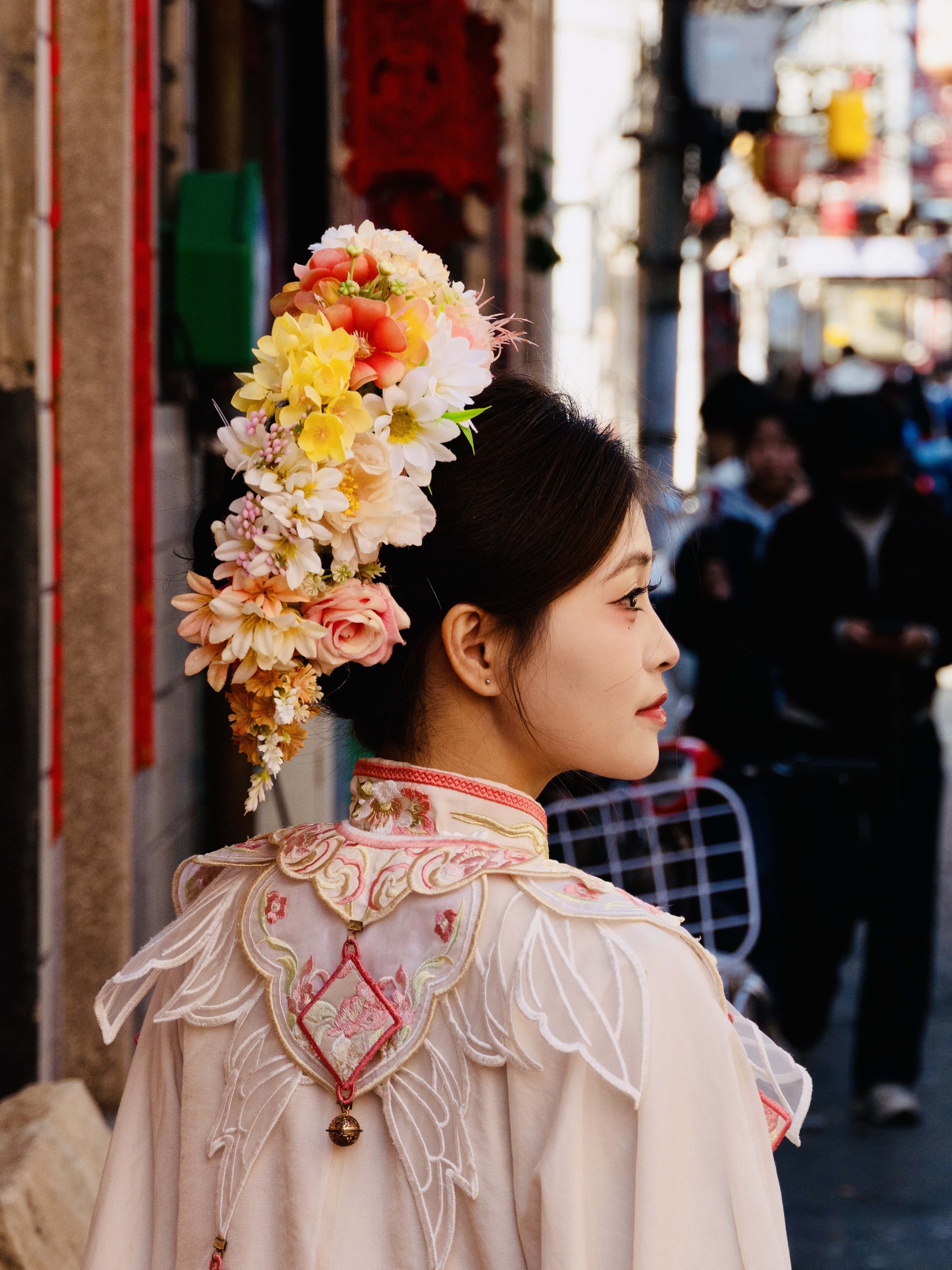
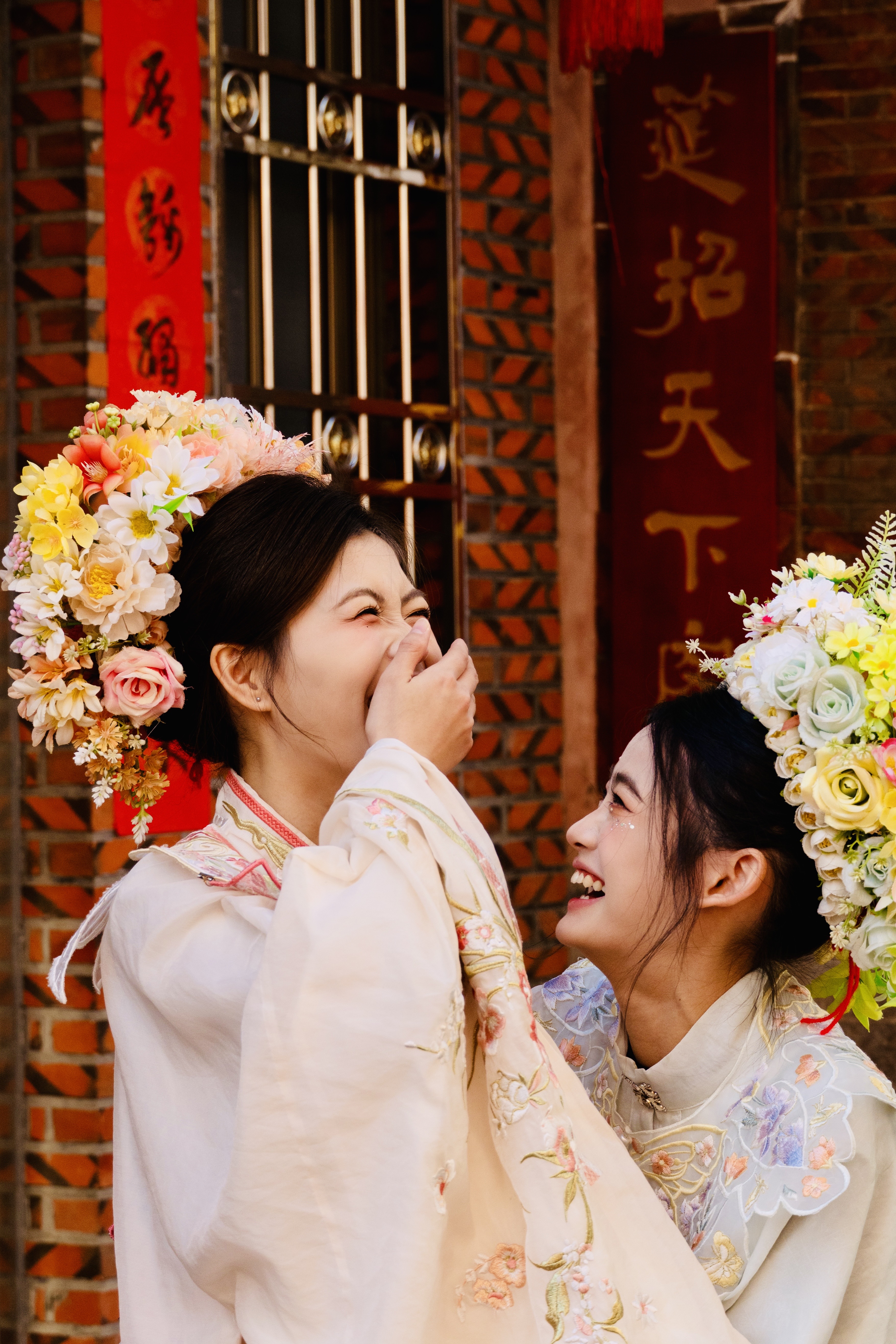
In this alley we snapped a photo of a girl wearing a hairpin; she later invited us to take more pictures, resulting in two of my favorite shots from the trip.
Bell Tower
The Bell Tower stands in the middle of West Street, built in the 23rd year of the Republic (1934). It’s an iconic Quanzhou landmark; its chimes once served as the city’s time‑signal.
The surrounding area is full of milk‑tea shops and a night market. We also watched the blockbuster Ne Zha 2 at the Quanzhou Film Theatre after the tower. A short walk past the tower leads to Zhongshan Road, where lanterns decorate the arcade buildings around the Lantern Festival—truly beautiful.


A spontaneous snap on the way to Yuanmiaoguan.
Yuanmiaoguan
Yuanmiaoguan is a famous Taoist palace in Quanzhou, hailed as “the premier Taoist temple in Fujian.” It enshrines the Three Pure Ones, the Jade Emperor, and other Taoist deities. Its architecture is simple yet elegant, and it stands as a key symbol of Quanzhou’s Taoist heritage.


Chengtiansi
Chengtiansi is a renowned Buddhist temple in southern Fujian, often called the “top temple of Minnan.” The grounds are tranquil, the history deep, and it once hosted the grand funeral rites for Master Hongyi.
When we visited, monks were holding a class (sorry, I don’t know the exact term). Listening to the chanting outside calmed my mind.


Tonghuai Guan Yue Temple
Tonghuai Guan Yue Temple is one of the busiest shrines in Quanzhou, with crowds, the clatter of fortune‑telling sticks, and the sound of dice‑throwing cups. You have to experience it.
Located on Tumen Street, it is one of the largest existing martial temples in Fujian, dedicated to Guan Yu and Yue Fei. Their loyalty and righteousness have made them revered deities. The temple’s grand architecture draws worshippers from across Southeast Asia. It is both a religious hub and a cultural cornerstone, embodying Quanzhou’s respect for loyalty. The “giant” fortune‑stick tube inside is rare in the city; during Chinese New Year the incense revenue reaches tens of millions of yuan, testifying to its perceived efficacy and devotees’ devotion.


Outside the temple, dozens of fortune‑tellers have set up stalls, each calling on Lord Guan.

Nearby a massive statue of Lord Guan stands; a medium‑size version even lets you try NFC‑based digital fortune‑telling. Give it a go!


Qingjing Mosque
Qingjing Mosque is one of China’s oldest surviving mosques, founded in the Northern Song period, showcasing classic Islamic architecture. Inside are precious Arabic stone inscriptions that testify to Quanzhou’s role as a maritime Silk Road hub and its intercultural exchanges. The mosque is both a place of worship and a vital window into Islamic culture in China.
It is the only ticketed site on our list, ¥3 per person. The accessible area is tiny (you can see most of it from outside 😂). The active prayer hall is off‑limits; we toured for about ten minutes.


Note: we couldn’t enter; we took a photo through the fence.
Fuwen Temple
Fuwen Temple was the highest‑level educational institution in ancient Quanzhou and an important venue for Confucian rites. Its simple, elegant architecture features a Song‑style double‑eaved hall, reflecting the solemnity of Confucian culture. Students flock here before the school year and before the gaokao to pray for academic success.


The bricks at Fuwen Temple are striking—perfect for photos.


Tianhou Palace
Tianhou Palace is one of China’s earliest and largest Mazu temples. As the sea goddess Mazu holds special significance along the coast, the palace’s exquisite architecture and the nearby Deji Gate ruins highlight Quanzhou’s historic role as a trading hub.
We rode the Xiaobai to get there; a local guide explained that sailors would pray to Mazu before setting out—if she approved, they’d safely reach America the next day.
P.S. I managed to draw a “top‑sign” in the cyber‑fortune‑telling game at the palace—very happy. Mazu bless you!
Quanzhou Tianhou Palace, one of the 22 World Heritage sites, is located at No. 1 Tianhou Road, South Gate, Licheng District. Founded in the third year of the Song’s Qingyuan era (1196 AD), many Mazu temples in Taiwan and Southeast Asia trace their lineage back to this site.
Mazu is the most revered sea deity in coastal China. This palace is the only Mazu temple designated a national key cultural relic protection unit, and it boasts the highest architectural standards, largest scale, and most elaborate rites among Mazu temples worldwide.
The official full title of Mazu (the longest for any deity, 68 characters) reads:
“Protect the nation, shelter the people, wondrous spirit, responsive, magnanimous benevolence, universal salvation, blessings to all living beings, sincere gratitude, all‑encompassing divine merit, graciously bestowing peace, tranquil seas, auspicious tides, harmonious waves, spreading beneficence, flourishing, tranquil seas, blessed by heaven, endless virtue, safeguarding the realm, guarding the rivers, flourishing the nation, granting safety, honoring the sovereign, granting longevity, bestowing martial vigor, protecting the borders, granting prosperity, bestowing grace, the divine Mother of the Sea.”


Nan Shaolin Temple
Note: Nan Shaolin Temple is outside the old‑city proper.
Nan Shaolin Temple is one of the birthplaces of Southern Kung Fu, founded during the Southern Dynasties and bearing a millennium of martial and Buddhist heritage. It offers martial‑arts performances; unfortunately we didn’t secure tickets, so we missed the show. Based on my experience at the Shaolin Temple in Dengfeng, I’m sure the performance would have been impressive.


🌆 Folk Performances
Quanzhou String‑Puppet Theatre
Quanzhou’s string‑puppet theatre, historically called “suspended‑silk puppetry,” dates back to the Qin‑Han period. It preserves over 700 traditional repertoires and a unique musical system built from more than 300 melodic patterns, making it the longest‑continuously transmitted puppet art in China and a benchmark of exquisite performance technique. It was listed in the first batch of national intangible cultural heritage in 2006 and entered UNESCO’s “Representative List of the Intangible Cultural Heritage of Humanity” in 2012—the only Chinese entry to date.
We followed the official WeChat account “Quanzhou String‑Puppet Heritage Protection Center” for ticket info and booked in advance. Set an alarm to grab tickets; the earlier the better, and seats near the front are worth the ¥80 price tag.
The show lasts about an hour, featuring several short stories. Subtitles are displayed for non‑Mandarin speakers. We saw “The Little Novice Descends the Mountain,” “Ruo Lan’s Journey,” “Zhong Kui Gets Drunk,” “Monkey Fun,” and “Lantern Festival Joy.” The little novice was the funniest, Ruo Lan the most lyrical, Zhong Kui’s drunken antics (including drinking from a wine cup) were lively, the monkey act showcased great versatility, and the Lantern Festival piece was the most festive, even featuring a surprise costume change. Highly recommended; I’ll definitely go again.
A few photos are included.
After the performance you can pose with the puppets on stage—maybe a little monk will tap your head for good luck?
P.S. The video quality isn’t great; I’ll upload a better version to Xiaohongshu later.
P.S. A friend mentioned Quanzhou’s glove‑puppet theatre is also famous—next time I’ll check it out.
Nanyin Performance
To the right of the Fuwen Temple entrance lies Zhengyin Academy, where we stopped for a break and unexpectedly caught a free Nanyin concert.
The instructor explained that Nanyin’s melodies are delicate and lingering; the five tones correspond to the five organs, nurturing both body and mind—essential for any “working‑person.”
Below is a clip we recorded on site. Nanyin is sung in Minnan dialect; you can’t understand the words, but it’s beautiful, and subtitles are provided.
Nanyin rendition of “Looking at Mount Lu Waterfall”
P.S. Same video‑quality note as above.
Quanzhou Lanterns
We visited during the Lantern Festival period, when the whole city is illuminated with lanterns. Quanzhou lanterns have a long history and are a national intangible cultural heritage. I can’t quite distinguish the “bone‑less” lanterns from the “silk‑thread” ones, but that doesn’t stop me from admiring their beauty. Strolling under the arcade on Zhongshan Street, lantern after lantern line the streets—each unique, depicting landscapes, pavilions, historic figures, etc. The most magical part: many lanterns have rotating centers! It was my first time seeing that, and it was amazing.
I snapped a few lanterns that day and posted them on Xiaohongshu; see the link for the full set:
15 Estela posted a note on Xiaohongshu—check it out! 😆 HJ4Tnc2Q1lu42hy 😆 http://xhslink.com/a/VUJz9MNmnST6 (copy the text and open the Xiaohongshu app).
For more background on Quanzhou lanterns, see the article below.
Min‑Tai Relations Museum
The museum is modest in size; we spent about two hours inside.
The first floor houses the “Min‑Tai Relations” exhibition, covering the intertwined history, geography, culture, and customs of Fujian and Taiwan.
The second floor is split: one side showcases local Fujian folk culture—lanterns, customs, opera, religion, etc.; the other side presents a collection of fine Min‑Tai ceramics, which I call the “White Porcelain Gallery.” The white porcelain is stunning, especially two pieces: “Myth” (the jade‑like Princess Yushu) and “Feathered Peacock” (a peacock lady). The delicate hair strands on Princess Yushu are astonishingly detailed.
There are many other exquisite works, each worthy of a photo, but we ran out of time.
🌆 Jinjiang Day Trip
Wudian Market
Wudian Market is a famous historic‑cultural district in Quanzhou, preserving many red‑brick houses from the Ming and Qing eras and exemplifying Minnan architectural style.
It’s incredibly photogenic; we breezed through in about two hours. If you return, consider lingering a full day—sunbathe, sip tea, explore ancestral halls and temples, and enjoy a slower pace.


Sorry, I snapped another pretty girl.

Cao’an Temple
Note: Cao’an Temple is outside Quanzhou’s urban core; we drove there.
Cao’an Temple, on Huabiao Mountain, is the only intact Manichaean site in China. Founded in the Northern Song, it enshrines the Manichaean “Great Bright God,” a figure imagined by Chinese artists—a uniquely local interpretation.
The temple is small but well‑visited. The Manichaean deity is protected by a glass case; it’s worth a quick stop on the way.


Luojia Temple
Luojia Temple lies near Shishi’s Ten‑Mile Golden Coast. Founded in the Song dynasty, it venerates Guanyin and enjoys bustling incense offerings. Set against mountains and sea, it represents an important facet of Quanzhou’s Buddhist heritage.
When the tide is high you must cross a bridge to enter; at low tide you can walk across the exposed sand—quite a sight. The temple has been recently renovated and looks fresh. It’s popular on Xiaohongshu for photo‑ops, but our experience was modest for two reasons: the sea was foggy that day, and the best aerial shots require a drone, which we didn’t have.
Here are a few casual photos.


🌆 Food City
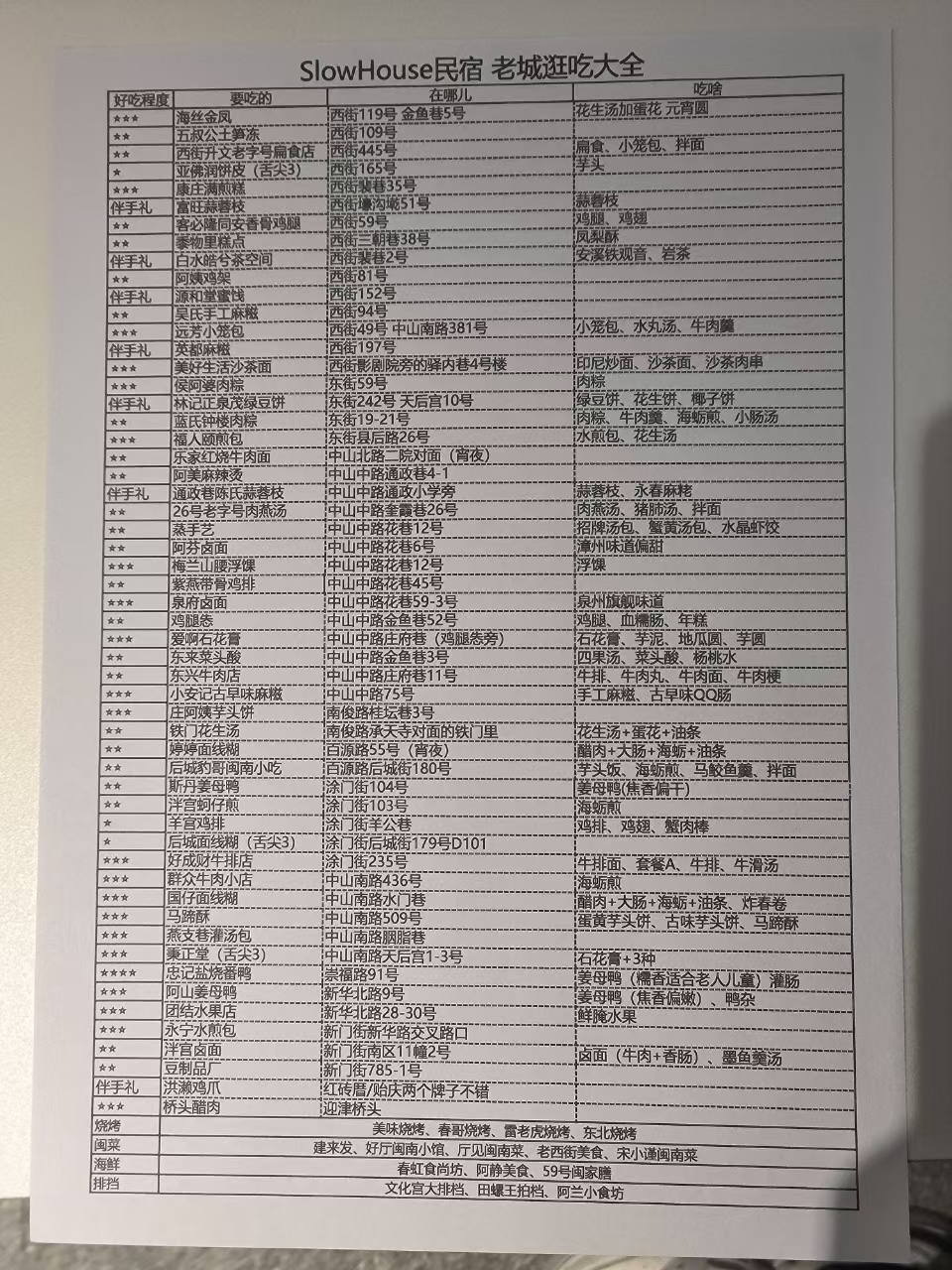
Local friends recommended a ton of dishes, which I’ll list at the end.
First, here are the foods we tried on this trip that we found especially delicious:
Noodle Soup (Mianxianhu) – This is my absolute favorite. The original shop “Shuimen Guozai” (Shuimen Alley location) is the best; “A‑wen Noodle Soup” (Xinmen Street location) is a close second. Classic toppings: large intestine, marinated egg, and vinegar‑marinated pork, served with fried dough sticks. The five‑spice roll is also tasty.
Peanut Soup – Zhang Ji Stone‑Milled Peanut Milk (West Street location) right below the guesthouse. Even if you’re not a peanut fan, it’s delicious; adding an egg is said to make it even better.
Milk Tea – KOI (golden bubble tea, half pearls, half taro balls), Tang Mo Cha Xi, Berry Crazy, Hu Jian, and Shuimen’s “A‑qin Sister’s Stone Flower Paste” (I grabbed a cup on the way; nothing extraordinary, but at 8 CNY a cup it’s cheap).
Clay‑pot Congee – Sanjiao Hu “Fresh‑Cooked Gout Pot” (West Street location). Very good!
Noodles – Strongly recommend Pan‑Gong Braised Noodles (the noodles, fried vinegar pork, and fried five‑spice rolls are all excellent). Near the airport, try Huang‑Ji Cart Noodles if you have time. Huan‑Ji Indonesian Satay Noodles (West Street location) has tasty satay fried noodles but is a bit pricey. Wang Yongli Quanzhou Big‑Pot Beef Noodles (Xiangyuan location) are also good.
Four‑Fruit Soup – A street‑front shop near Fu‑wen Yard. Honestly, it’s hard to find a sweet soup that isn’t tasty.
Fruit – Guava and green mango sprinkled with plum powder; highly recommended!
Taro Cake – Bought from Qin Ji on West Street; delicious!
In short, everything is incredibly tasty and full of local flavor—prepare yourself for some weight gain!
Other Notes
Dongxing Beef Shop didn’t suit my palate, so I wouldn’t recommend it.
I didn’t try the ginger duck because I’m not a fan of ginger or duck; maybe next time.
Local Friends’ Recommendations
- Noodle Soup: Shuimen Guozai, Zeng’s (if the line is too long, any other shop will do). Their pork‑blood soup and peanut soup are also excellent.
- Southern Fujian Cuisine: Linjia, Haoting
- Ginger Duck: Si‑dan
- Steak‑Salted Rice & Beef Soup: A‑qiu
- Meat Zongzi: Hou A‑po, Lan’s, Dongjie Meat Zongzi
- Congee‑Based Hot Pot: Feida
- Four‑Fruit Soup: Ai A, Bingzheng Tang, Xie Ji
- Taro Cake: Aunt Zhuang’s Taro Cake (the line can be intense)
- Barbecue: Chunge Iron‑Plate BBQ (try the sugar‑glazed roasted ginkgo nuts!), Tie Xia, Chicken Leg You, Lei Laohu
- Earthworm Jelly: Wu Shu Gong
- Coffee: Ba Lang Yu
🌆 Extras: Some Cute Souvenirs


📄 Reference Guides
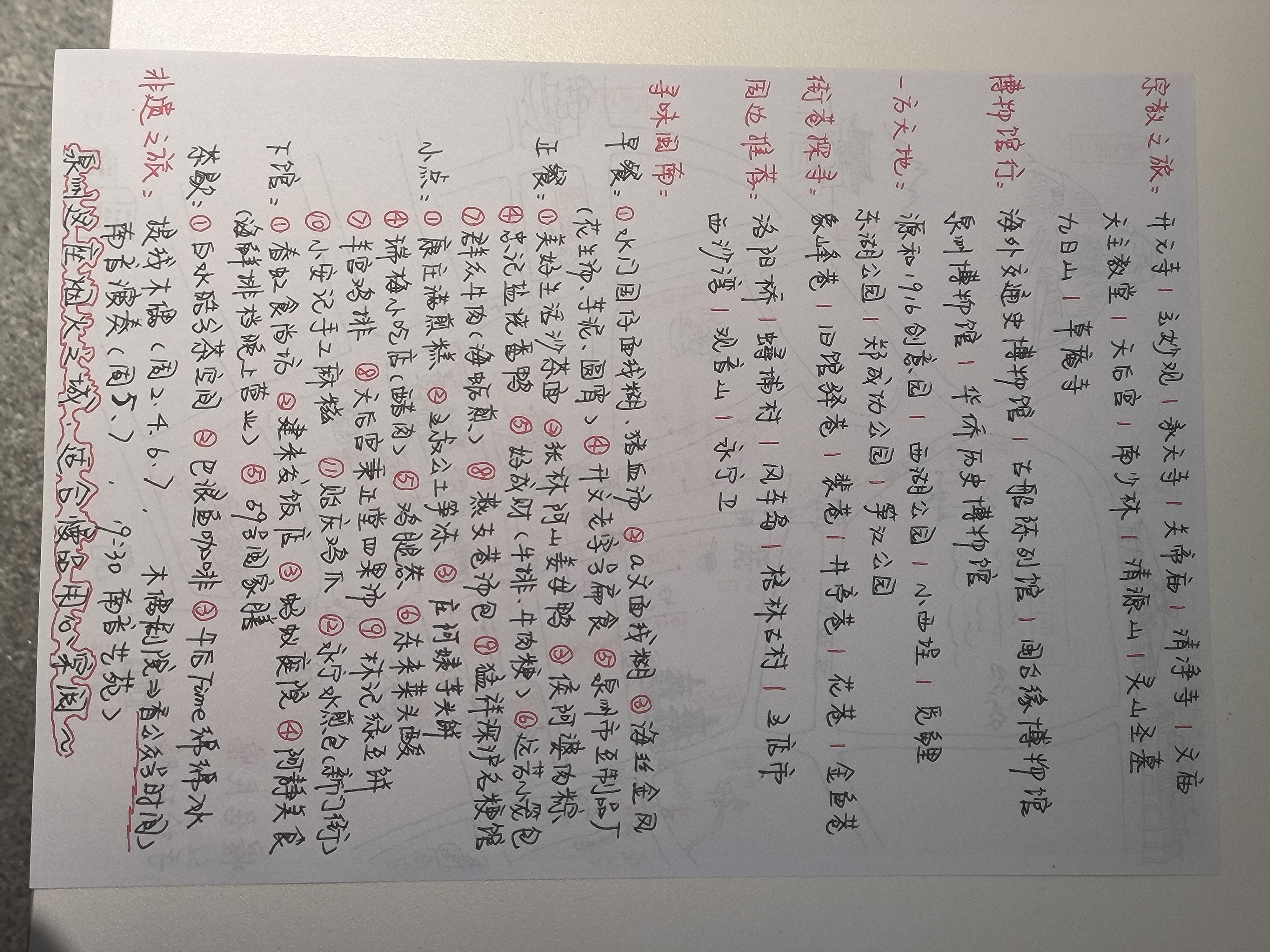
There are just too many Quanzhou guides… I was overwhelmed while compiling them.
🌆 Hand‑drawn Guesthouse Guide
— END —

If this content inspired you, feel free to 👍 like, ✏️ comment, 🤳 share, and 👀 follow.
Also, follow the public account.

Product Manager | Reading | Travel | Psychology | Everyday Life
Originally written by Estela Young and published in Chinese on 一只产品汪的自白. Translated and edited for DriftSeas with permission.