Delivering the Message to Garcia
Estela Young
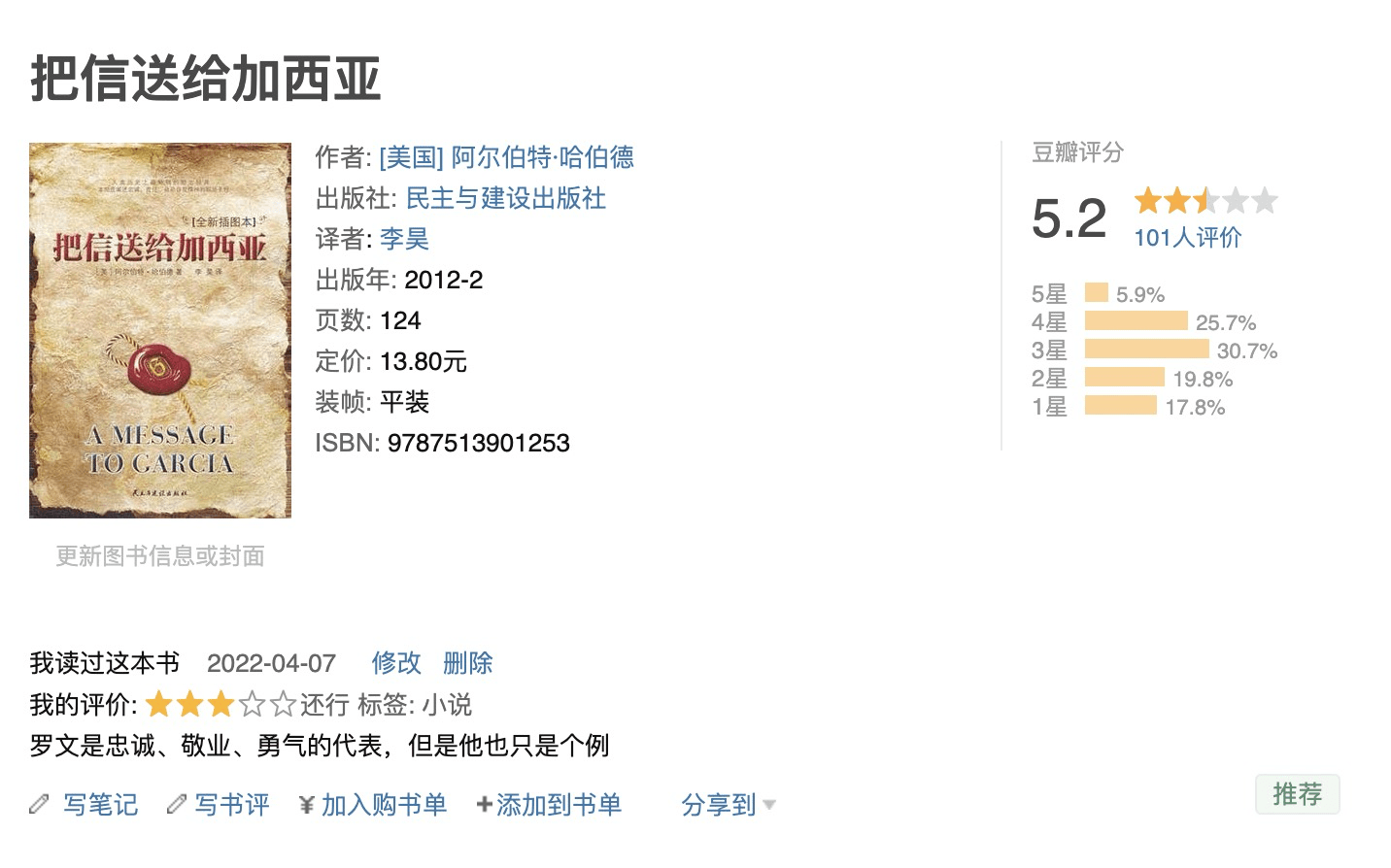
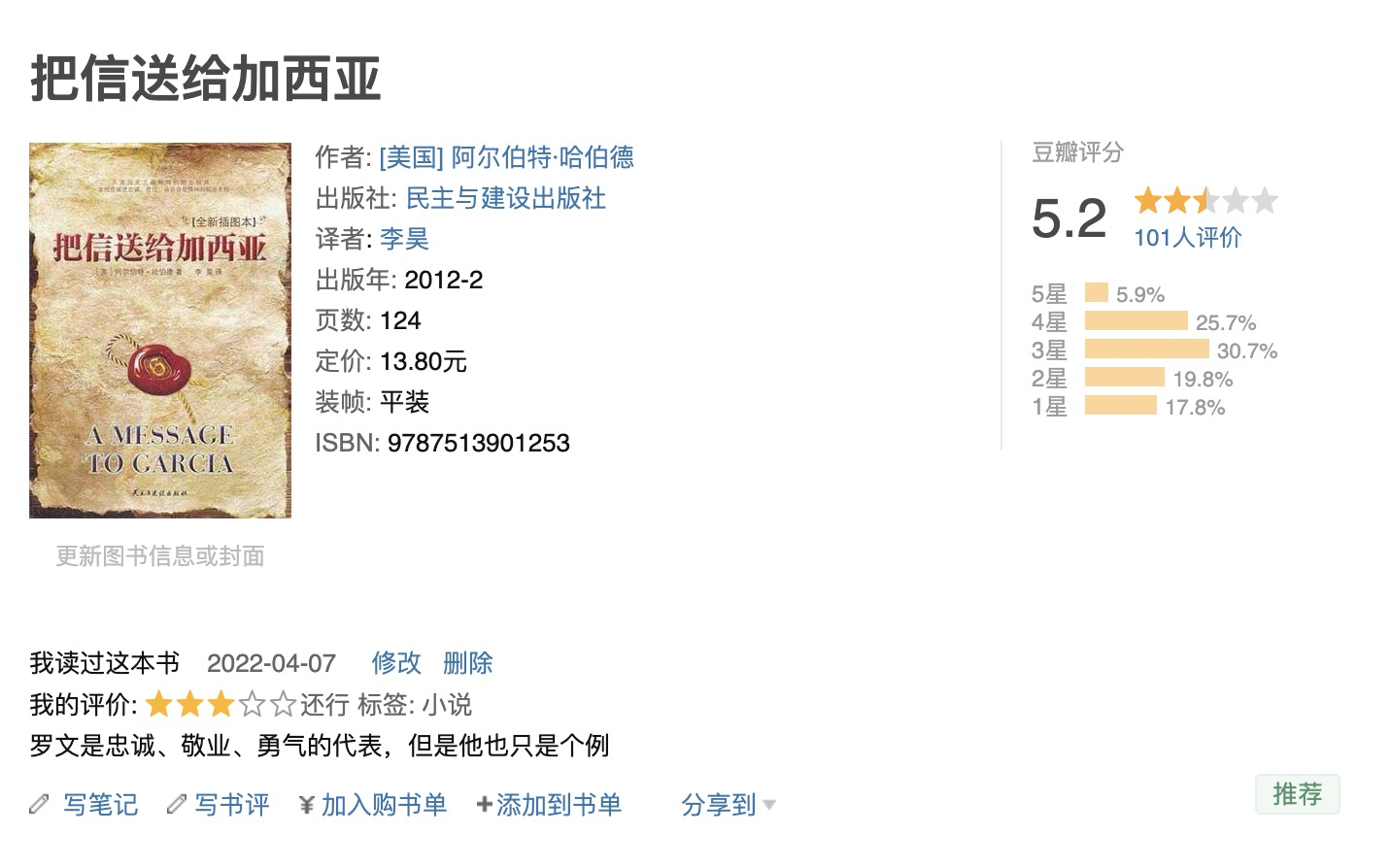
Because of the article “From ‘A Message to Garcia’ to Where the ‘Ideal Employee’ Comes From,” I was tempted to pick up this book. The actual reading experience, however, was rather...
Because of the article “From ‘A Message to Garcia’ to Where the ‘Ideal Employee’ Comes From,” I was tempted to pick up this book.
The actual reading experience, however, was rather split: the story itself is quite interesting, but the later chapters (essential career growth, career advice for young people) have a bit of a PUA vibe. That’s why I suddenly understood why the book’s reviews are “mixed”: those who can do it may think the book is full of nonsense, while those who can’t may find it somewhat inspiring—both groups show up in the comments from WeChat Read users.
As for my rating of the book—at most three stars, which isn’t very high—besides the reasons above, the main issue is that the “self‑help” tone is overwhelming, and I’m already saturated and can’t take any more 😝. That’s all, just to clarify.
The Story of Rowan
In short, before the Spanish‑American War of 1898, President McKinley needed to get a message to General García, the leader of the Cuban insurgents. García was fighting the enemy in the Cuban jungle and was also a target of the Spanish army, so no one knew where he was.
Colonel Arthur Wagner didn’t hesitate to tell the president, “I have a man—a young lieutenant, Andrew Rowan. If anyone can deliver a message to García, it’s him.”
An hour later the letter for García was placed in front of Rowan. Without asking any questions, Rowan set out on the journey to find García.
Rowan delivered the letter to García and brought back a reply. He never asked, “Where is he? What does he look like? How can I contact him? How do I get there?” He simply accepted the order and did what he was supposed to do.
Some Takeaways
First, I must state that I do not agree with the idea that subordinates should never ask questions when a boss assigns a task, as implied by the line “without asking any questions, Rowan began his search for García.” There is often a huge information and understanding gap between people; to ensure quality results, a superior must make sure the subordinate fully grasps the problem and the expected deliverable.
Second, the book claims that “Rowan became a symbol of dedication, obedience, loyalty, and diligence.” That view is, of course, subjective. In my opinion, Rowan’s success was not only due to his own excellence but also to other essential, unmentioned factors: “the boss’s trust,” “the support and help of capable teammates.” These cannot be ignored. In other words, Rowan’s dedication and loyalty were part of why the mission succeeded, not the sole or decisive factor. This is why I feel the later analysis in the book is overly self‑help‑y—crediting success entirely to personal virtues while overlooking “the right time, place, and people.”
Finally, three sentences sum up what the story taught me:
- Gold will shine.
- Do your core job well.
- If possible, go a step further and be more proactive.
Appendix: Original Text of “A Message to Garcia”
WeChat Public Account – Confessions of a Product Dog
Recording product insights and reflections, keeping reading notes.
Updates synced here; feel free to scan the QR code to follow so we don’t lose touch.

Originally written by Estela Young and published in Chinese on 一只产品汪的自白. Translated and edited for DriftSeas with permission.
Keywords
Sources & References
- [1]Douban link
- [2]一只产品汪的自白