Bucket List: A Palliative Care Worker’s Memoir
Estela Young
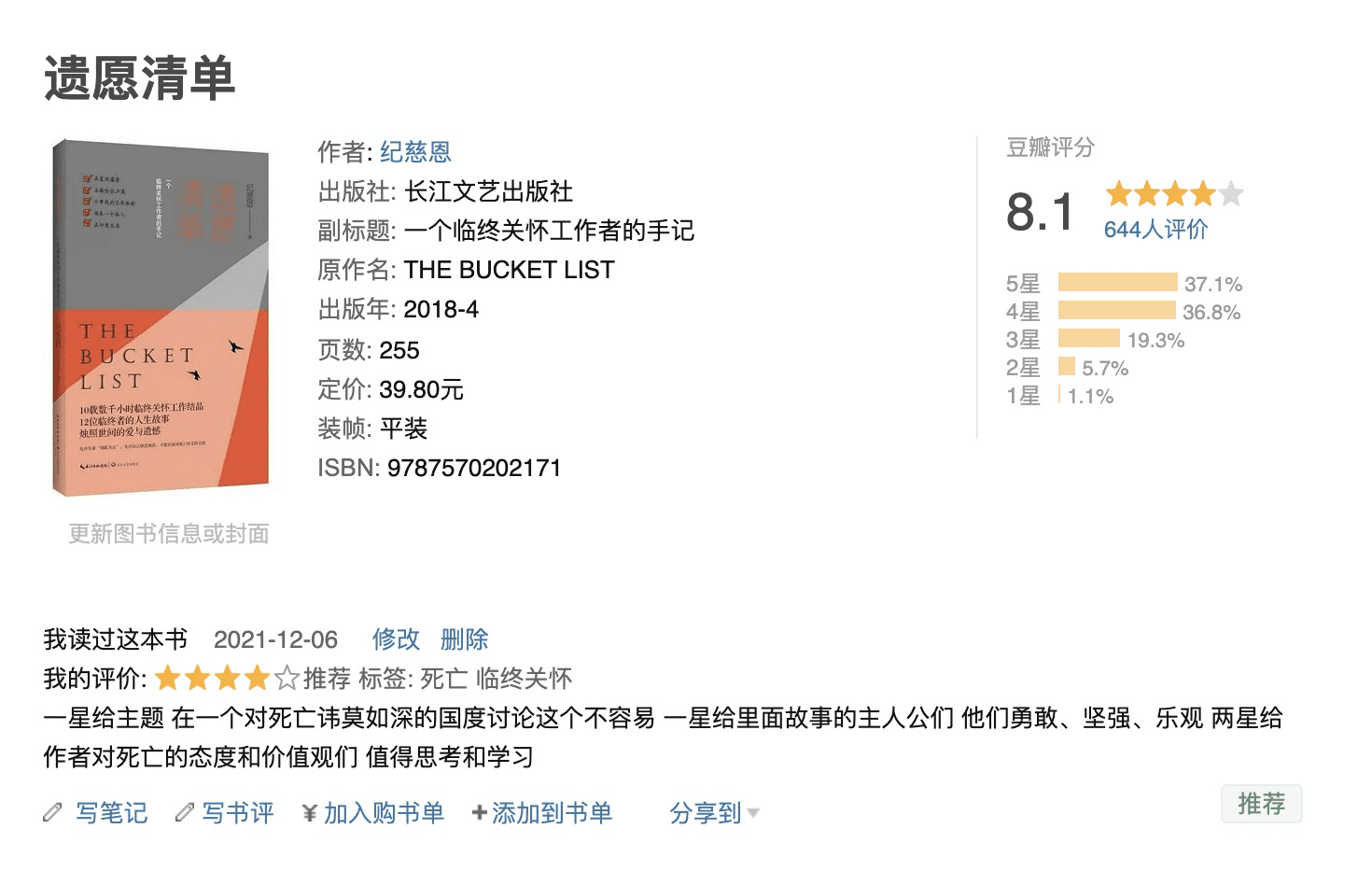
Death Is Not Far From Us Douban “The Bucket List” (《遗愿清单》) After finishing Yang Jiang’s We Three (《我们仨》), WeChat Reading recommended The Bucket List: A Palliative Care Worker’s Jou...
Death Is Not Far From Us
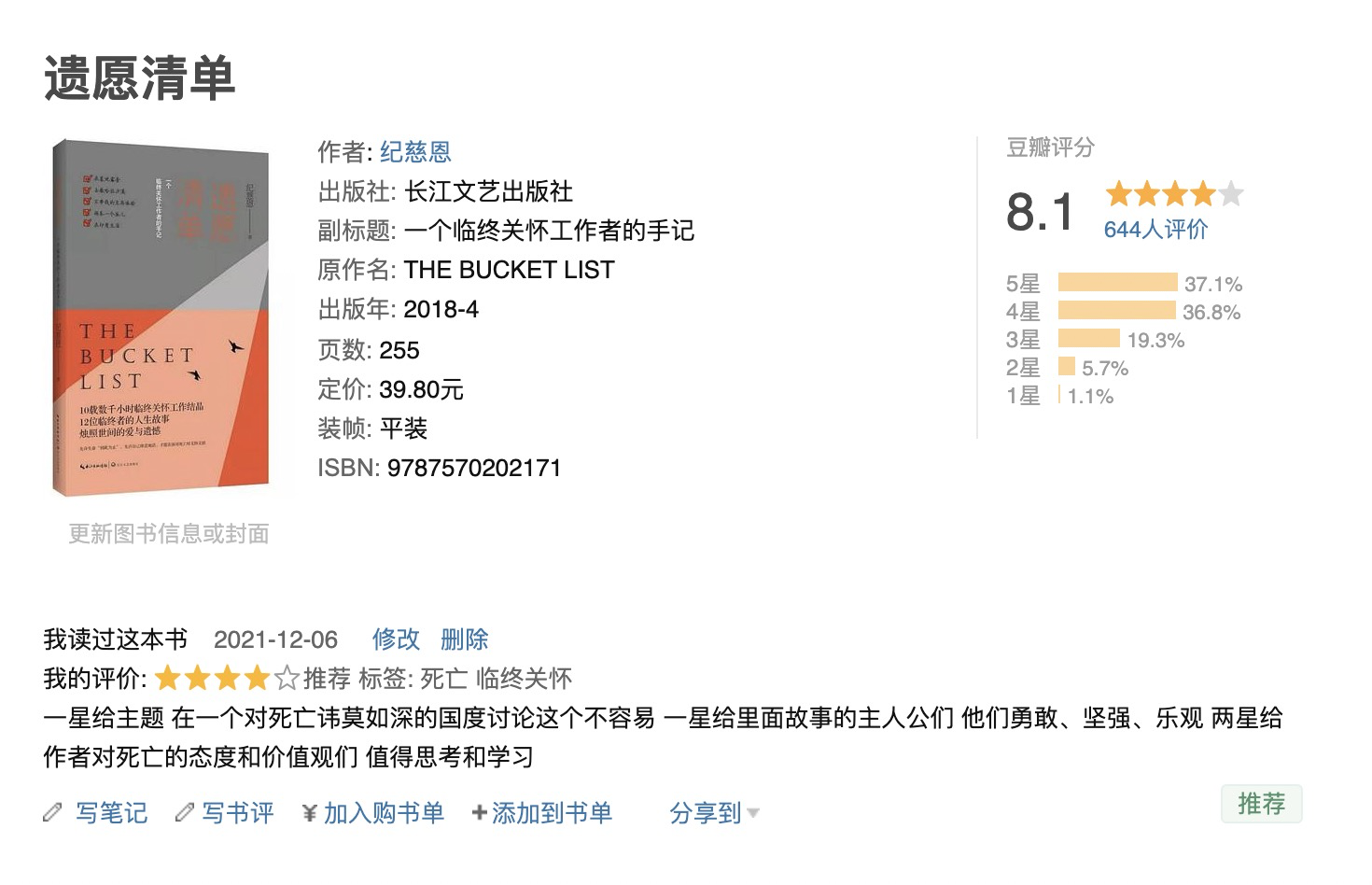
After finishing Yang Jiang’s We Three (《我们仨》), WeChat Reading recommended The Bucket List: A Palliative Care Worker’s Journal on its homepage. One‑sentence summary: this book is for people who enjoy listening to life stories and those who are pondering the meaning of life.
Death has actually never been that far away from us—at least for me.
It isn’t just the loss of relatives, nor just the high‑school classmate who, at 24 (his zodiac year), was diagnosed with a terminal illness and ultimately chose euthanasia abroad, nor just my own near‑drowning experience (yes, when you’re on the brink of death you really do replay scenes from your life).
What happens even more often is that, when I’m feeling lost and stuck, my therapist loves to ask me questions like: “If you only had three minutes, what would you most want to do? If you only had a month left to live, what would you most want to do?” When I take those questions seriously, the tangled issues eventually clear up.
Life Is More Harsh Than We Imagine
The Bucket List: A Palliative Care Worker’s Journal is written by Ji Enci (纪恩慈), a social worker who has served both a children’s welfare home and a hospice. The book distills ten years—about 2,700 hours—of palliative‑care work into stories about the people she served and her own encounters with death. Through these narratives we can reflect on our understanding and attitude toward death, and consider how we should face it.
The stories that stuck with me most (not full accounts, just the impressions they left after I finished the book) are:
- At 19, Ji signed a euthanasia consent form for her best friend, who was in the late stage of liver cancer. At the friend’s funeral, she was accused of killing her friend—a murderer.
- Grandma Qi, who chose to coexist peacefully with cancer and face death calmly, left the hospice hospital and set off to travel the world.
- An HIV‑positive pregnant mother, faced with a 3 % risk of transmitting the virus to her baby via Caesarean section versus a 30 % risk via natural birth, chose to give birth naturally.
- Grandma Hao brought her intellectually disabled granddaughter—abandoned by her biological parents—to a welfare home to “audit classes.” Not long after, Grandma Hao herself was diagnosed with cancer.
- Grandma Yang continued aggressive cancer treatment (essentially overtreatment) so as not to shatter her daughter’s dreams. Years later, when her daughter also faced a terminal illness, Yang finally understood how much unnecessary suffering she had caused her mother.
- Thompson, an American volunteer in China with a congenital heart defect, knew he didn’t have long to live. Despite opposition, Ji chose to fall in love with him.
- Ji’s adopted daughter Zhenzhen, who also has a severe congenital heart disease, and Ji grew together by loving each other.
These are not fictional tales; they really happened. Sometimes life is simply brutal.
We Still Have Much to Learn About Death
What I most want to share are Ji’s own reflections on death, quoted directly from the book.
On Death Itself
If there’s anything truly fair in this world, it’s only two things: death and time. A day has 24 hours, and that’s the same for everyone.
The only way to solve the problem of death is to live well. If you can’t grasp death, if you have unsolvable riddles about it, if you’re worried about it, there’s only one thing you can do: live fully in the present.
How we decide the manner of our own death may be more important than death itself.
On the Meaning of Life
I think the world is a big mishmash—everyone is different, each walks their own path, hurrying along, yet few stop to ask themselves, “I’m rushing—where am I going? Is the destination more important, or the journey?”
As children we were fed countless lies: “It’ll be fine once you get into college,” “It’ll be fine once you have a job,” “It’ll be fine once you’re married,” “It’ll be fine once you have kids”… Later we realize the “it’ll be fine” life never arrives. In fact, nothing in this world is permanent; the only certainty is the grave. No one promised us that we’re born to enjoy happiness and pleasure. So when disaster and misfortune strike, we must accept them.
On Attitude Toward Death
Death is simply a physiological phenomenon. No living person has truly experienced death; the dying may lose consciousness before they can feel it. What we truly need to learn is the work surrounding death—our attitude toward it, the peace and calm before the end.
Overall, I think few people dare to face death. Humans fall into three categories: those who absolutely refuse to talk about it and completely avoid it; those who talk about it but still cannot confront it—a large group; and those who accept it more calmly, though only intellectually, and still see their own death as a mystery until the day arrives.
On Accepting Death
If life ends here, we should choose the gentlest way to send it where it belongs. From early on we must understand that everyone will die, that life will end, and we need the courage to say goodbye. We shouldn’t waste energy on avoidance, concealment, or burial.
I suddenly realized that palliative care has been in mainland China for 20 years, yet it has not progressed and remains stuck at the level of two decades ago. The purpose of palliative care is “to help a person die well,” but most families refuse to accept that their elders are nearing the end, leaving them in a web of deception, overtreatment, and undignified suffering.
Helping people correctly understand, accept, and recognize death as part of life reveals that what truly scares us is not death itself but our views on death.
Fear of death cannot be eliminated; it’s part of us. We don’t need to eradicate fear—fighting it drains too much energy, and there’s no victor. We simply live alongside it, coexist peacefully, and make peace. Then you’ll find you’re not erasing fear; you just no longer care when it appears. True strength isn’t the absence of fear, but the ability to move beyond it.
Experiencing the meaning of death means standing before it, seeing it clearly, accepting it, and then living well. When death finally comes, die well. This year I’ll mainly promote “living memorials”: holding a memorial while the person is still alive, letting them host their own ceremony, speak their heartfelt words, and say goodbye face‑to‑face. Death becomes something beautiful.
On Respecting Patients’ Wishes
I’m a doctor who has worked in hepatology for 20 years. People assume I know liver disease and liver cancer inside out, but if you ask me how painful liver cancer is, I can only say: I don’t know. I’ve never had the disease, so how could I know its pain? Moreover, who can precisely define “pain”? Indeed, the Netherlands has had hospice and palliative care for years, and every specialist can list a litany of professional “benefits.” Yet we have no right to impose those “benefits” on patients. No one knows how painful it truly is, and no one can judge. What’s most important? Euthanasia? Hospice? Palliative care? None of those. The patient’s feeling is paramount.
Do you support euthanasia? I have no right to support or oppose it; I think no one does. Both support and opposition only add pressure to the patient. The best approach is to accompany them in the way they wish, not in the way others think is best.
You haven’t experienced it—how can you understand? Even if you have, you can only claim to be closer to “understanding.” I never believe there’s true “empathy.” I’ve seen many patients and dying people and thought I understood them, but it’s impossible—I’ve never had the disease, never felt the pain, never known despair, never counted the days. What right do I have to claim understanding?
On Near‑Death Experiences
By “near death” I mean the last minute or so before death. At that point the dying person no longer feels much of the external world; attachments to family and lingering regrets fade. They enter a highly ego‑centric realm where their whole life plays out like a movie. They want to express what they see and feel, but what they say is unheard by others; some even report “out‑of‑body” experiences.
On Final Wishes
Some ask what dying people most want to do before they die. It varies individually, there’s no single answer. From my experience, most want to go home, see their loved ones, and many feel deep regret over past wrongs or apologies they never gave, yearning to make amends or say “I’m sorry.”
Life Within and The Bucket List
Palliative care has been in China for over 20 years, yet substantive progress remains limited.
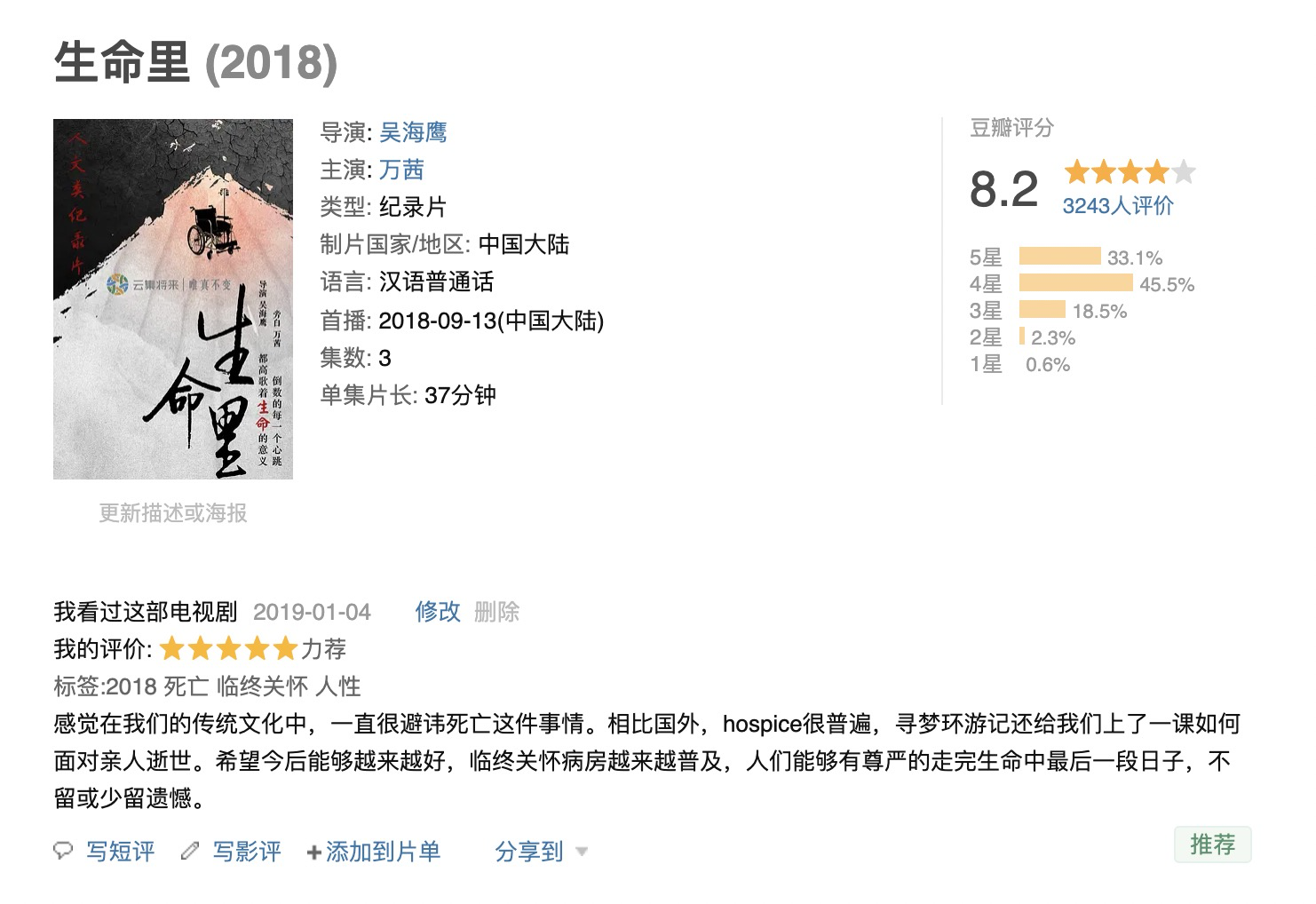
If you’re interested in palliative care, check out the documentary Life Within (《生命里》) on Bilibili, filmed in the hospice ward of a Shanghai community hospital.
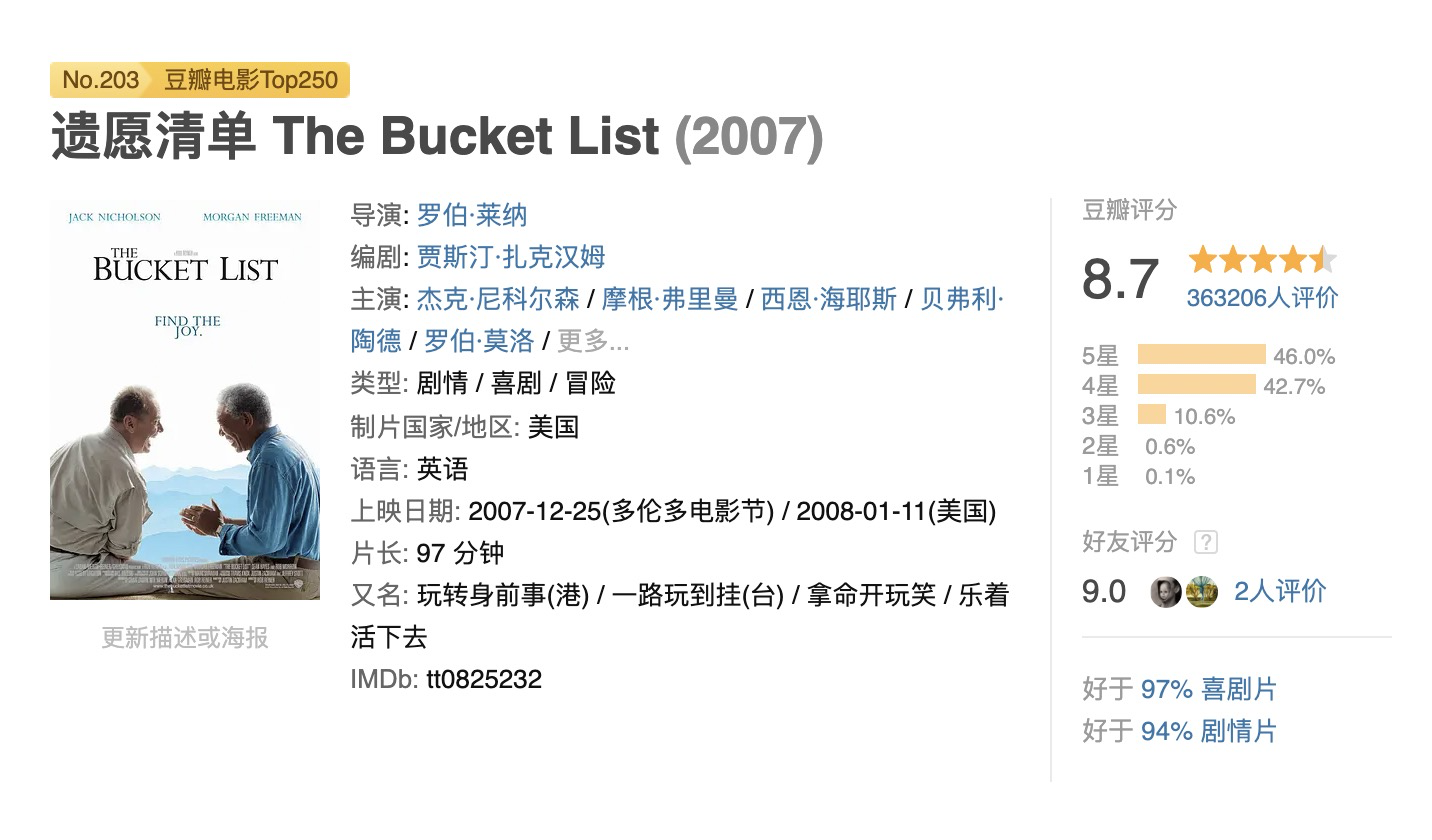
The book also mentions the film The Bucket List (《遗愿清单》), which follows two cancer patients with completely different personalities, professions, and economic statuses as they write and fulfill a list of wishes in their final days, leaving this world without regrets. It’s worth watching.
Finally, may we all come to understand the meaning of life and death and live in the state we truly desire.
WeChat Official Account: A Product Dog’s Confession (一只产品汪的自白)
Recording product insights, reflections, and reading notes.
Follow us via QR code to stay connected.

Originally written by Estela Young and published in Chinese on 一只产品汪的自白. Translated and edited for DriftSeas with permission.