A Brief Look at the Ride‑Sharing Business
Estela Young
In the past ten years of product work, ride‑sharing has been the most complex, most interesting, and most rewarding business for me. I previously wrote an article briefly introduci...
In the past ten years of product work, ride‑sharing has been the most complex, most interesting, and most rewarding business for me. I previously wrote an article briefly introducing how the user experience of ride‑sharing differs from that of regular rides and what product optimizations we made to improve the experience and order‑completion rate.
Today I want to dedicate a full article to the ride‑sharing business itself, discussing it systematically.
A Small Story: My First and Second Encounters with Ride‑Sharing
The first time I heard about ride‑sharing was when a certain company was just launching its taxi‑hailing service. During a routine morning meeting, senior executives attended. After reviewing the daily data, one of the senior leaders shared a ride‑sharing experience he had in San Francisco while taking Uber, urging us to think about that scenario: he rode to SFO’s Terminal 2 with two fellow riders, then one got off, a new rider hopped on, and later he and another rider got off at Terminal 3. In that single trip, the driver picked up and dropped off four passengers. The executive marveled at how cleverly the mechanism was designed—truly ingenious.
As a newcomer to the taxi‑hailing business, I immediately thought, “Ride‑sharing is amazing—one trip can serve multiple passengers, so the driver shortage problem is solved right away. Brilliant!” Moreover, for a long period afterward, our team leaders kept wavering between two solutions to the problem of long passenger response times (which stemmed from insufficient driver supply): dynamic pricing (yes, we even had dynamic pricing back then) and ride‑sharing. This back‑and‑forth reinforced my belief that ride‑sharing was a great business model.
Years later, when I finally started working on ride‑sharing, I realized how naïve my earlier assumptions had been. The stark contrast between my initial impression and the reality on the ground taught me a lot and prompted deep reflection—not only about work but also about how I perceive and think about the world.
So I’m writing this down as a record.
1. What Is Ride‑Sharing?
Ride‑sharing means grouping multiple passengers traveling along similar routes and having a single driver serve them all.
Ride‑sharing isn’t a brand‑new product; long before ride‑hailing apps existed, people shared rides in the real world: the small vans at train stations or bus terminals that would pick up anyone heading in a certain direction were essentially ride‑sharing.
With the rise of mobile internet, online ride‑hailing apps exploded, and ride‑sharing naturally migrated online. Take Didi, the Chinese ride‑hailing giant, as an example: Didi launched its “Express” (快车) service in 2015 and soon after added a ride‑sharing (拼车) option within that service.

When it first launched, ride‑sharing worked like this:
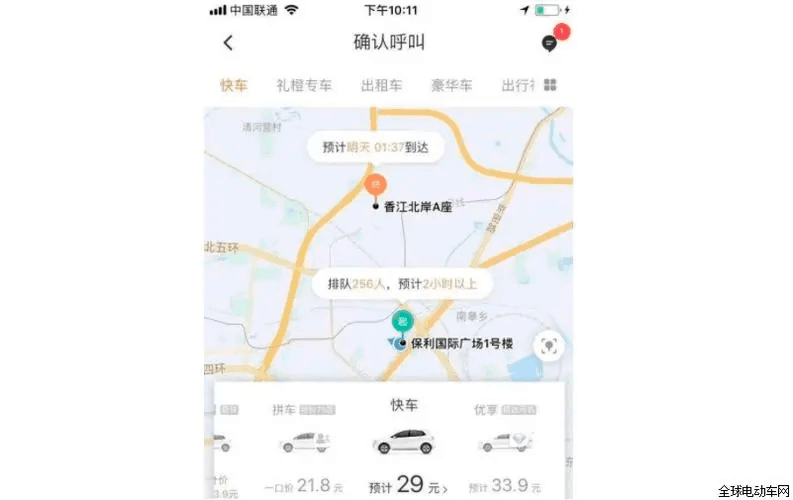
For passengers: When ordering a ride, they first select “Express” at the top, then choose among “Ride‑Sharing,” “Express,” or “Premium.” Prices differ by vehicle type; ride‑sharing is the cheapest, offered as a flat‑rate (one‑price) fare, roughly 70 % of the estimated Express price. After selecting ride‑sharing, passengers pay the flat rate regardless of whether they end up sharing a ride. The appeal is simple: even though you may travel a slightly longer route, you save money—especially during traffic jams, when the flat rate can be more economical than Express. It suits passengers who aren’t in a hurry, don’t mind a detour, and are okay with sharing the car.
For drivers: The dispatch system only tells drivers whether an incoming order is Express or ride‑sharing; drivers cannot opt out of ride‑sharing orders, though they are allowed a limited number of daily cancellations of ride‑sharing trips. Ride‑sharing fares are calculated in real time, essentially the same as Express.
In the ideal scenario (the one the senior executive described), all riders start from the same point at the same time and head to the same destination. Passengers pay less, drivers earn more, the platform processes more orders—everyone wins.
But wake up! In reality, how often do you find a bunch of people needing to travel from the same origin to the same destination at the exact same time?
Think about typical cases: black‑market ride‑sharing in small towns, custom shuttle buses, or the airport example at the start. They share a common trait: they occur during a concentrated time window (e.g., rush hour) or at a concentrated location (airport, train station). If you expand the time window to the whole day or the geographic scope to the entire city, offline ride‑sharing becomes rare.
I’ll call the “all‑same‑time, same‑origin, same‑destination” scenario “perfect ride‑sharing.” Its counterpart is “imperfect ride‑sharing.” When you broaden time and space, perfect ride‑sharing is like hitting the lottery, while imperfect ride‑sharing is the everyday norm—and that determines both the complexity of the business and its ceiling on scale.
2. Ride‑Sharing Pricing
For a long time, the goal of the ride‑sharing business was to prove its value: can it alleviate driver shortages while still being profitable? Answering that requires understanding the pricing rules for both passengers and drivers.
Pricing means the amount a passenger pays the platform for a trip from point A to point B, and the amount the platform pays the driver for that same trip.
Before I got into ride‑sharing, I rarely thought about how ride‑hailing fares were calculated. Once I was in the trenches, I discovered many misconceptions I held—misconceptions that are common among ordinary passengers and drivers, and which shape how people view the whole industry.
Misconception 1: Driver income = passenger payment × (1 – commission rate)
This is a very common mistake. People assume the driver’s earnings are directly tied to what the passenger pays. For example, if a passenger pays ¥20 and the commission is 20 %, they think the driver earns ¥20 × (1 – 0.20).
In reality, passenger and driver pricing are two independent rule sets. The passenger side may be real‑time pricing (like a taxi meter, based on base fare, distance, and time) or a flat‑rate fare (more common abroad with Uber, less so in China). The driver side is usually real‑time pricing, though some orders can also be flat‑rate. Even when both sides use real‑time pricing, the fare components—base fare, per‑kilometer charge, per‑minute charge—are generally different for passengers and drivers. For the same Express ride, a passenger might see a base fare of ¥13 for the first 3 km, while the driver’s base fare for those 3 km could be ¥10, and so on.


Why decouple passenger and driver pricing? Because the added complexity creates more leeway for profitability.
But that complexity also makes the system harder to understand. Driver‑income opacity has long been a pain point for Didi; during the driver protests of 2021 the company rolled out a series of measures to improve billing transparency. (You can read more about that here.) That’s a story for another time.

Misconception 2: Ride‑sharing pricing is the same as Express pricing
It’s not, especially on the passenger side.
Ride‑sharing pricing model
Passenger side: Because the extra distance caused by detours cannot be passed to the passenger, ride‑sharing uses a flat‑rate fare from A to B, independent of time or mileage, and offers a discount to encourage sharing. Typically, the flat‑rate (per‑person price) is a percentage of the estimated real‑time Express fare—currently about 70 % of the Express price.
Driver side: Initially, ride‑sharing used the same real‑time pricing as Express (based on distance and time), with fare components (base fare, per‑km, per‑minute) largely identical, though they could be adjusted per city. In plain terms, a driver earned roughly the same from a ride‑sharing order as from an Express order.
However, because ride‑sharing often involves multiple pick‑ups and drop‑offs, drivers frequently experience detours and congestion, especially during peak hours, leading to dissatisfaction. Moreover, drivers feel they receive only one share of the total passenger fare while the platform also takes a commission, amplifying the discontent. Some overseas companies like Uber once offered a fixed “ride‑sharing order bonus” of ¥1–2 per order to incentivize drivers.
In China, Didi upgraded its ride‑sharing pricing in 2021: during weekday mornings from 7 am to 10 am, the platform waives its commission on all completed ride‑sharing orders, giving drivers the full passenger fare. (See the relevant announcement.) When I was writing this in November 2023, I even heard a driver’s app announce “No commission on shared‑ride segments,” another similar pricing upgrade you might notice.
Misconception 3: The platform takes a huge cut from ride‑sharing orders
Both passengers and drivers often claim that Didi’s commission on ride‑sharing is excessive—“It’s so unfair!” Some drivers argue that three passengers pay, yet the driver receives less than one share after the commission.
Is the platform really taking a larger cut on ride‑sharing?
Short answer: Not according to the rules, though the platform’s objectives may suggest otherwise.
In 2021 Didi published an article explaining ride‑sharing pricing to drivers, which is far clearer than my own explanation, so I’ll quote it directly.

Platform revenue = total passenger payments – driver earnings
For a shared order, passenger payment equals 70 % of the original Express fare (the green + orange lines in the diagram), while driver earnings are calculated in real time based on the actual distance driven (the blue line). From the platform’s perspective, it must account for the passenger discount (the 30 % reduction) and the extra cost of any detours caused by sharing. It’s not a simple “0.7 × A + 0.7 × B” addition/subtraction. In short, the more the routes of passengers A and B overlap, the higher the platform’s profit.
For orders that fail to match, the platform must absorb the loss from the passenger discount.
Didi illustrated this with three example cases.

Returning to the question posed at the start of this section—whether ride‑sharing can be profitable—it hinges on the proportion of shared orders and how well the routes align. The ability to match, and the quality of the match, leads us to a deeper discussion I call “the ride‑sharing paradox.”
3. “The Ride‑Sharing Paradox”
Because of its nature, ride‑sharing is evaluated along three dimensions: experience, efficiency, and scale.
Experience refers to the rider’s journey: while the price is lower, passengers endure longer travel times, longer routes, sharing the car with strangers, and many unpredictable variables.
Efficiency (from the platform’s viewpoint) is the probability of successfully matching riders. This probability directly affects platform revenue, which includes both the extra earnings from successful matches and the loss from discounts on unmatched orders.
Scale concerns the total volume of ride‑sharing orders, especially completed shared trips. Since ride‑sharing has higher cancellation rates (both passenger‑initiated and driver‑initiated) than Express, its order volume is further constrained.
Logical reasoning—augmented by real data and experience—shows that ride‑sharing is a dynamic equilibrium among these three factors; a change in one inevitably impacts the other two. For example:
- If you prioritize experience, you need highly compatible matches, which lowers efficiency and reduces order volume.
- If you chase efficiency, you match more riders, but the user experience suffers, and order volume may not increase because dissatisfied riders cancel.
- If you aim for scale, you need many matches and few cancellations, but a high match rate inevitably means poorer route compatibility, leading to more cancellations.
That tension is what I call the ride‑sharing paradox.
4. The Future of Ride‑Sharing
Ride‑hailing is a highly complex business where supply and demand can be severely mismatched at specific times and places. Ride‑sharing has evolved amid controversy. By 2019, Didi began upgrading its ride‑sharing product to better address peak‑hour capacity constraints and improve profitability, splitting the service into distinct offerings.


The first upgrade introduced “Express Ride‑Sharing” (极速拼车), using a “not‑matched X ¥ / matched Y ¥” pricing model (matched rides get about a 70 % discount versus Express). Orders are dispatched on‑demand. If a ride fails to match, the passenger bears the cost risk; the platform no longer subsidizes the discount.
The second upgrade launched “Green Ride‑Sharing” (later renamed “Special‑Price Ride‑Sharing”). This offers a 50 % discount on Express fares but allows a longer wait time (up to 15 minutes) and imposes stricter route‑overlap requirements to achieve break‑even on each order. In plain terms: the cheaper you want to be, the longer you wait, and the platform selects rides with high route overlap to stay profitable.
These are the two current forms of Didi’s ride‑sharing.
5. What Ride‑Sharing Taught Me
I originally set out to write this piece to share the insights I’ve gained from the ride‑sharing business. I’m a bit exhausted now, so I’ll keep the takeaways brief.
First and biggest lesson: Return to reality and stay rational.
From dreaming about perfect ride‑sharing to debunking the myth that the platform takes an excessive commission, many of the “aha” moments turned out to be common sense. Yet we often forget the basics. Sitting in an office day after day, we lose touch with everyday life and history, get lost in our own fantasies, and mistakenly think we’re clever. That’s both laughable and tragic—not just at work, but in life.
Stay humble. Stay foolish. Stay hungry.
Second lesson: The more constraints a transaction has, the lower its conversion rate. To improve conversion, you must loosen those constraints. The ride‑sharing funnel can be simplified as:
Passenger willingness to share × Temporal & spatial compatibility × Driver willingness to accept
This funnel determines the ceiling on ride‑sharing scale. Understanding this principle makes it easier to estimate the potential size of other businesses. For example, Gaode’s “Starbucks Street Pickup” service had many complex transaction constraints, suggesting a low order‑size ceiling. If you’re interested, I could write a dedicated article on that.
That’s it for this stage of my summary. Ride‑sharing is truly fascinating!
WeChat Official Account: “A Product Dog’s Confession”
Recording product insights, reflections, and reading notes
Thanks for following

Originally written by Estela Young and published in Chinese on 一只产品汪的自白. Translated and edited for DriftSeas with permission.
Keywords
Sources & References
- [1]一只产品汪的自白